

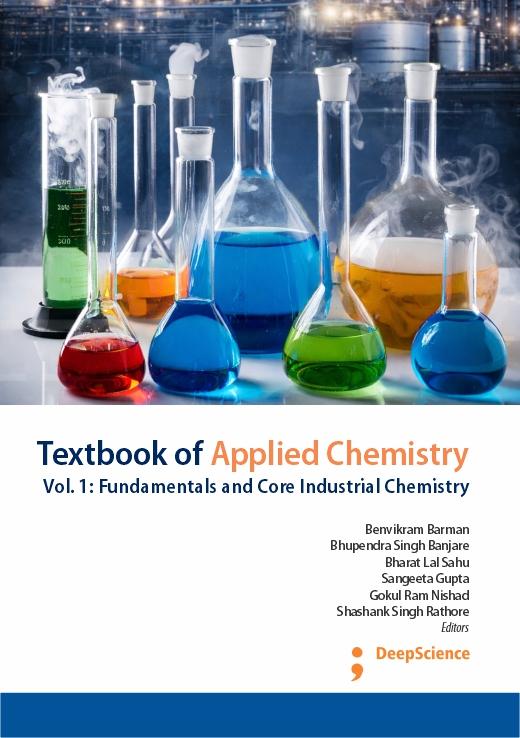
Textbook of Applied Chemistry
##plugins.pubIds.doi.readerDisplayName##
https://doi.org/10.70593/978-93-7185-430-6
Keywords:
Chemistry, Thermodynamics, Kinetics, Electrochemistry, Surface Phenomena, Colloids, Surfactants, Fuels, Industrial WaterSynopsis
Applied Chemistry is at the center of the translation of the basic knowledge in chemistry to the type of technologies, materials, energy systems, and processes involved in industrial activity that serve the contemporary society. The textbook has been developed as an all-encompassing, conceptual, and industry-based learning tool of undergraduate and postgraduate students of Chemistry, Chemical Engineering, Materials Science, Environmental Science, and related subjects. The focus of the book is towards industrial chemistry, applied application and problem solving, and not towards abstract descriptive or policy-oriented curricular models. The book has been organized in such a way that students can be able to move in a logical way starting with the basic principles and then to the more complicated applications in industries. Each unit will be built on enhancing theoretical knowledge and at the same time illustrate how these concepts work at chemical plants, laboratories, power plants, and materials industries. Classical laws and models are wherever suitably related with new trends in energy storage equipment, green catalysis, advanced materials, sustainable fuels, and water management in industries.
Unit I: Foundations of Applied Chemistry & Thermodynamics
All applied chemistry branches need this unit to give them the conceptual and mathematical knowledge they need. It presents the breadth, the interdisciplinary character, and the industrial importance of chemistry, and then proceeds to discuss in detail the states of matter, and how they are important in the process of chemical processing. The thermodynamic, entropy, and free energy laws are presented in the framework of the feasibility of the reactions, energy efficiency, and maintenance of the equilibrium. They also consist of phase equilibria and metallurgical processes to ensure that students learn the behavior of materials in high-temperature and multi-phase industrial systems and have a sound foundation upon which to build their further higher-level work with.
Unit II: Chemical Kinetics & Catalysis
These unit dwells on rate and mechanism of chemical reactions that are vital to industrial productivity and safety. Basic kinetic principles, rate laws, and temperature influences are built up and issues that influence reaction rates. Catalysis is then further discussed, such as heterogeneous industrial catalysts, biochemical catalysts through enzyme catalysis and catalytic approaches in green chemistry. The focus is put on reaction optimization, selectivity, catalyst efficiency, and environmental impact, allowing students to enjoy the role played by chemistry in industrial innovation.
Unit III: Electrochemistry & Surface Phenomena
This unit puts emphasis on the role of the electrochemical and interfacial process in converting energy, protecting materials and industrial synthesis. The electrochemical cells, batteries, fuel cells, corrosion mechanism, electroplating and electrorefining are covered with industrial examples. They include adsorption and surface catalysis to describe the nature of heterogeneous reactions and separation processes. Students are prepared with knowledge to grasp contemporary energy technologies, prevention techniques on corrosion and mass production system in electrochemical processes through the unit.
Unit IV: Colloids, Surfactants & Industrial Materials
Physical chemistry Unit IV connects with materials science and formulation technology. It includes colloids, surfactants, micelles, and emulsions with a special focus on their use in pharmaceuticals, food technology, cosmetics, paints, detergents, and nanomaterials. It also offers a comprehensive study of cement, glass, and ceramics in terms of composition, manufacturing process, structure property relationship, and industrial application. This unit assists the students to know how chemical principles control the design and performance of structural and functional materials.
Unit V: Fuels & Industrial Water Chemistry
The last section will discuss two most important elements of industrial chemistry which are energy and water. It talks about solid, liquid, gaseous and other alternative fuels in terms of composition, calorific value, combustion efficiency, and environmental impact. Industrial water chemistry deals with impurities, analysis, treatment of water, softening, and boiler water issues. They have a focus on scaling, corrosion, energy efficiency, and sustainable resource management, which prepares students to meet real-world challenges of the industrial world.
Pedagogical Features of the Book
Clear explanation of fundamental principles with industrial linkage.
Emphasis on process chemistry and applied problem-solving.
Inclusion of industrial examples, reaction schemes, and practical relevance.
Suitable depth and rigor for UG and PG level learning.
Useful for university examinations, competitive exams, and industry-oriented studies.
Overall Aim
The main purpose of the book is to build the good conceptual base along with the industrial understanding, which helps the students to fill the gap between chemistry in the classroom setting and the chemical technology at the real world. Combining theory and practice, this textbook can be considered as an effective source of information to students, teachers, and practitioners working in the field of applied and industrial chemistry.
Chapters
-
Introduction and Scope of Applied Chemistry
-
States of Matter & Industrial Relevance
-
Laws of Thermodynamics in Chemistry
-
Entropy & Free Energy in Real Systems
-
Phase Equilibria & Metallurgical Processes
-
Chemical Kinetics – Fundamentals
-
Factors Affecting Reaction Rates
-
Catalysis in the Chemical Industry
-
Enzyme Catalysis in Biochemistry
-
Catalysts in Green Chemistry
-
Electrochemical Cells & Nernst Equation
-
Primary & Secondary Batteries
-
Fuel Cells & Flow Batteries
-
Corrosion – Mechanism & Prevention
-
Electroplating & Electrorefining
-
Industrial Electrochemical Production
-
Adsorption – Types & Isotherms
-
Surface Catalysis in Heterogeneous Reactions
-
Colloids – Properties & Applications
-
Surfactants, Micelles & Emulsions
-
Cement – Composition & Manufacturing
-
Cement – Setting, Hardening & Types
-
Glass – Composition & Industrial Production
-
Ceramics – Traditional & Advanced
-
Solid Fuels – Coal, Coke, Charcoal
-
Liquid & Gaseous Fuels
-
Alternative Fuels – Biofuels, Hydrogen, Syngas
-
Water Chemistry – Impurities & Analysis
-
Water Treatment & Softening Methods
-
Industrial Water Problems
References
Barker, V., & Millar, R. (1999). Students’ reasoning about chemical reactions: What changes occur during a context-based post-16 chemistry course? International Journal of Science Education, 21(6), 645–665.
Bennett, J., & Lubben, F. (2006). Context-based chemistry: The Salters approach. International Journal of Science Education, 28(9), 999–1015.
Blumenfeld, P. C., Soloway, E., Marx, R., Krajcik, J. S., Guzdial, M. E., & Palincsar, A. (1991).
Motivating project-based learning: Sustaining the doing, supporting the learning. Educational Psychologists, 26(3), 369–398.
Brand, M., Gerrans, G., McCarogher, K., & Pool, C. (1991). Zinc today and through the ages. Spectrum, 29(1), 17–20.
Byrne, M., & Johnstone, A. (1988). How to make science relevant? School Science Review, 70(251), 43–46.
Frailich, M., Kesner, M., & Hofstein, A (2006). The influence of web-based chemistry learning on students’ perceptions, attitudes and achievements. Paper at the NARST Conference, San Francisco.
Hofstein, A., Kesner, M., & Ben-Zvi, R. (2000). Students’ perception of an industrial classroom learning environment. Learning Environments Research, 2(3), 291–306.
Banjare, M. K., Barman, B., Behera, K., Khan, J. M., Banjare, R. K., Pandey, S., & Ghosh, K. K. (2024). Molecular interaction between three novel amino acid based deep eutectic solvents with surface active ionic liquid: A comparative study. Heliyon, 10(15).
Banjare, B. S., Banjare, M. K., Sarkar, N., Behera, K., Baghel, D., Barman, B., ... & Ghosh, K. K. (2025). Physicochemical insight of phosphonium-based ionic liquid with carbocyclic sugar-based inositol derivative. Cleaner Chemical Engineering, 100179.
Downloads
Published
10 February 2026
Copyright (c) 2026 Dr. Benvikram Barman, Dr. Bhupendra Singh Banjare; Dr. Manoj Kumar Banjare; Dr. Bharat Lal Sahu, Dr. Sangeeta Gupta, Mr. Gokul Ram Nishad, Mr. Shashank Singh Rathore; Mrs. Hema R. Tandon, Mrs. Neelam Ram Dhansay, Dr. Toshikee Yadav, Mr. Santosh Kumar Dahariya, Ms. Aditi Banjare, Mr. Ganesh Ram Kurrey; Mrs. Poonam Thawait; Mr. Chitresh Kumar Bareth, Mr. Rupendra Kumar , Dr. Sandhya Rani Panda, Dr. Manisha Thakur, Dr. Prachi P Nimje, Mr. Ajhar Ali, Mr. Rupesh Kumar, Ms. Shaesta Jabeen, Dr. Tula Ram Sahu, Ms. Namrata Tamboli, Mr. Pradeep Kanher, Mr. Seecharan Banjare , Ms. Suman R. Tirkey, Mr. Yashwant Raj Mahilane, Dr. Swati Chandrawanshi, Mr. Sudhanshu Kumar Giri, Mr. Sagar Kumar Rajak, Dr. Akansha Ekka, Dr. Jyoti Diwan, Dr. Khilawan Patel, Mr. Mukesh Kumar Patel, Mrs. Madhuri Patel, Chitrakiran Patel, Dr. Manoj Kumar Banjare, Dr. Prachi P Nimje, Dr. Sandhya Rani Panda, Mr. Prakashmani Sahu
Details about the available publication format: E-Book
E-Book
ISBN-13 (15)
978-93-7185-430-6
Details about the available publication format: Book (Paperback)
Book (Paperback)
ISBN-13 (15)
978-93-7185-404-7
How to Cite
Thawait, P. (2026). Textbook of Applied Chemistry (B. Barman, B. S. Banjare, B. L. Sahu, S. Gupta, G. R. Nishad, & S. S. Rathore , Eds.). Deep Science Publishing. https://doi.org/10.70593/978-93-7185-430-6
Download Citation






 WhatsApp +91 7977171947