

Colloids – Properties & Applications
Synopsis
In this chapter, an in-depth study on colloids, the nature of colloids, types and their uses in the industry will be presented. Colloids are heterogeneous in the sense that a given substance is suspended in another substance, which is distinctly different in terms of physical and chemical characteristics. The chapter divides the colloids into the lyophilic (solvent-attracting) and the lyophobic (solvent-repelling) systems, and remarks on the principal features of the Brownian motion, the Tyndall effect, the electrophoresis, and the stability mechanisms. Its use is emphasized in paints, inks, foodstuffs, pharmaceuticals, cosmetics and wastewater treatment, with the texture, stability and performance being mainly dictated by the colloidal behavior. The methods of the colloid preparation, coagulation and protective colloid, have also been discussed in the chapter, and the theoretical models related to the real-life processes have been correlated. Concerns regarding colloidal stability, such as electrolyte concentration, pH and temperature, are brought up so that the challenges in the industrial formulations are highlighted. The theory, experiments and applications combined enable students to possess a consistent concept of colloidal chemistry, since it permits them to build and create stable colloidal systems and optimise business procedures. Any application of colloidal systems is pervasive in nature and the empirical world of mankind, whether in the field of material science, chemical engineering, pharmaceuticals, food technology and nanotechnology, all require colloidal science.
Downloads
Pages
225-235
Published
10 February 2026
Copyright (c) 2026 Dr. Benvikram Barman, Dr. Bhupendra Singh Banjare; Dr. Manoj Kumar Banjare; Dr. Bharat Lal Sahu, Dr. Sangeeta Gupta, Mr. Gokul Ram Nishad, Mr. Shashank Singh Rathore; Mrs. Hema R. Tandon, Mrs. Neelam Ram Dhansay, Dr. Toshikee Yadav, Mr. Santosh Kumar Dahariya, Ms. Aditi Banjare, Mr. Ganesh Ram Kurrey; Mrs. Poonam Thawait; Mr. Chitresh Kumar Bareth, Mr. Rupendra Kumar , Dr. Sandhya Rani Panda, Dr. Manisha Thakur, Dr. Prachi P Nimje, Mr. Ajhar Ali, Mr. Rupesh Kumar, Ms. Shaesta Jabeen, Dr. Tula Ram Sahu, Ms. Namrata Tamboli, Mr. Pradeep Kanher, Mr. Seecharan Banjare , Ms. Suman R. Tirkey, Mr. Yashwant Raj Mahilane, Dr. Swati Chandrawanshi, Mr. Sudhanshu Kumar Giri, Mr. Sagar Kumar Rajak, Dr. Akansha Ekka, Dr. Jyoti Diwan, Dr. Khilawan Patel, Mr. Mukesh Kumar Patel, Mrs. Madhuri Patel, Chitrakiran Patel, Dr. Manoj Kumar Banjare, Dr. Prachi P Nimje, Dr. Sandhya Rani Panda, Mr. Prakashmani Sahu
How to Cite
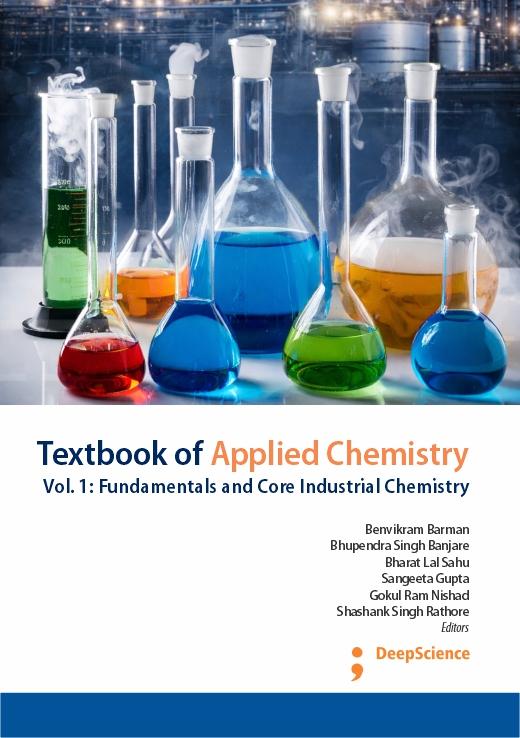
Sahu, T. R. (2026). Colloids – Properties & Applications. In B. Barman, B. S. Banjare, B. L. Sahu, S. Gupta, G. R. Nishad, & S. S. Rathore (Eds.), & P. Thawait, Textbook of Applied Chemistry (pp. 225-235). Deep Science Publishing. https://doi.org/10.70593/978-93-7185-430-6_19
Download Citation






 WhatsApp +91 7977171947