

Phase Equilibria & Metallurgical Processes
Synopsis
The phase equilibria will be introduced in this chapter and the role of phase equilibria in the metallurgical processes and material science will be learned. The chapter introduces the idea of phase diagrams as graphical illustrations of the stability of the different phases at different temperatures and composition, however, it talks about the iron-carbon (Fe-C) diagram and the water (H2O) diagram in particular. The lever rule has been defined as a quantitative method of determining the phases of a two phase system in relation to each other. The design and fabrication of alloys, metals and ceramics require knowledge of phase behavior to offer the preferred mechanical, thermal, and chemical characteristics to the material. The chapter also has industrial applications that consist of steel production, alloy formulation, casting and ceramic production where phase diagrams are applied in controlled cooling, solidification and in heat treatment. In addition, the chapter shows the impact of impurities on the material performance and reliability, cooling rate and phase change. With the theory and the real life process experience, the student actually learns how to use phase equilibria to make material decisions, process decisions and quality decisions in the area of metallurgy and materials engineering. The information forms a foundation in the advanced materials production and industry chemical processes.
Downloads
Pages
52-65
Published
10 February 2026
Copyright (c) 2026 Dr. Benvikram Barman, Dr. Bhupendra Singh Banjare; Dr. Manoj Kumar Banjare; Dr. Bharat Lal Sahu, Dr. Sangeeta Gupta, Mr. Gokul Ram Nishad, Mr. Shashank Singh Rathore; Mrs. Hema R. Tandon, Mrs. Neelam Ram Dhansay, Dr. Toshikee Yadav, Mr. Santosh Kumar Dahariya, Ms. Aditi Banjare, Mr. Ganesh Ram Kurrey; Mrs. Poonam Thawait; Mr. Chitresh Kumar Bareth, Mr. Rupendra Kumar , Dr. Sandhya Rani Panda, Dr. Manisha Thakur, Dr. Prachi P Nimje, Mr. Ajhar Ali, Mr. Rupesh Kumar, Ms. Shaesta Jabeen, Dr. Tula Ram Sahu, Ms. Namrata Tamboli, Mr. Pradeep Kanher, Mr. Seecharan Banjare , Ms. Suman R. Tirkey, Mr. Yashwant Raj Mahilane, Dr. Swati Chandrawanshi, Mr. Sudhanshu Kumar Giri, Mr. Sagar Kumar Rajak, Dr. Akansha Ekka, Dr. Jyoti Diwan, Dr. Khilawan Patel, Mr. Mukesh Kumar Patel, Mrs. Madhuri Patel, Chitrakiran Patel, Dr. Manoj Kumar Banjare, Dr. Prachi P Nimje, Dr. Sandhya Rani Panda, Mr. Prakashmani Sahu
How to Cite
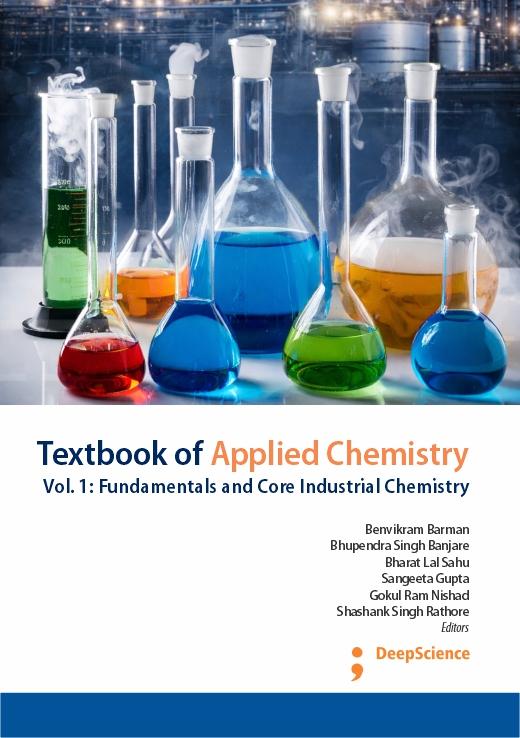
Yadav, T. (2026). Phase Equilibria & Metallurgical Processes. In B. Barman, B. S. Banjare, B. L. Sahu, S. Gupta, G. R. Nishad, & S. S. Rathore (Eds.), & P. Thawait, Textbook of Applied Chemistry (pp. 52-65). Deep Science Publishing. https://doi.org/10.70593/978-93-7185-430-6_5
Download Citation






 WhatsApp +91 7977171947