

Catalysis in the Chemical Industry
Synopsis
The author goes into detail in this chapter by reflecting on the phenomenon of catalysis and its preeminence in the chemical industries insofar as the homogeneous and heterogeneous catalytic processes are concerned. The catalysts promote the rate of reactions by lowering the activation energy, and they are neither consumed, which enhances the efficiency and selectivity. The chapter explains the catalysis mechanisms (adsorption, product formation, and product desorption), which are related to theory and practical implementation. Industries such as the Haber process to produce ammonia, the Contact process to produce sulfuric acid and the Ziegler-Natta catalysis to produce polymers, among others, are explained to demonstrate real-life applicability. Saving on energy, minimization of wastes and maximization of product yields are some of the economic and environmental advantages of catalysis that are pointed out by the chapter. The students are introduced to the parameters of ideal catalyst selection and catalytic reactor design applied in the industry. The chapter is an integration of mechanistic understanding and industrial experience, where it identifies how catalysis was used in large-scale chemical production and modern industrial chemistry. It is also with the help of catalytic knowledge that enables the simplification of reactions, new industrial reactions are produced, and improved green and sustainable chemical reactions.
Downloads
Pages
88-100
Published
10 February 2026
Copyright (c) 2026 Dr. Benvikram Barman, Dr. Bhupendra Singh Banjare; Dr. Manoj Kumar Banjare; Dr. Bharat Lal Sahu, Dr. Sangeeta Gupta, Mr. Gokul Ram Nishad, Mr. Shashank Singh Rathore; Mrs. Hema R. Tandon, Mrs. Neelam Ram Dhansay, Dr. Toshikee Yadav, Mr. Santosh Kumar Dahariya, Ms. Aditi Banjare, Mr. Ganesh Ram Kurrey; Mrs. Poonam Thawait; Mr. Chitresh Kumar Bareth, Mr. Rupendra Kumar , Dr. Sandhya Rani Panda, Dr. Manisha Thakur, Dr. Prachi P Nimje, Mr. Ajhar Ali, Mr. Rupesh Kumar, Ms. Shaesta Jabeen, Dr. Tula Ram Sahu, Ms. Namrata Tamboli, Mr. Pradeep Kanher, Mr. Seecharan Banjare , Ms. Suman R. Tirkey, Mr. Yashwant Raj Mahilane, Dr. Swati Chandrawanshi, Mr. Sudhanshu Kumar Giri, Mr. Sagar Kumar Rajak, Dr. Akansha Ekka, Dr. Jyoti Diwan, Dr. Khilawan Patel, Mr. Mukesh Kumar Patel, Mrs. Madhuri Patel, Chitrakiran Patel, Dr. Manoj Kumar Banjare, Dr. Prachi P Nimje, Dr. Sandhya Rani Panda, Mr. Prakashmani Sahu
How to Cite
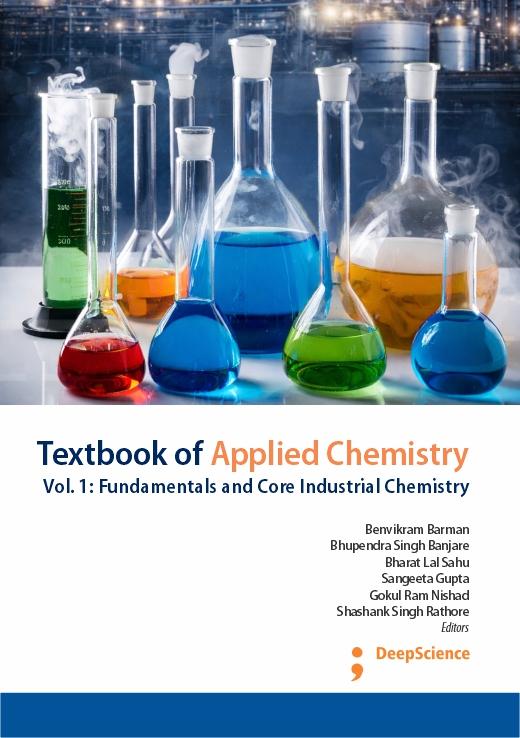
Kurrey, G. R. (2026). Catalysis in the Chemical Industry. In B. Barman, B. S. Banjare, B. L. Sahu, S. Gupta, G. R. Nishad, & S. S. Rathore (Eds.), & P. Thawait, Textbook of Applied Chemistry (pp. 88-100). Deep Science Publishing. https://doi.org/10.70593/978-93-7185-430-6_8
Download Citation






 WhatsApp +91 7977171947