
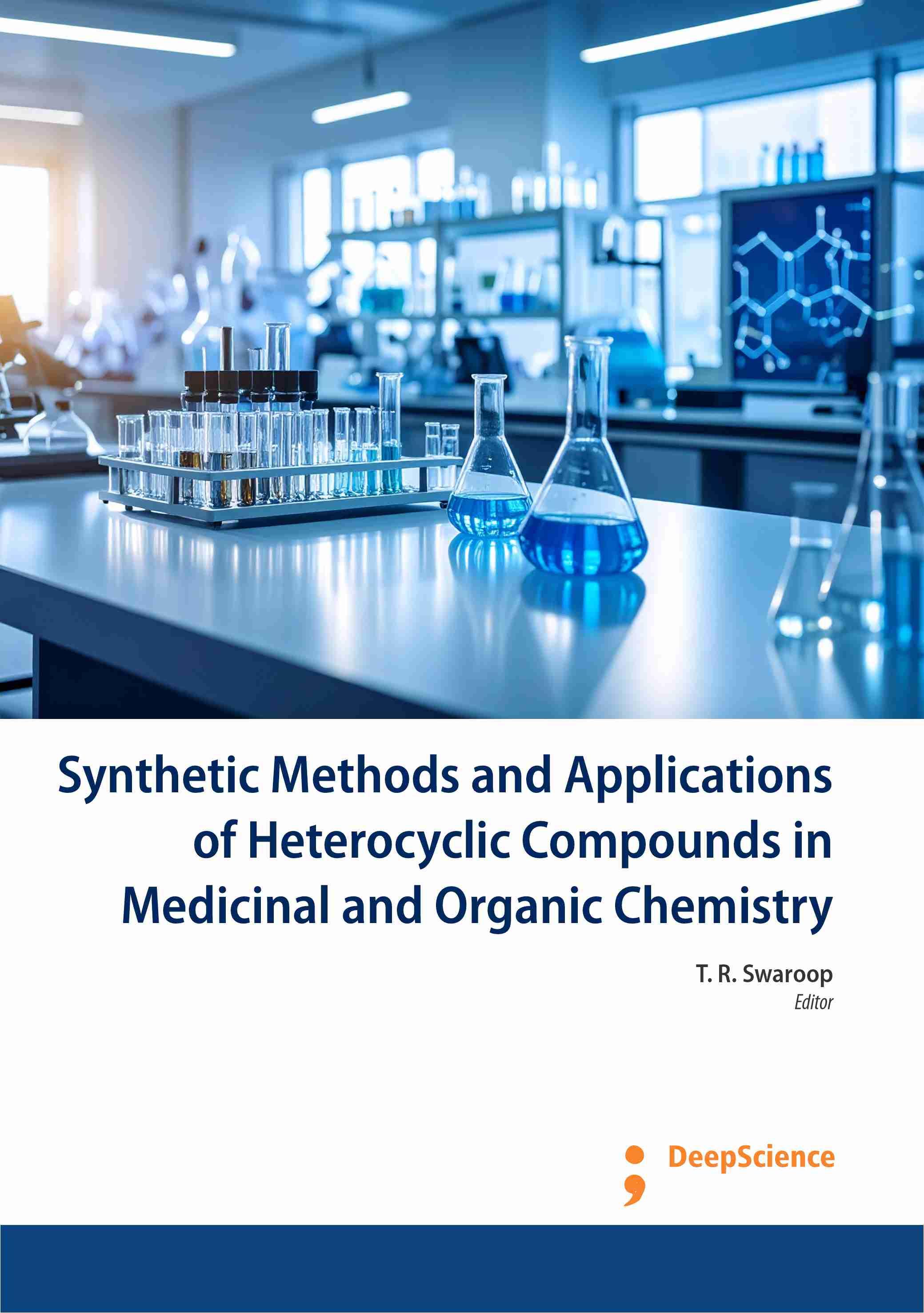
Synthetic Methods and Applications of Heterocyclic Compounds in Medicinal and Organic Chemistry
##plugins.pubIds.doi.readerDisplayName##
https://doi.org/10.70593/978-93-7185-164-0
Keywords:
Heterocyclic compounds, Bioactive heterocycles, Pyran derivatives, Asymmetric catalysis, Enantioselective synthesis, Green chemistry, Multicomponent reactionsSynopsis
This book offers a comprehensive exploration of synthetic methods for heterocyclic compounds and their applications in medicinal and organic chemistry. Heterocyclic compounds are an important class among different types of organic compounds. They found applications not only in medicinal chemistry but also in metarial science and agrochemicals.
The book begins with synthesis and biological applications of tryptanthrin based heterocyclic compounds in Chapter 1. In Chapter 2, synthesis and applications of α-oxothioamides is presented. Chapter 3 gives a summary of synthesis of new coumarine derivatives. Synthesis of tartaric acid based heterocyclic compounds and their applications in asymmetric catalysis are presented in Chapter 4. Chapter 5 describes recent advancements in the synthesis and applications of heterocycles in the perspective of emerging strategies and multidisciplinary applications. Interestingly, Chapter 6 shed light on electroorganic synthesis of heterocyclic compounds. Chapter 7 concludes different methods for multicomponent synthesis of 4H-pyrans. Applications of anthranils in the synthesis of nitrogen containing heterocyclic compounds are detailed in Chapter 8. Chapter 9 entails synthesis and applications of glycoconjugated heterocycles. Chapter 10 summarizes catalytic strategies for the synthesis of heterocyclic compounds. Finally, Chapter 11 gives a view on synthesis, physical properties and biological behaviours of synthetic derivatives of aromatic heterocyclic compounds.
This book provides lot of information related to different approaches involved in the synthesis of heterocycles and their applications in different scientific domains. I hope this book may provoke chemists to develop novel aspects, which can contribute to the development of chemistry of heterocyclic compounds.
I thank the researchers from all over India, who have contributed chapters to this book. I am grateful to Deep Science Publishing for giving me an opportunity to edit this book.
Chapters
-
Tryptanthrin incorporated N/S/O heterocycles – synthesis and biological properties
-
Synthesis and applications of α-oxothioamides
-
Synthesis of pyranocoumarin and furocoumarin derivatives
-
Synthesis and applications of tartaric acid in asymmetric catalysis
-
Recent advances in the synthesis and functional applications of heterocyclic compounds: Emerging strategies and multidisciplinary perspectives
-
Horizons in synthetic organic electrochemistry
-
Multicomponent synthesis of functionalized 4H-pyrans
-
Applications of anthranils in the synthesis of nitrogen heterocycles
-
Glycoconjugated heterocyclic compounds: synthesis and applications
-
Sustainable catalytic protocols for the synthesis of biologically active heterocyclic compounds
-
Synthesis, physical properties, and biological behaviour of synthetic aromatic heterocyclic compounds and their derivatives
References
Al-Sharifi, H. K., Leena, S. S., Saxena, D., Maitra, R., Chopra, S., & Deepthi, A. (2024). Green synthesis of tryptanthrin appended 4-spiropiperidines and their anti-bacterial evaluation. Tetrahedron, 151, 133786.
Azizian, J., Karimi, A. R., & Arefrad, H. (2004). mohammadi AA, Mohammadizadeh MR Monatshefte für Chemie, 135, 729-733.
Bandekar, P. P., Roopnarine, K. A., Parekh, V. J., Mitchell, T. R., Novak, M. J., & Sinden, R. R. (2010). Antimicrobial activity of tryptanthrins in Escherichia coli. Journal of medicinal chemistry, 53(9), 3558-3565.
Beyrati, M., & Hasaninejad, A. (2017). One-pot, three-component synthesis of spiroindoloquinazoline derivatives under solvent-free conditions using ammonium acetate as a dual activating catalyst. Tetrahedron Letters, 58(20), 1947-1951.
Bloxam, W. P. (1905). CIII.—Our present knowledge of the chemistry of indigo. Journal of the Chemical Society, Transactions, 87, 974-987.
Brandão, P., Pineiro, M., & Burke, A. J. (2022). Tryptanthrin and its derivatives in drug discovery: synthetic insights. Synthesis, 54(19), 4235-4245.
Filatov, A. S., Knyazev, N. A., Shmakov, S. V., Bogdanov, A. A., Ryazantsev, M. N., Shtyrov, A. A., & Stepakov, A. V. (2019). Concise synthesis of tryptanthrin spiro analogues with in vitro antitumor activity based on one-pot, three-component 1, 3-dipolar cycloaddition of azomethine ylides to сyclopropenes. Synthesis, 51(03), 713-729.
Friedländer, P., & Roschdestwensky, N. (1915). Über ein Oxydationsprodukt des Indigblaus. Berichte der deutschen chemischen Gesellschaft, 48(2), 1841-1847.
Jähne, E. A., Eigenmann, D. E., Sampath, C., Butterweck, V., Culot, M., Cecchelli, R., Gosselet, F., Walter, F. R., Deli, M. A., Smieško, M., Hamburger, M., & Oufir, M. (2016). Pharmacokinetics and in vitro blood-brain barrier screening of the plant-derived alkaloid tryptanthrin. Planta medica, 82(11/12), 1021-1029.
Jahng, Y. (2013). Progress in the studies on tryptanthrin, an alkaloid of history. Archives of pharmacal research, 36, 517-535.
Jao, C. W., Lin, W. C., Wu, Y. T., & Wu, P. L. (2008). Isolation, structure elucidation, and synthesis of cytotoxic tryptanthrin analogues from Phaius mishmensis. Journal of natural products, 71(7), 1275-1279.
Downloads
Published
14 November 2025
Copyright (c) 2025 T R Swaroop; Anupama Anjali , Swadhin Swaraj Acharya, Bibhuti Bhusan Parida, Ram Singh Jat, M. Bhanuchandra, Anjali Sharma, Rajib Panchadhayee, Aminul Islam, Pranab Ghosh, Nithesh Kumar Krishnan, Harini Bhagyaraj, Esakkimuthu Shanmugasundaram, Vikash Kumar Sonu, Apoorv Saraswat, Ani Deepthi, Sruthi S. L.; Devika Krishnan; Rajaghatta N Suresh, Kempegowda Mantelingu, Toreshettahally R Swaroop, Kanchugarakoppal S Rangappa, M Sarasija, Vijaya Lakshmi , Ramchandra Thorat, Owais Mujawar, Ram Chandra Maji, Stalin Thambusamy
Details about the available publication format: E-Book
E-Book
ISBN-13 (15)
978-93-7185-164-0
Details about the available publication format: Book (Paperback)
Book (Paperback)
ISBN-13 (15)
978-93-7185-560-0
How to Cite
Swaroop, T. R. (Ed.). (2025). Synthetic Methods and Applications of Heterocyclic Compounds in Medicinal and Organic Chemistry. Deep Science Publishing. https://doi.org/10.70593/978-93-7185-164-0
Download Citation





 WhatsApp +91 7977171947