

Synthesis, physical properties, and biological behaviour of synthetic aromatic heterocyclic compounds and their derivatives
Synopsis
Aromatic heterocyclic compounds are a versatile class of organic compounds that are categorized by incorporating one or heteroatoms such as nitrogen, oxygen, or sulphur. The presence of non-carbonaceous exhibits the unique electronic configurations, structural versatility, and chemical and thermal stability. These heterocyclic compounds play a vital role in various areas of chemistry, particularly in the areas of biological applications. This chapter provides an overview of the heterocyclic compounds such as pyrrole, pyridine, quinoline, imidazole, and azole derivatives with their significant properties and their application in biological applications.
Downloads
Volume
Pages
150-164
Published
14 November 2025
Copyright (c) 2025 T R Swaroop; Anupama Anjali , Swadhin Swaraj Acharya, Bibhuti Bhusan Parida, Ram Singh Jat, M. Bhanuchandra, Anjali Sharma, Rajib Panchadhayee, Aminul Islam, Pranab Ghosh, Nithesh Kumar Krishnan, Harini Bhagyaraj, Esakkimuthu Shanmugasundaram, Vikash Kumar Sonu, Apoorv Saraswat, Ani Deepthi, Sruthi S. L.; Devika Krishnan; Rajaghatta N Suresh, Kempegowda Mantelingu, Toreshettahally R Swaroop, Kanchugarakoppal S Rangappa, M Sarasija, Vijaya Lakshmi , Ramchandra Thorat, Owais Mujawar, Ram Chandra Maji, Stalin Thambusamy
How to Cite
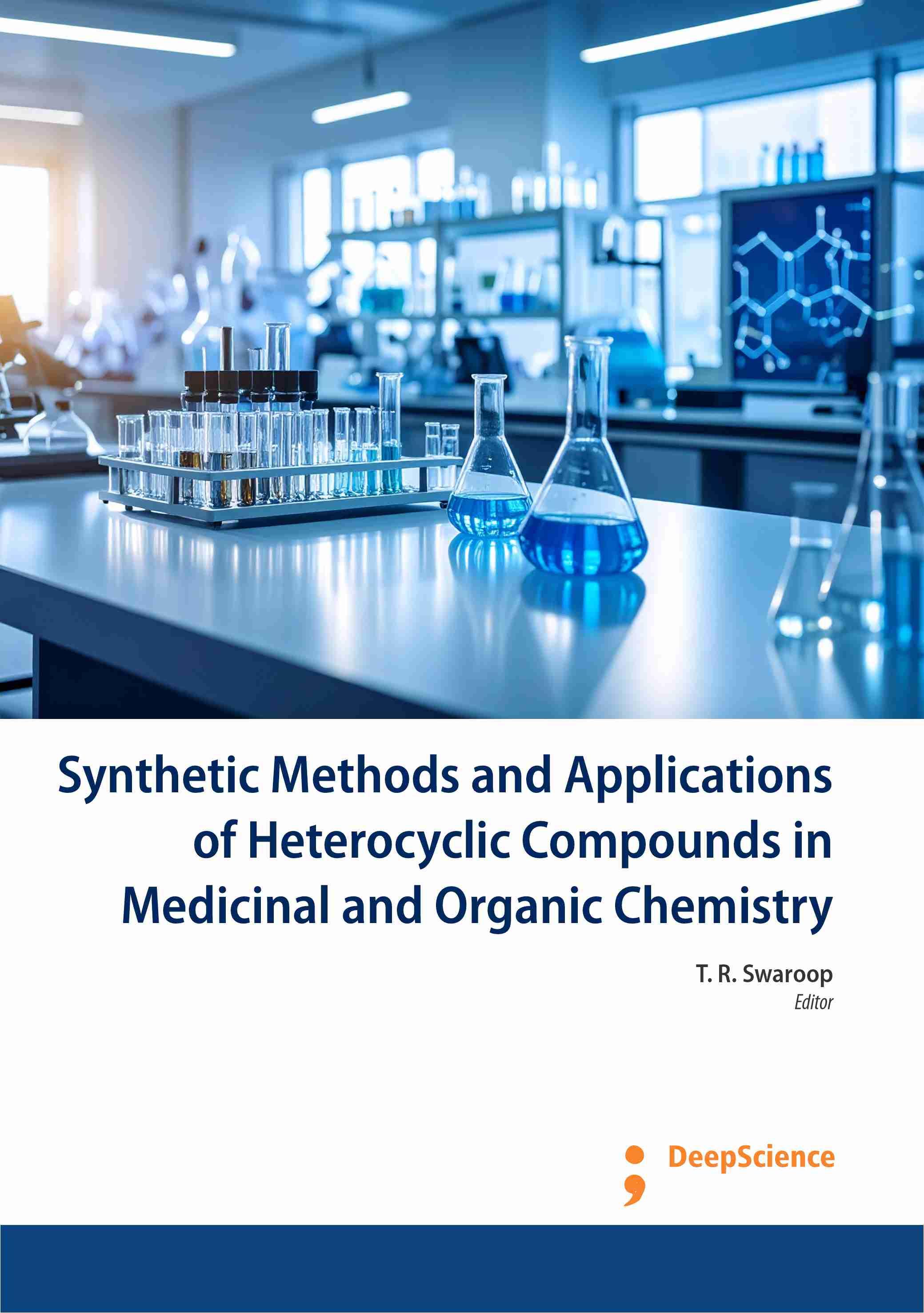
Krishnan, N. K. ., Bhagyaraj, H. ., Shanmugasundaram, E. ., & Thambusamy, S. . (2025). Synthesis, physical properties, and biological behaviour of synthetic aromatic heterocyclic compounds and their derivatives . In T. R. Swaroop (Ed.), Synthetic Methods and Applications of Heterocyclic Compounds in Medicinal and Organic Chemistry (pp. 150-164). Deep Science Publishing. https://doi.org/10.70593/978-93-7185-164-0_11
Download Citation






 WhatsApp +91 7977171947