

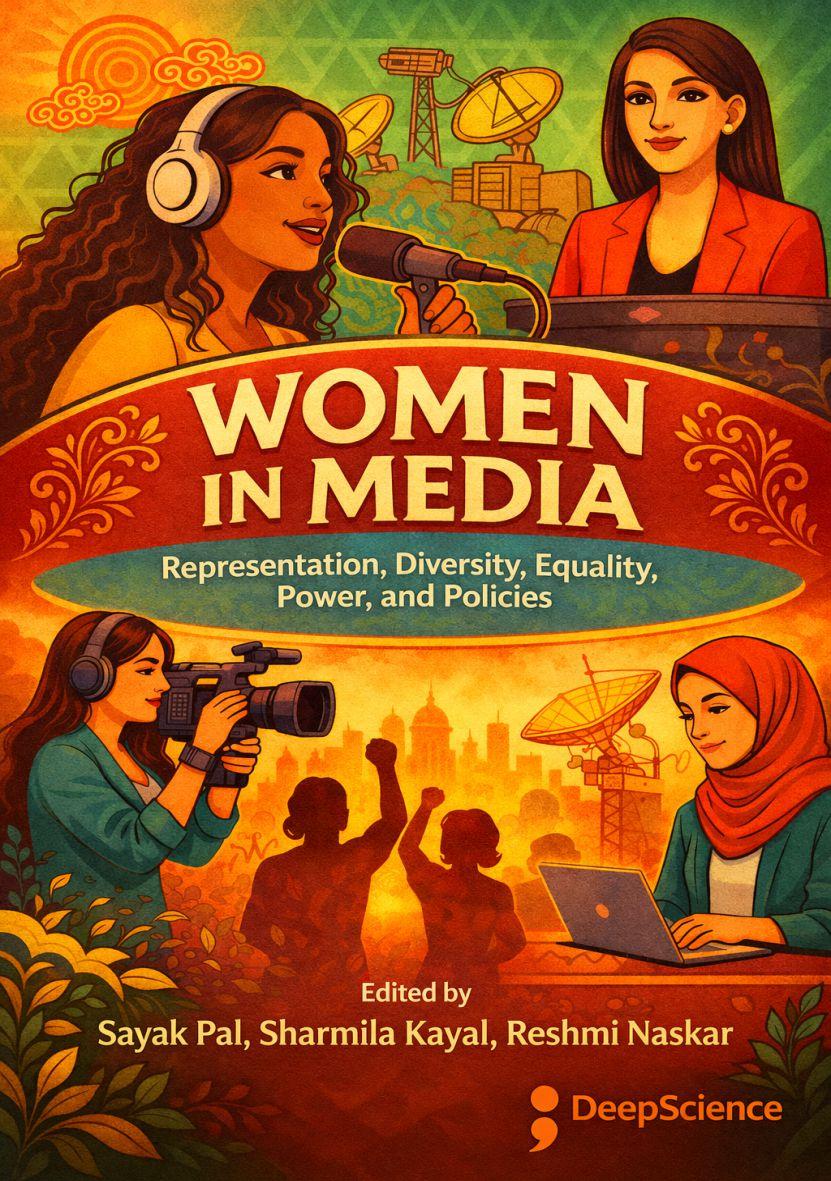
Women in Media: Representation, Diversity, Equality, Power, and Policies
##plugins.pubIds.doi.readerDisplayName##
https://doi.org/10.70593/978-93-7185-912-7
Keywords:
Women, Media, Diversity, Equality, Policies, Necropolitics, AdvertisementsSynopsis
This has been the case as the portrayal of women on the traditional, new and digital media channels has informed the definition of gender identities and roles in the society. Despite the fact that until recently the portrayal of women in the media was only restricted, objectified, stereotyped and partial, there has been a slow but steady move towards the empowerment of women and thus they began to make a contribution to the industry. This may be viewed as a good gesture towards inclusivity and acceptance. The advances in representation are disruptive to customary demarcations and conceptions of women in appraising their role in the media industry. Representative diversity is also very important because women are not one group, but may be divided into class, age, race, culture, ethnicity, sexuality, and background. Equality is not an area limited to representation, but emphasizes the scope and the opportunities that women have in the industry such as the discrimination at the workplace, fair pay, structural change, career growth, an enabling work climate, and so on to ensure long-term growth and development. Power dynamics point out both favorable and unfavorable influences of women placement in organizational frameworks, undermining the conventional, mainly patriarchal structure prevalent in media industry. Changes can be realized within a media organization with the help of policies that help promote equality and sustainability but in this case, constant advocacy and monitoring is needed.
The book helps bring to the fore positions and representations, contributions and roles of women in the literary field, the social life, economy, journalism, content development, democracy, politics, cinema, animation, fashion, television, mythology, advertising, and a lot of other related fields, and the gendered nature of perceptions in the media at various points in the chapters. We want to thank all the contributors, collaborators, and the community that have made this book a success, and hope that the curated and structured knowledge can assist students, professionals, scholars, and researchers in knowing and discovering the subject and being able to work in the field.
Chapters
-
Representation of women in Indian television animation: A gendered media analysis
-
Trial by Fire, Social Death: Necropolitics and Feminist Counter-Narratives of Sita, Draupadi and Ahalya
-
Women In Indian Television Advertisements
-
Silenced Pages: Coverage of Women’s Issues in Indian Mainstream Newspapers
-
Women Content Creators in India: Representation, Challenges and Empowerment in the Digital Era
-
Women in Indian Mythology and Media Representation: Power, Patriarchy and Reinterpretation
-
From Sacrifice to Selfhood: Belated Female Agency in Contemporary Hindi Cinema
-
The Ambivalent Gaze: Feminization, Post-feminism, and the Political Economy of Gender Representation in Indian OTT Media
-
Unstable-Selves and More-than-Human-Worlds: A Posthuman Feminist Reading of Patriarchal Misinterpretation in Aparna Sen’s 15 Park Avenue
-
The Contemporary Challenges and Participation of Women in Animation Industry
-
Self-Love, Simplicity and Social Acceptance: New Age Fashion Influencers Redefining the Standards of Beauty
References
Bandura A. Social Foundations of Thought and Action: A Social Cognitive Theory. Englewood Cliffs: Prentice-Hall; 1986.
Gerbner G, Gross L, Morgan M, Signorielli N. Growing up with television: Cultivation processes. In: Bryant J, Zillmann D, editors. Media Effects: Advances in Theory and Research. Hillsdale: Lawrence Erlbaum; 2002. P. 43–68.
Gramsci A. Selections from the Prison Notebooks. Hoare Q, Smith GN, editors. New York: International Publishers; 1971.
Thussu DK. Media and Social Change in India: Gender and Cultural Representations. London: Routledge; 2019.
Ranganathan M. Gender and advertising in Indian children’s programming. South Asian J Media Stud. 2018;5(1):45–60.
Eagly AH, Karau SJ. Role congruity theory of prejudice toward female leaders. Psychol Rev. 2002;109(3):573–598.
Downloads
Published
11 April 2026
Copyright (c) 2026 Sayak Pal, Sharmila Kayal, Reshmi Naskar; Piu Banerjee, Ashique Rashul, Nilofar Yasmin, Gauri S. Matekar, Dnyaneshwar B. Shirode, Debastuti Dasgupta, Rick Sarkar, Harsha V. Patil, Soumyadeep Sen, Anmol Shekhar Srivastava, Jaya Bharti, Sananda Sen, Debasmita Biswas, Debarpita Naha, Baishali Deb Roy, Abhishek Bhattacharjee, Doyel Dutta
Details about the available publication format: E-Book
E-Book
ISBN-13 (15)
978-93-7185-912-7
Details about the available publication format: Book (Paperback)
Book (Paperback)
ISBN-13 (15)
978-93-7185-051-3
How to Cite
Pal, S., Kayal, S. ., & Naskar, R. (Eds.). (2026). Women in Media: Representation, Diversity, Equality, Power, and Policies. Deep Science Publishing. https://doi.org/10.70593/978-93-7185-912-7
Download Citation









 WhatsApp +91 7977171947