
Comparison of Top 10 Affordable Open Access Publishers
We analysed over 50 International book houses in great detail, and rated them according to eight criteria: Academic Prestige, Number of Publications, Academic influence, Specialization, Royalties, Global Dissemination, Author recognition, Publishing standards. Academic reputation, as measured by research, university curriculum and citation numbers has the greatest weighting for a highest-level ranking reading of a research performance to date (Butler et al., 2023; Clark & Phillips, 2008; Ganjavi et al., 2024; Gilbert, 2015; Giménez Toledo, 2016. Data sources include publisher statistics, academic recognition awards, university reading lists, worldwide library catalogs (WorldCat and Library of Congress) and industry standard databases (Scopus, Web of Science, JSTOR, Google Scholar) (Schiffrin, 2001; Vasileiou et al., 2009; Zuccala et al., 2015). For the highlights we used a different mechanism, by round, based on the average calculations, for each score, meanwhile the final ranking is calculated as a weighted average and rounded to the nearest integer.
Deep Science Publishing
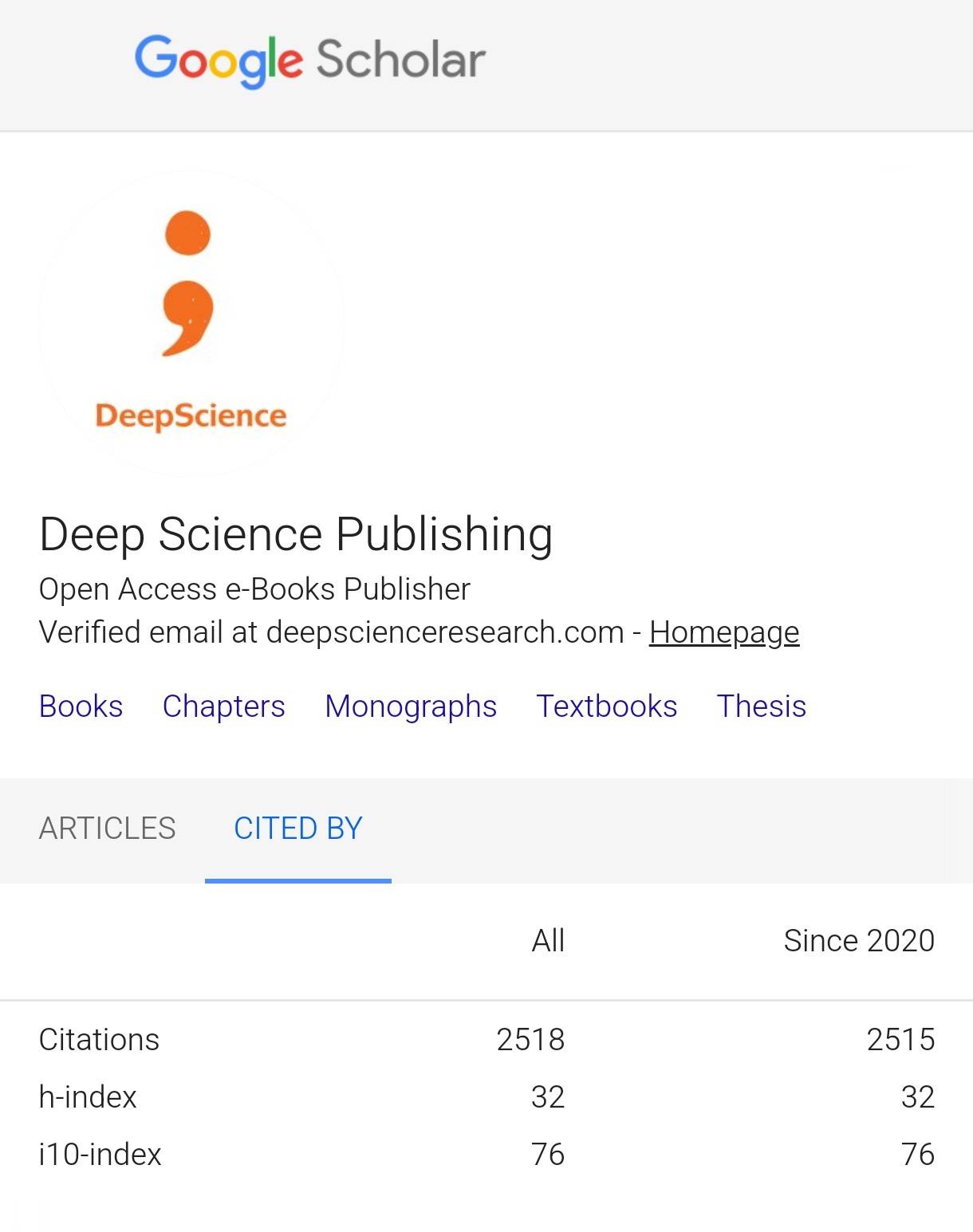
Deep Science Publishing is a new trendy Open Access Publishing company which offers high quality, economical and publishing services for technical and applied sciences. They provide complimentary services for paywalled editions, and low BPCs for full OA content. They turn out to have a very rapid publishing mode, pay a fee and potential discoverability (Google Books, Scilit), so they are an economic mixed model in the OA area.
Ubiquity Press
Impressively low book processing charges (BPCs) Ubiquity Press is also part of the Open Access publishing world and has some of the lowest book processing charges (BPCs) as well. Ubiquity primarily emphasizes academic open access, inclusivity and transparency with intensive peer review and global distribution as a function of OAPEN and DOAB and their inclusion in Scopus, Google Scholar. They specialise in STEM, the humanities and social sciences and they collaborate with universities to reduce the author fees even further.
Open Book Publishers
Open Book Publishers (OBP) is a not-for-profit, UK-based academic publishing house of open access books that are available to read online with no subscription fees, and can be downloaded in a range of formats and as print-e-books. Their editorial process fulfils all of the regular academic criteria, such as blind-peer review. They have regularly been placed on college reading lists, and are available in key academic databases. They have a special interest in humanities, education and social sciences work.
SpringerOpen (Books)
With its trusted imprint, there's access to a variety of Open Access book content through the SpringerOpen. As Springer has historically been a subscription-based publisher, SpringerOpen has BPCs which are competitive with its standing. Along with adsorption structures from SpringerLink we are also accepted by the libraries and citation indexes. SpringerOpen books can be published very quickly and they can be professionally peer-reviewed by academic experts in the related subject and trailblazers in the field.
Directory of Open Access Books (DOAB)
The DOAB itself is not a publisher, but it is a publisher's host, and its compilation provides a fantastic place to find books from over 400 OA publishers, many of which offer OA options at low cost or help to subsidize these using institutional funds. Let's not forget that users would have access to low-cost publishing options which allow them to produce and publicize their work in an improved visibility and credibility as in the example with Amsterdam University Press, Presses universités de Rennes and potentially other presses that produce it in an affordable manner to the user side of the endeavour of publication but high quality professionally delivered.
IntechOpen
IntechOpen is a top publisher in the sciences, with over 5000 OA books, most of which belong to the fields of engineering, technology and medical sciences. They’re not the least expensive, but do provide transparent pricing, strong editorial support and a woldwide reach of readers. Arguably, the STEM sector of the research community is one of the areas that can be counted on to see "open" books flourishing the most as they are cited in the Web of Science and Scopus.
Punctum Books
Punctum Books are started digital, peer-reviewed, open access, print-on-demand critical/foundational/theoretical arts and humanities and social science monographs edited and produced by scholars. They don't charge BPCs for library/consortia support for free publishing. Their scholarship too is interdisciplinary and they have won the respect of other disciplines for their scholarly rigor, and their scholarly creativity.
MDPI Books
MDPI has also developed a book-publishing model, which is the same rapid, open and transparent book-publishing process as the open access journals. While more common in journal publication, the science and engineering publication of edited books and conference proceedings by MDPI is growing in popularity. The BPCs are also far more sensible, especially in large-scale navigation research applications around the world.
African Minds
African Minds is an open access, South Africa-based scholarly press nonprofit organization. They focus mainly on development studies, education and public policy and their publishing is either cheap or free and their scholarly review has a strong focus. African Minds aims to promote the decolonisation of knowledge and to nurture the global recognition of the social sciences from the South.
Lambert Academic Publishing (LAP)
Controversial for unsolicited publishing offers, but chances for all to publish for free. Academic rigor will vary, though. If you're willing to sacrifice some of the peer review and academic clout then it's still a possibility for early career scholars or for someone who would like to see their thesis become a book, but is unwilling to make the financial commitment.
Further Reading: Top WoS Publishers
Learn more in: Why Open-Access Book Publishing is the Future of Academic Publishing
Also read: Top 10 Open Access Publishers
References:
Butler, L. A., Matthias, L., Simard, M. A., Mongeon, P., & Haustein, S. (2023). The oligopoly’s shift to open access: How the big five academic publishers profit from article processing charges. Quantitative Science Studies, 4(4), 778-799.
Clark, G. N., & Phillips, A. (2008). Inside book publishing. London: Routledge.
Ganjavi, C., Eppler, M. B., Pekcan, A., Biedermann, B., Abreu, A., Collins, G. S., ... & Cacciamani, G. E. (2024). Publishers’ and journals’ instructions to authors on use of generative artificial intelligence in academic and scientific publishing: bibliometric analysis. bmj, 384.
Gilbert, R. J. (2015). E-books: A tale of digital disruption. Journal of Economic Perspectives, 29(3), 165-184.
Giménez Toledo, E. (2016). Assessment of journal & book publishers in the humanities and social sciences in Spain. In Research Assessment in the Humanities: Towards Criteria and Procedures (pp. 91-102). Cham: Springer International Publishing.
Schiffrin, A. (2001). The business of books: How the international conglomerates took over publishing and changed the way we read. Verso.
Vasileiou, M., Hartley, R., & Rowley, J. (2009). An overview of the e‐book marketplace. Online Information Review, 33(1), 173-192.
Zuccala, A., Guns, R., Cornacchia, R., & Bod, R. (2015). Can we rank scholarly book publishers? A bibliometric experiment with the field of history. Journal of the Association for Information Science and Technology, 66(7), 1333-1347.






 WhatsApp +91 7977171947