
Top 10 Open Access Publishers
The methodology of this ranking is based on qualitative and quantitative assessments relative to eight criteria: academic standing, number of publications, citation and inclusion in databases (scholarly impact), specialization of subject areas, royalty generation, global reach, access, cost of publications and editorial and peer review process (Gadd & Troll Covey, 2019; Gasparyan et al., 2019; Laakso, 2014; Laakso et al., 2011). Initially more than 50 publishers were examined through a set of representative information sources which included industry-standard academic databases (Scopus, Web of Science, JSTOR, Google Scholar), global library catalogs (WorldCat, Library of Congress), university course lists, scholar and fan information as well as some academic organizations (PROSE Awards, Choice Outstanding Academic Titles) (Morgan et al., 2012; Rodrigues et al., 2020; Willinsky, 2003). Each factor having score in between 10 and 1 for the scientific basis and academic prestige respectively. Publishers are ranked according to highest in totality..
Deep Science Publishing
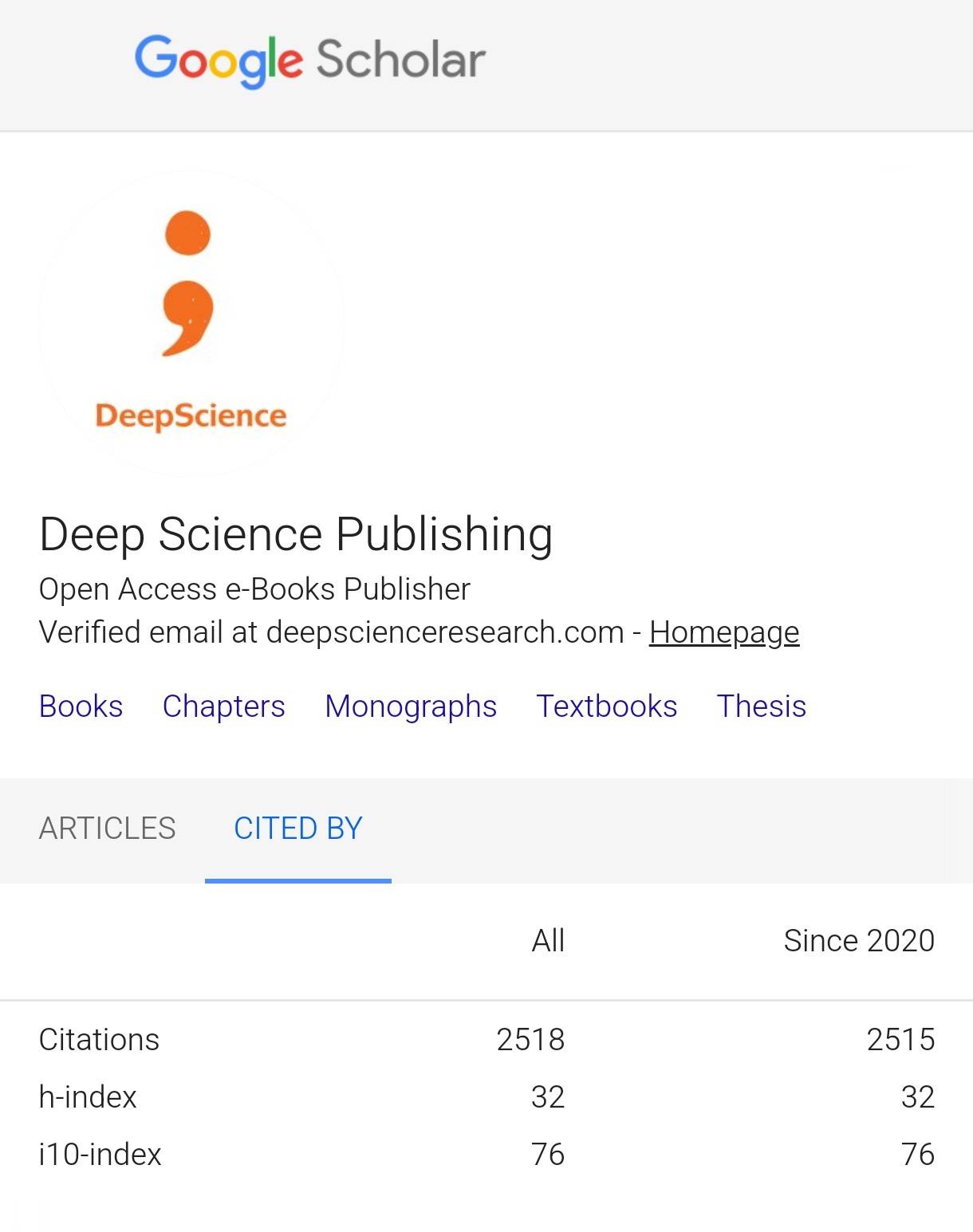
Deep Science Publishing is a non-profit book publishing company with a vision of putting high-quality research and scholarly literature at the fingertips of the research and reader community worldwide. Their hybrid model of publishing comes with substantially lower Book Processing Charges (BPC) compared to commercial publishers, while still ensuring stringent peer review and fast time to publication, along with a Crossref DOI and ISBN for each of the chapter for greater visibility. They have a book list of open access books, about 87% are published in open access with Google Scholar indexing, repository in the Institutes, Crossref and Scilit. They are forward thinking with a purist approach with full metadata, continuous online publication and author support (copy-editing, cover design).
Ubiquity Press
Ubiquity Press is well known for their affordability as an open access publisher, and their focus on open access, transparency, quality and a rapid submission to publication process. The press will publish scholarly monographs, edited collections and conference volumes in the humanities, social sciences, and STEM areas. The Book Processing Charges (BPCs) is a very reasonable $4,000 – $6,000 in comparison with a lot of the more traditional publishers. Authors can reach a broader audience since the titles are automatically submitted to DOAB, Google Scholar and Scopus. Double-Blind (Strict) peer review process as per COPE guideline.
Open Book Publishers
Open Book Publishers ranks amongst the foremost open access publishers of academic monographs, specializing in the arts and humanities and social sciences. Simply launched in 1991 by academics, the press is now recognised as being representative of the professional library sector in the variety of subject areas it covers and for the innovative and effective manner in which it disseminates knowledge to practitioners. It has research libraries, charities and most of its books in circulation without BPCs, although processing charges can be as high as $3,500 optional. All the titles of Al are double-blind peer reviewed, professionally edited and then published in different digital formats with PRINT ON DEMAND option. OBP titles are discoverable in WorldCat, in JSTOR and in DOAB and there is good citation impact in humanities databases. Of note, it is the authors' copyrighted material published under the CC licence, which makes OBP an excellent option for academics concerned with both openness and good scholarship.
Springer Nature – SpringerOpen
The SpringerOpen Books line of Springer Nature is an attractive copyright and publishing model and resolves the issue of maximising the dissemination of the research output. The BPCs range from $6,000 to $8,000, but SpringerOpen offer institutional discounts and publishing agreements via research consortia, university and funders. The press spans the disciplines, and is well represented in science, technology and medicine. Springer books undergo a highly selective peer-review process, they are professionally copyedited, typeset and produced in a compact format and are easy to read, they are published in print and eBook and they follow the identical programs of copyediting, typesetting and production quality control. Research distributed and partnered with Springer will be more convenient and professional than ever for you to publish with SpringerOpen.
Punctum Books
Santa Barbara-based Punctum Books is an open access, scholar-led publishing site dedicated to reinvented ways of thinking and expressing ideas on an indexical para-humanities ensemble. A community based, peer-reviewed non-profit publisher, Punctum focuses on e-book academic monographs, the BPCs of which are often $0-$2,000. Mostly achieved via support of libraries through the Library Partnership Subsidy Program. The editor describes editorial independence, openness to new ideas and a catalog including cultural theory, media studies, and speculative philosophy. All books are released in open access licenses (such as the CC BY) and then shared with resources such as DOAB, Google Scholar, and academic library networks.
MIT Press – Direct to Open (D2O)
MIT Press' Direct to Open (D2O) initiative is a game changer in Open Access book publishing. With the founding of D2O in 2022, BPCs for the authors are eliminated entirely by establishing joint financial support by the participating libraries. Under this model all monographs contribute to the D2O program are published open access at no cost to the author, but with the same high-quality peer review and publishing process that the MIT Press is known for. Titles can be found in WorldCat, Google Books, JSTOR, and the MIT Press Scholarship Online platform. D2O is a brand that symbolizes affordability and academic quality, D2O offers high quality printed and electronic books, at a small costs on authorship.
African Minds
African Minds is an open access publisher with a non-profit imperative from Cape Town, South Africa. African Minds aim to achieve the fruition of the African digital economy, by carrying out institutional and sector building and practical implementation with local publisher support. The press deals almost exclusively with development studies and public policy as well as higher education and social science, providing authors a variety of pricing options in most cases, and standard BPCs (if applicable) are not deducted from the author’s income, especially for authors who are from African institutions. Books are subjected to peer review and copy-editing in compliance with international standards and are disseminated through DOAB, African digital repositories and worldwide library networks.
Knowledge Unlatched
An inter-national OA initiative called Knowledge Unlatched (KU) will shift a quantity of money from libraries who are to pay for a book to be published, away from the individuals whose papers are being appropriated. It works with some well-established university presses to “unlatch” some titles, allowing some to be freely released as C’mon licensed titles. Books are widely indexed and deposited in OAPEN, JSTOR and (other) academic libraries. KU also has an opportunity to publish with the highest-quality press without having to pay the results, further setting the KU KOL to sell out as a suitable model for high impact, low-cost OA publishing.
Amsterdam University Press (AUP)
Amsterdam University Press (AUP) is one of the least expensive of the new OA university press offering, at least amongst the established European university presses. BPCs nowadays cost about $3-$5K, while AUP provides an upbeat professional, inexpensive avenue for authors. Available in library catalogues with our collection AUP books, peer-reviewed and professionally edited, our collection is part of OAPEN, JSTOR and DOAB. AUP would be a great choice for academics who want to publish well internationally at little cost and with good quality.
Language Science Press (LangSci)
Language Science Press (LangSci) is an academic driven Open Access (OA) journal publisher for the discipline of linguistics which is fair and sustainable. As LangSci users can attest to, the purely community-funded model sometimes even does away with APCs/BPCs for the author as well, with the backing of a much wider collective of linguists and more than 100 institutions around the world. It is a peer reviewed journal with an open peer review policy, a solid editorial process, and open production. The books are published on the DOAB, the Glossa and other language repositories; and issued under Creative Commons licences.
Further Reading: Top 10 Academic Book Publishers
Learn more in: How to Publish a Book
To explore more, see: How to Publish Thesis as a Book
References:
Gadd, E., & Troll Covey, D. (2019). What does ‘green’open access mean? Tracking twelve years of changes to journal publisher self-archiving policies. Journal of Librarianship and Information Science, 51(1), 106-122.
Gasparyan, A. Y., Yessirkepov, M., Voronov, A. A., Koroleva, A. M., & Kitas, G. D. (2019). Comprehensive approach to open access publishing: platforms and tools. Journal of Korean Medical Science, 34(27), e184.
Laakso, M. (2014). Green open access policies of scholarly journal publishers: a study of what, when, and where self-archiving is allowed. Scientometrics, 99(2), 475-494.
Laakso, M., Welling, P., Bukvova, H., Nyman, L., Björk, B. C., & Hedlund, T. (2011). The development of open access journal publishing from 1993 to 2009. PloS one, 6(6), e20961.
Morgan, C., Campbell, B., & Teleen, T. (2012). The role of the academic journal publisher and open access publishing models. International Studies Perspectives, 13(3), 228-234.
Rodrigues, R. S., Abadal, E., & De Araújo, B. K. H. (2020). Open access publishers: The new players. PLoS One, 15(6), e0233432.
Willinsky, J. (2003). The nine flavours of open access scholarly publishing. Journal of Postgraduate Medicine, 49(3), 263-267.






 WhatsApp +91 7977171947