
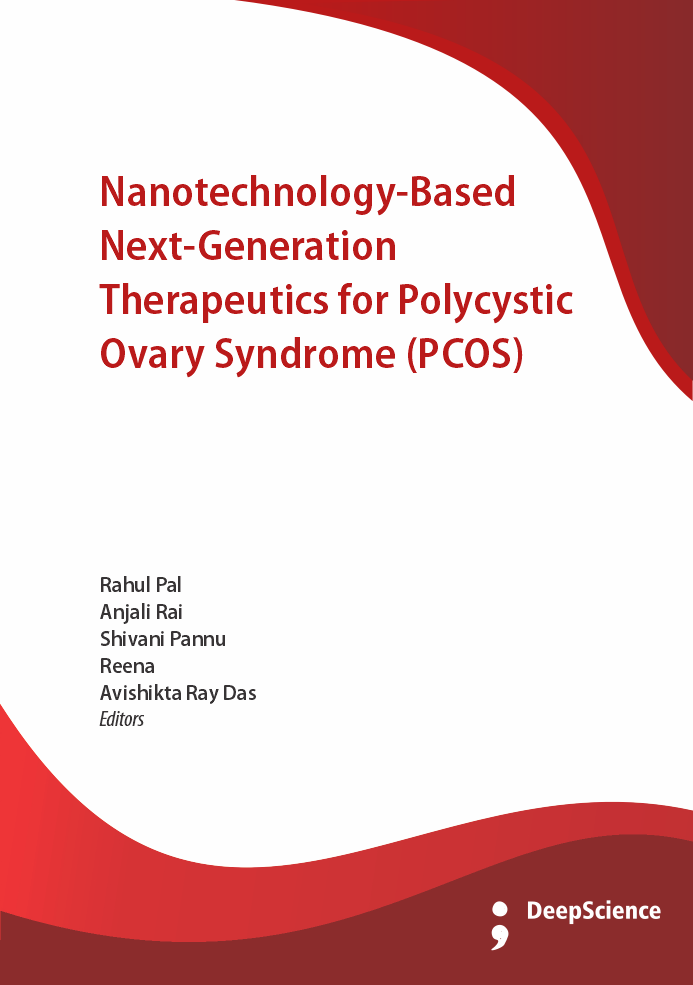
Nanotechnology NextGen: From Treatment to Transformation in Polycystic Ovary Syndrome (PCOS)
##plugins.pubIds.doi.readerDisplayName##
https://doi.org/10.70593/978-93-7185-087-2
Keywords:
Nanotechnology, Therapeutics, Polycystic Ovary Syndrome, PCOS, Nanocarriers, Personalized Nanomedicine, AntioxidantsSynopsis
Polycystic Ovary Syndrome (PCOS) is one of the most prevalent and complex endocrine–metabolic disorders affecting women of reproductive age, characterized by hyperandrogenism, chronic anovulation, insulin resistance, inflammation, and long-term cardiometabolic complications. Despite the availability of pharmacological and lifestyle-based interventions, conventional therapies often suffer from limited efficacy, systemic side effects, poor patient compliance, and an inability to address the multifactorial pathophysiology of PCOS. In this context, nanotechnology has emerged as a next-generation transformative platform capable of redefining PCOS management beyond symptomatic treatment.
This book explores the evolving role of nanotechnology-driven strategies in PCOS, spanning targeted drug delivery, enhanced bioavailability of therapeutics, controlled and sustained release systems, and precision-based intervention. Advanced nanocarriers such as polymeric nanoparticles, lipid-based systems, nanoemulsions, solid lipid nanoparticles, nanostructured lipid carriers, dendrimers, and phytochemical-loaded nanoplatforms are critically discussed for their potential to improve insulin sensitization, hormonal modulation, anti-inflammatory activity, and ovarian tissue targeting. The integration of nanotechnology with nutraceuticals, phytomedicines, gene-based therapies, and diagnostic nanodevices highlights a paradigm shift from conventional management to personalized and predictive care.
Furthermore, the book addresses translational challenges, regulatory considerations, safety and toxicity concerns, and emerging clinical evidence supporting nanomedicine-based interventions in PCOS. By bridging molecular insights with technological innovation, this volume provides a comprehensive roadmap illustrating how nanotechnology can move PCOS management from treatment toward long-term transformation. It serves as a valuable resource for researchers, clinicians, pharmaceutical scientists, and healthcare professionals seeking next-generation solutions for holistic and precision-driven PCOS care.
Chapters
-
Bridging Gaps in PCOS Care: The Nanotechnology Revolution Begins
-
Role of Nanocarriers (Liposomes, SLNPs, Niosomes and Dendrimers) in Reproductive Health: An Emerging Paradigm
-
Exploring Nanotechnology With Traditional Herbal Pharmacology: Nano Carrier-Based Phytochemical Delivery In PCOS Treatment
-
Silencing Inflammation: Nano-Antioxidants and Immunomodulators in PCOS Management
-
Beyond Treatment: Theranostic and Personalized Nanomedicine Approaches in (In-vitro, In vivo and Ex-vivo) PCOS
-
From Lab to Life: Safety, Regulatory Pathways and Clinical Trials in PCOS Nanomedicine
-
Translational Challenges and Future Directions in 3-D for PCOS Nanotherapy
-
Nanotechnology-Driven Antioxidants and Immunomodulators for Polycystic Ovary Syndrome (PCOS) Therapy
References
Abdallah, A. B. E., El-Ghannam, M. A., Hasan, A. A., Mohammad, L. G., Mesalam, N. M., & Alsayed, R. M. (2023). Selenium Nanoparticles Modulate Steroidogenesis-Related Genes and Improve Ovarian Functions via Regulating Androgen Receptors Expression in Polycystic Ovary Syndrome Rat Model. Biological Trace Element Research, 201(12), 5721–5733. https://doi.org/10.1007/s12011-023-03616-0
Advancements in lead therapeutic phytochemicals polycystic ovary syndrome: A review—PMC. (n.d.). Retrieved October 9, 2025, from https://pmc.ncbi.nlm.nih.gov/articles/PMC9868606/
Ahmad, S., Jaiswal, R., Yadav, R., & Verma, S. (2024). Recent advances in green chemistry approaches for pharmaceutical synthesis. Sustainable Chemistry One World, 4, 100029. https://doi.org/10.1016/j.scowo.2024.100029
Ali, F., Neha, K., & Parveen, S. (2023). Current regulatory landscape of nanomaterials and nanomedicines: A global perspective. Journal of Drug Delivery Science and Technology, 80, 104118. https://doi.org/10.1016/j.jddst.2022.104118
Altammar, K. A. (2023). A review on nanoparticles: Characteristics, synthesis, applications, and challenges. Frontiers in Microbiology, 14, 1155622. https://doi.org/10.3389/fmicb.2023.1155622
Alwan, S. H., & Al-Saeed, M. H. (2023). Silver Nanoparticles Biofabricated from Cinnamomum zeylanicum Reduce IL-6, IL-18, and TNF-ɑ in Female Rats with Polycystic Ovarian Syndrome. International Journal of Fertility and Sterility, 17(1), 80–84. https://doi.org/10.22074/IJFS.2022.539396.1189
Downloads
Published
15 July 2025
Copyright (c) 2025 Mr. Rahul Pal (Young Scientist), Ms. Anjali Rai, Ms. Shivani Pannu, Km. Reena, Dr. Avishikta Ray Das; Jhilli Basu, Jyoti Devi, Diksha Chauhan, Priya Jaswal, Binita Ghosh, Shantanu Prajapati, Sushant Mouraya, Sneha Patil, Nikhil Rajnani, Monal Jain, Nalini Kurup , Ranjan Kumar Singh, Komal Sharma, Mantun Prasad Gupta, Ravikant, Mahesh Singh Rajpurohit, Vaibhav Saxena, Ajay Garg, Raman Kumari, Priyanka Rani, Kamal Kumar Daal, Sami Ahmad, Sneha Chauhan, Sheelendra Kumar, Hemant Sharma, Rishabh Gupta, Shweta Singh, Tanuja, Harsh Goswami, Abhishek Tyagi, Sonal Sharma, Subhanshi Vishwas, Sami Ahmad, Kamal Kumar Daal, Divyansh Bhatnagar, Rishabh Gupta, Shweta Singh, Vandna Tiwari, Subhanshi Vishwas, Shivang Shukla, Sushant M. Ahire, Prerana S. Pawar, Shivraj P. Jadhav, Vijay V. Shewale, Chandrashekhar D. Patil, Sunil K. Mahajan, Subhanshi Vishwas
Details about the available publication format: E-Book
E-Book
ISBN-13 (15)
978-93-7185-087-2
Details about the available publication format: Book (Paperback)
Book (Paperback)
ISBN-13 (15)
978-93-7185-910-3
How to Cite
Pal, R., Rai, A., Pannu, S. ., Reena, & Das, A. R. . (Eds.). (2025). Nanotechnology NextGen: From Treatment to Transformation in Polycystic Ovary Syndrome (PCOS). Deep Science Publishing. https://doi.org/10.70593/978-93-7185-087-2
Download Citation






 WhatsApp +91 7977171947