

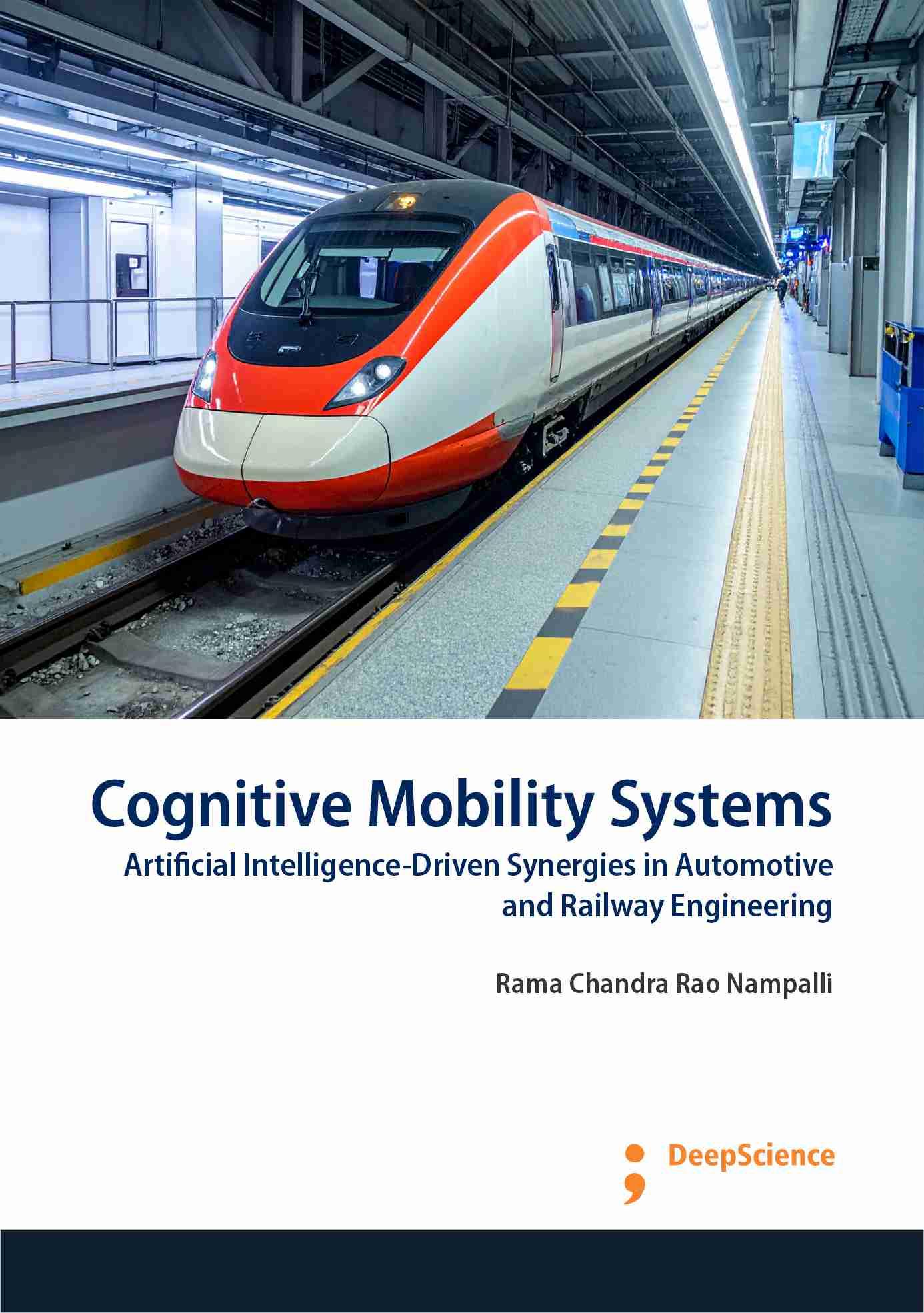
Cognitive Mobility Systems: Artificial Intelligence-Driven Synergies in Automotive and Railway Engineering
##plugins.pubIds.doi.readerDisplayName##
https://doi.org/10.70593/978-93-7185-139-8
Keywords:
Cognitive Mobility Systems, Artificial Intelligence, Transportation, Intelligent Transportation Systems, Machine Learning, Predictive Analytics, Computer VisionSynopsis
Transportation engineering is at a crossroad because of the growing fast convergence between the physical world and the digital world. In the automobile, railway, maritime, and aerial industries, mobility systems are not only intelligent but in fact, becoming more and more cognitive, that is, able to perceive, reason, and plan, learn and cooperate with human beings and other machines. This change also implies one of the technological shifts, which are deepest since the birth of automation as such. This book was planned with an eye to shedding light upon this very change. The current mobility systems are complex, uncertain, and always changing. Proven control and automation models are defective with the vagaries of realistic environments- dynamic traffic flows, random human behaviour, variability of operation conditions and high-risk decision situations. The way cognitive mobility systems address this divide is by having intelligence at all levels, such as the multimodal sensor fusion-based perception leading to the decision-making enhanced by augmented cognition, and the adaptive planning under uncertainty leading to the seamless human-machinery collaboration that fosters trust, safety, and explainability.
This book aims at giving a systematic and deep-seated view about these new systems. Starting with the roots of cognition perception, reasoning, decision making, planning, control and learning, it investigates architectural concepts that enable mobility agents to become effective agents functioning under complex environments. It also explores the fast emerging uses in the automotive and railway engineering industry, with the cognitive systems using the information to synchronize the fleet, comprehend real-time sensor information, develop courses around hazards, manage resources, and assist operators to make critical decisions about the mission. In no less importance than these are the cross-sector understandings conveyed here. The concept of cognitive mobility does not rely on the sphere of transportation, but its principles find reflection in the world of industrial automation, logistics, clinical care, smart cities, and cyber-physical infrastructures. The chapters on the governance systems, the moral aspects, the human privacy, and evolution of human-machines interaction all make sure that the technological advancement is guided by the values that the society has of the fairness, transparency, and accountability. The purpose of this book will be two-fold: it will be a scholarly synthesis to researchers and practitioners who will be defining the future of intelligent transportation and as an inspiration to think anew about the possibilities that open up when cognition is a capability of mobility systems. Although the global arrangement of mobility networks is moving towards more autonomous, interconnected and resilient ecosystems, I hope this work serves as a roadmap, as well as a catalyst of innovation. I wish to thank the researchers, engineers, and visionaries that made the field of cognitive mobility possible as a result of their work. Their innovative practice is still transforming the way the vehicles move, talk and make decisions and at the end of the day the way societies prosper and live, under intelligent and sustainable mobility systems.
Chapters
-
Introduction to Cognitive Mobility Systems
-
Evolution of Artificial Intelligence in Transportation Engineering
-
Intelligent Automotive Manufacturing: From Automation to Autonomy
-
Machine Learning Frameworks for Predictive Vehicle Design and Maintenance
-
Cognitive Railways: The Role of AI in Signal Optimization and Safety
-
Data Fusion and Sensor Integration Across Automotive and Rail Systems
-
Federated Learning for Multi-Domain Transportation Networks
-
Edge and Cloud Computing Architectures in Mobility Engineering
-
AI-Enhanced Energy Efficiency and Engine Performance Optimization
-
Human–Machine Collaboration and Ethical Considerations in Smart Mobility
-
Case Studies: Cross-Industry Applications of Cognitive Mobility Technologies
-
Future Horizons: Towards Unified Intelligent Transportation Ecosystems
References
Iyer, L. S. (2021). AI enabled applications towards intelligent transportation. Transportation Engineering, 5, 100083.
Bharadiya, J. P. (2023). Artificial intelligence in transportation systems a critical review. American Journal of Computing and Engineering, 6(1), 35-45.
Wang, F. Y., Lin, Y., Ioannou, P. A., Vlacic, L., Liu, X., Eskandarian, A., ... & Olaverri-Monreal, C. (2023). Transportation 5.0: The DAO to safe, secure, and sustainable intelligent transportation systems. IEEE Transactions on Intelligent Transportation Systems, 24(10), 10262-10278.
Tang, R., De Donato, L., Besinović, N., Flammini, F., Goverde, R. M., Lin, Z., ... & Wang, Z. (2022). A literature review of Artificial Intelligence applications in railway systems. Transportation Research Part C: Emerging Technologies, 140, 103679.
Tang, R., De Donato, L., Besinović, N., Flammini, F., Goverde, R. M., Lin, Z., ... & Wang, Z. (2022). A literature review of Artificial Intelligence applications in railway systems. Transportation Research Part C: Emerging Technologies, 140, 103679.
Nwakanma, C. I., Ahakonye, L. A. C., Njoku, J. N., Odirichukwu, J. C., Okolie, S. A., Uzondu, C., ... & Kim, D. S. (2023). Explainable artificial intelligence (XAI) for intrusion detection and mitigation in intelligent connected vehicles: A review. Applied Sciences, 13(3), 1252.
Pamucar, D., Deveci, M., Gokasar, I., Tavana, M., & Köppen, M. (2022). A metaverse assessment model for sustainable transportation using ordinal priority approach and Aczel-Alsina norms. Technological Forecasting and Social Change, 182, 121778.
Pamucar, D., Deveci, M., Gokasar, I., Tavana, M., & Köppen, M. (2022). A metaverse assessment model for sustainable transportation using ordinal priority approach and Aczel-Alsina norms. Technological Forecasting and Social Change, 182, 121778.
Garikapati, D., & Shetiya, S. S. (2024). Autonomous vehicles: Evolution of artificial intelligence and the current industry landscape. Big Data and Cognitive Computing, 8(4), 42.
Downloads
Published
15 November 2025
Copyright (c) 2025 Rama Chandra Rao Nampalli
Details about the available publication format: E-Book
E-Book
ISBN-13 (15)
978-93-7185-139-8
Details about the available publication format: Book (Paperback)
Book (Paperback)
ISBN-13 (15)
978-93-7185-985-1
How to Cite
Nampalli, R. C. R. . (2025). Cognitive Mobility Systems: Artificial Intelligence-Driven Synergies in Automotive and Railway Engineering. Deep Science Publishing. https://doi.org/10.70593/978-93-7185-139-8
Download Citation








 WhatsApp +91 7977171947