

Future Horizons: Towards Unified Intelligent Transportation Ecosystems
Synopsis
Intelligent Transport Systems (ITS) encompass a wide range of technologies, services, and methods focused on enabling more efficient transport networks and systems by integrating various transportation modes with the shared objective of improving quality of service to users. However, the coordination of vehicle and transport systems for cooperative operation across different modes is still in its infancy. To advance Smart Transport Network and Smart Autonomous Transport Network concepts, a unified transport system ecosystem that incorporates Self-Organizing Transport Networks (SOTN) is proposed. The research examines current developments in vehicle-to-vehicle (V2V) and vehicle-to-infrastructure (V2I) areas aimed at boosting transport network efficiencies, safety, and user experience.
Recent developments in Intelligent Transport Systems (ITS) represent a major step towards the efficient exchange of transport information within a geographically concentrated area. However, at the moment this exchange is mainly confined to interactions between vehicles and the roadside infrastructure and does not consider the capabilities of other transport modes and their networks. The concept of the Smart Transport Network describes a framework for accelerating the delivery of transport-related Cooperative Intelligent Transport Systems (C-ITS) services, focusing primarily on the information exchange taking place in a dynamically defined geographical area involving connected vehicles, facilities, and transport networks. Nevertheless, to maximize the quality of information exchanged and the benefits derived, the concept needs to evolve to consider the status of other transport networks and modes.
Downloads
Pages
182-196
Published
15 November 2025
Copyright (c) 2025 Rama Chandra Rao Nampalli
How to Cite
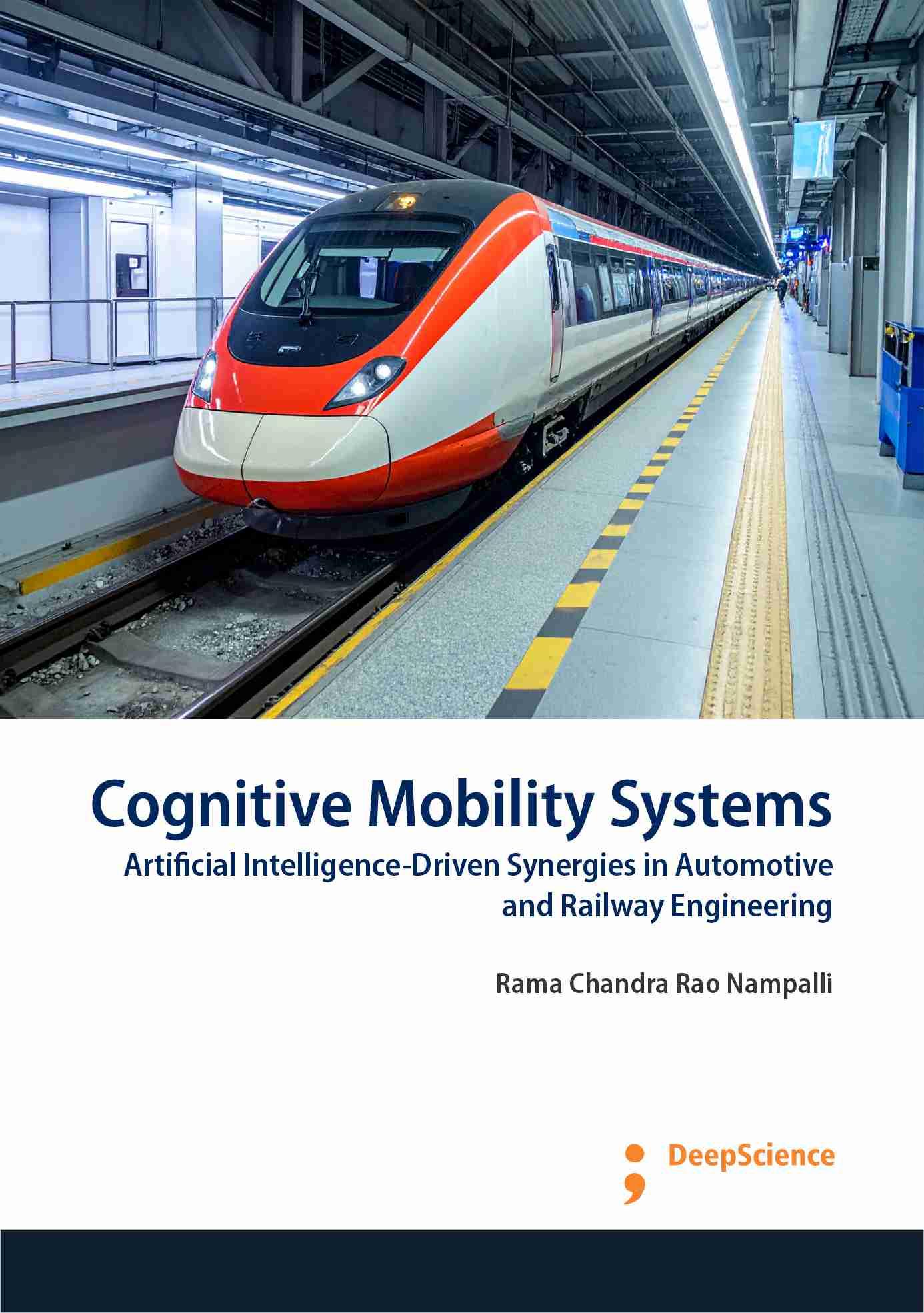
Nampalli, R. C. R. . (2025). Future Horizons: Towards Unified Intelligent Transportation Ecosystems. In Cognitive Mobility Systems: Artificial Intelligence-Driven Synergies in Automotive and Railway Engineering (pp. 182-196). Deep Science Publishing. https://doi.org/10.70593/978-93-7185-139-8_12
Download Citation






 WhatsApp +91 7977171947