

Cognitive Railways: The Role of AI in Signal Optimization and Safety
Synopsis
As cognitive railway concepts reshape various rail operations and support decision-making, communication, maintenance, and monitoring systems, signal systems represent a largely untouched area. The role of artificial intelligence in cognitive railways is less about developing completely autonomous systems that can act unsupervised and more about enabling better decisions by human and machine together. To what extent cognitive signalling systems can act autonomously is a matter of context, from enabling self-driving trains to assisting dispatchers with faster, safer, or more efficient decisions. The technologies to make signalling systems smarter and more efficient are already here. What is missing is the transformative thinking needed to grasp the opportunities they bring, fill the remaining gaps in safety and evidence, and ensure they are then correctly deployed along a journey.
The implications for research, policy, and practice go beyond signalling and their immediate field of application, namely railway traffic management, safety, and reliability – considered the backbone of the overall railway system that permits operating even under reduced data availability or uncertain operational conditions. Signal optimisation is uncharted territory for AI. Functions can be changed and moved, intelligent components introduced for new or improved feature extraction, fused sensor information made interpretable, and task-specific data quality addressed. Key questions centre around which traffic management or supervisory functions can be safely offloaded, what supervision and safety support and assurance measures must be taken, and whether these approaches can also close safety gaps.
Downloads
Pages
68-81
Published
15 November 2025
Copyright (c) 2025 Rama Chandra Rao Nampalli
How to Cite
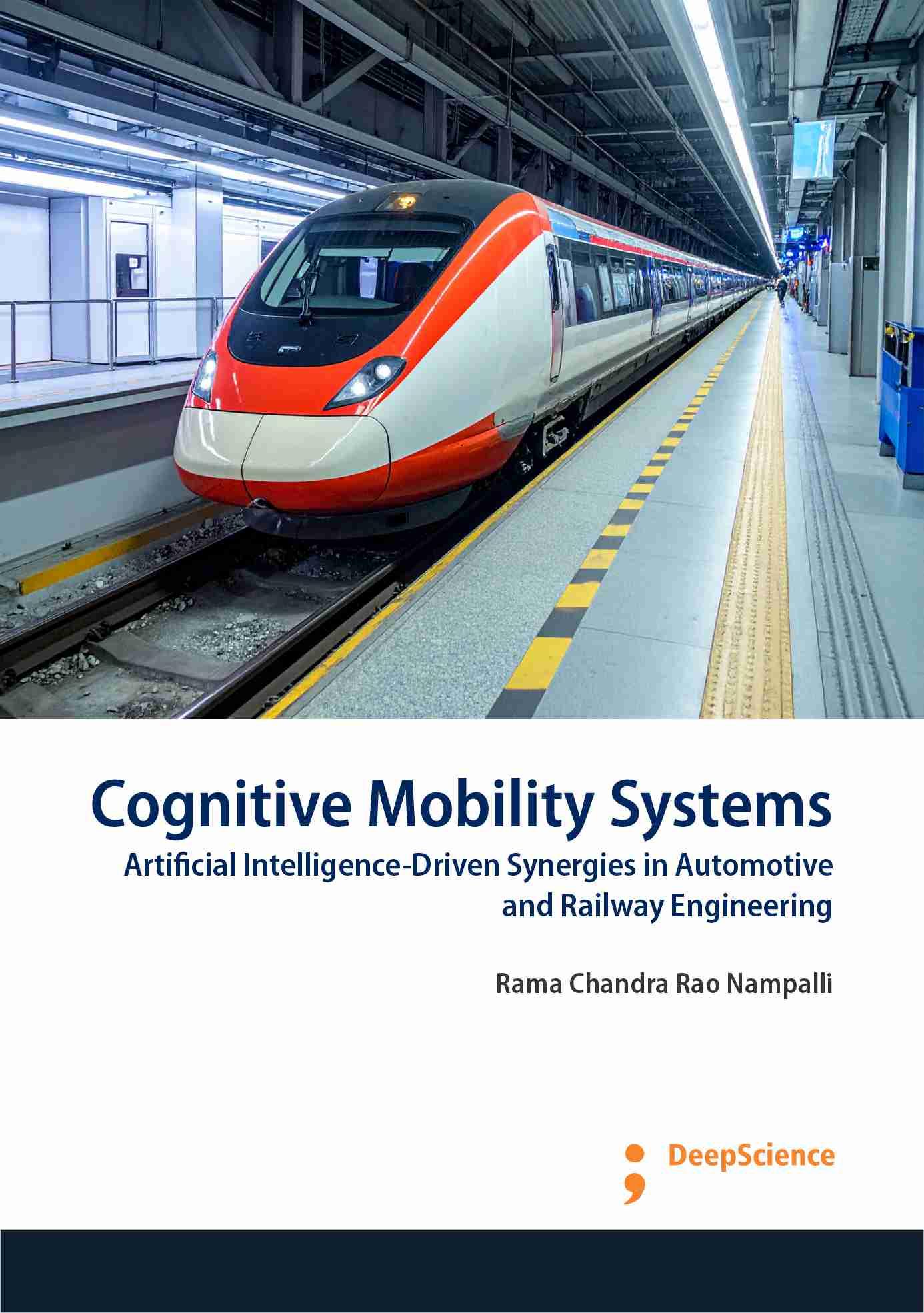
Nampalli, R. C. R. . (2025). Cognitive Railways: The Role of AI in Signal Optimization and Safety . In Cognitive Mobility Systems: Artificial Intelligence-Driven Synergies in Automotive and Railway Engineering (pp. 68-81). Deep Science Publishing. https://doi.org/10.70593/978-93-7185-139-8_5
Download Citation









 WhatsApp +91 7977171947