

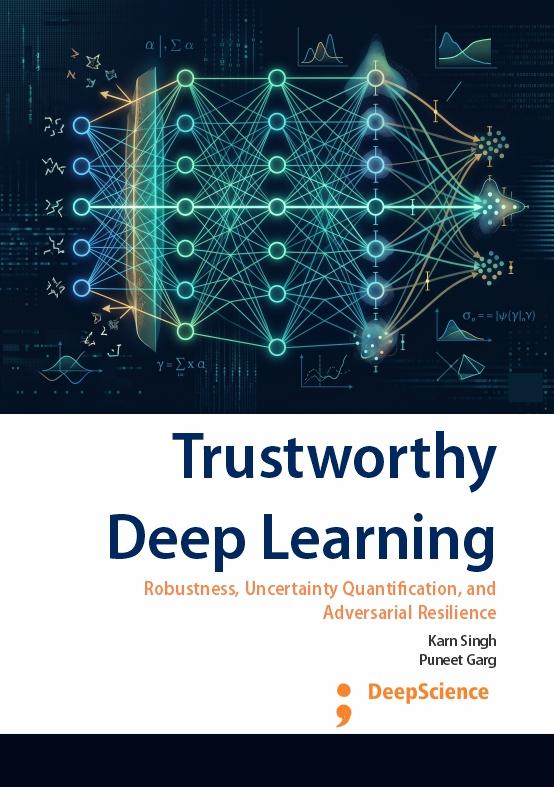
Trustworthy Deep Learning: Robustness, Uncertainty Quantification, and Adversarial Resilience
##plugins.pubIds.doi.readerDisplayName##
https://doi.org/10.70593/978-93-7185-510-5
Keywords:
Deep Learning, Robustness, Uncertainty, Adversarial Resilience, Neural Networks, Bayesian Neural Networks, Model CalibrationSynopsis
Deep learning has become one of the most vital infrastructures under study and entirely a subject of research not at a slow rate that will allow us to comprehend its failures. We apply neural networks to hospitals, financial markets, autonomous systems, and so on, but the culture of the field has traditionally been that benchmark accuracy is the most valued criterion. This book is a corrective. Credible AIs are based on three pillars that are interdependent. Robustness poses whether a model will continue to handle purely outside the regime of its training distribution. Uncertainty quantification inquires a question on whether a model knows which it does not know. Adversarial resilience. The question of adversarial resilience is whether a model can be resilient to its intended manipulation. Each of the challenges is severe in itself; the combination of all of them determines the difference between a model that is functional in the laboratory and one that is worth trusted in the real world.
The book is structured in this regard, having three parts, each of them representing the pillar, and a final section, the evaluation frameworks and open problems. The chapters are concluded by exercises as well as annotated literature pointers. The companion repository contains the code of the core examples. It presupposes the knowledge of the basics of deep learning among the readers. It does not need any specific experience in Bayesian statistics or adversarial machine learning. Graduate learners, those who work in the high-stakes fields, and researchers who seek to make cross-cutting in the three areas will all have something appropriate to them.
We are honest in our writing of what cannot and can be done by the current method. Strategies that seemed to be good have again and again been defeated by an adaptive attack; distributions that seemed to be estimated have been wrecked by distribution shift. Where evidence is great, we say so. Where it is amalgamated, we say that too. Instead of an optimistic map of the frontier an accurate map of the frontier is of better service to the reader. Deep learning has provided us with unprecedented abilities. There is work to do in order to get those capabilities dependable, truthful about their capabilities and inaccessible to abuse. Hopefully, this book is one of these steps.
Downloads
Published
13 April 2026
Copyright (c) 2026 Karn Singh, Puneet Garg
Details about the available publication format: E-Book
E-Book
ISBN-13 (15)
978-93-7185-510-5
Details about the available publication format: Book (Paperback)
Book (Paperback)
ISBN-13 (15)
978-93-7185-764-2
How to Cite
Singh, K. ., & Garg, P. . (2026). Trustworthy Deep Learning: Robustness, Uncertainty Quantification, and Adversarial Resilience. Deep Science Publishing. https://doi.org/10.70593/978-93-7185-510-5
Download Citation








 WhatsApp +91 7977171947