

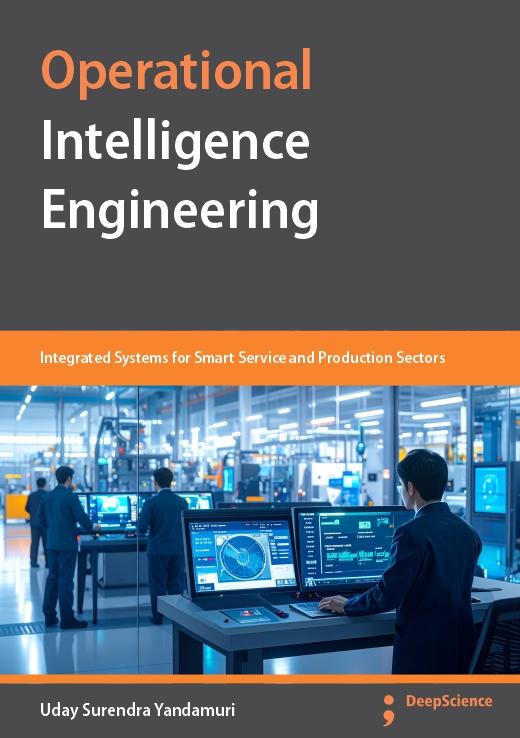
Operational Intelligence Engineering: Integrated Systems for Smart Service and Production Sectors
##plugins.pubIds.doi.readerDisplayName##
https://doi.org/10.70593/978-93-7185-114-5
Keywords:
Operational Resilience, Operational Support Systems, Scalable Analytics, Cloud Platforms, Machine Learning, Artificial Intelligence, Operational PlatformsSynopsis
Operational Intelligence Engineering stands at the intersection of data, systems thinking, and decision science transforming how organizations perceive, analyze, and act in real time. As industries navigate rapid digital transformation, the ability to convert operational data into actionable intelligence has become not merely advantageous, but essential. This book, Operational Intelligence Engineering: Integrated Systems for Smart Service and Production Sectors, is written to guide readers through the principles, architectures, and applications that enable intelligent, adaptive operations.
Across both service and production environments, modern enterprises face unprecedented complexity. Distributed supply chains, cyber-physical systems, IoT-enabled infrastructure, AI-driven analytics, and customer-centric service models demand integrated frameworks capable of continuous sensing, learning, and optimization. Operational intelligence engineering responds to this challenge by combining systems engineering, data analytics, automation, and strategic management into cohesive, scalable solutions.
This text presents a structured approach to designing and implementing intelligent operational ecosystems. It bridges theory and practice—linking foundational concepts such as real-time analytics, predictive modeling, digital twins, and process automation with practical applications in manufacturing, logistics, healthcare, energy, finance, and smart services. Emphasis is placed not only on technological integration but also on governance, resilience, cybersecurity, and ethical deployment.
Designed for engineers, researchers, practitioners, and graduate students, this book offers both conceptual clarity and implementation insight. Case studies, system architectures, and methodological frameworks provide readers with tools to engineer operational intelligence systems that are robust, adaptive, and value-driven.
Ultimately, this work envisions organizations that are not merely automated, but aware—capable of learning from data streams, anticipating disruptions, and continuously improving performance. By integrating intelligence into operations, we move toward smarter industries, sustainable production, and responsive service ecosystems prepared for the demands of an increasingly dynamic world.
This book is an invitation to engineers in the future.
Chapters
-
Foundations of Operational Intelligence Engineering
-
Architecture of Integrated Systems for Modern Industries
-
Data Engineering and Scalable Analytics Pipelines
-
Cloud Platforms for Intelligent Operational Systems
-
Machine Learning for Process Optimization
-
Predictive Modeling for Resource and Demand Management
-
Intelligent Decision Support in Service and Production Environments
-
Workflow Automation and Operational AIOps
-
Governance, Security, and Responsible System Design
-
Future Directions in Autonomous Operational Platforms
References
Amistapuram, K. (2025). Agentic AI for Next-Generation Insurance Platforms: Autonomous Decision-Making in Claims and Policy Servicing. Journal of Marketing & Social Research, 2, 88-103.
van der Aalst, W. M. P. (2021). Process mining: Data science in action (2nd ed.). Springer.
Nagabhyru, K. C., Rani, M., Reddy, D. S., & Krishnaraj, V. (2025, August). Machine Learning-Driven Fault Detection in Electric Vehicles via Hybrid Reinforcement Learning Model. In 2025 2nd International Conference on Intelligent Algorithms for Computational Intelligence Systems (IACIS) (pp. 1-6). IEEE.
Gama, J., Žliobaitė, I., Bifet, A., Pechenizkiy, M., & Bouchachia, A. (2020). A survey on concept drift adaptation. ACM Computing Surveys, 46(4), 44..
Sutton, R. S., & Barto, A. G. (2020). Reinforcement learning: An introduction (2nd ed.). MIT Press.
Downloads
Published
13 February 2026
Copyright (c) 2026 Uday Surendra Yandamuri
Details about the available publication format: E-Book
E-Book
ISBN-13 (15)
978-93-7185-114-5
Details about the available publication format: Book (Paperback)
Book (Paperback)
ISBN-13 (15)
978-93-7185-210-4
How to Cite
Yandamuri, U. S. . (2026). Operational Intelligence Engineering: Integrated Systems for Smart Service and Production Sectors. Deep Science Publishing. https://doi.org/10.70593/978-93-7185-114-5
Download Citation









 WhatsApp +91 7977171947