

Cloud Platforms for Intelligent Operational Systems
Synopsis
The importance of advancing intelligence into operational systems—such as intelligent transportation, smart energy, and intelligent supply chain systems—cannot be overstated. Such systems manage demanding physical processes for real-time operations, yet their intelligence has typically been limited to business systems that operate in time frames of seconds to days. Intelligent Operational Systems aim to combine event-driven, real-time data processing with external AI and machine learning for high-frequency, real-time decisions and high-sensitivity supervised learning. To date, the concept has largely been explored using on-premises, private-cloud infrastructure. The analysis here focuses on Cloud Platforms for Intelligent Operational Systems, with an emphasis on definitions, architectural patterns, supporting cloud platform paradigms, enabling data provisioning and processing, cloud support for AI and ML, and key components of reliability, scalability, and availability.
The term cloud provides strong intuitive guidance about what is possible from a cloud platform. That is, the service abstraction of Infrastructure as a Service (IaaS) enables the hosting of compute and storage resources in the cloud, which can then be capitalized, instrumented, and scaled to improve developer productivity and reliability. When resources are hosted on IaaS, the Cloud provider is responsible for deploying, managing, and operating the software packages. Platform as a Service (PaaS) provides an even more compelling operational product abstraction with benefits from both Execution as a Service (EaaS) and Software as a Service (SaaS)—lower operational costs and reduced software management overhead.
Downloads
Volume
Pages
49-64
Published
13 February 2026
Copyright (c) 2026 Uday Surendra Yandamuri
How to Cite
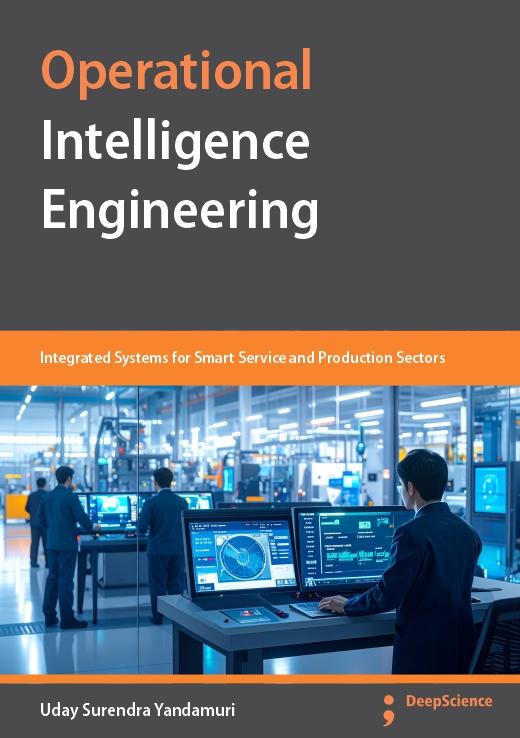
Yandamuri, U. S. . (2026). Cloud Platforms for Intelligent Operational Systems. In Operational Intelligence Engineering: Integrated Systems for Smart Service and Production Sectors (pp. 49-64). Deep Science Publishing. https://doi.org/10.70593/978-93-7185-114-5_4
Download Citation







 WhatsApp +91 7977171947