

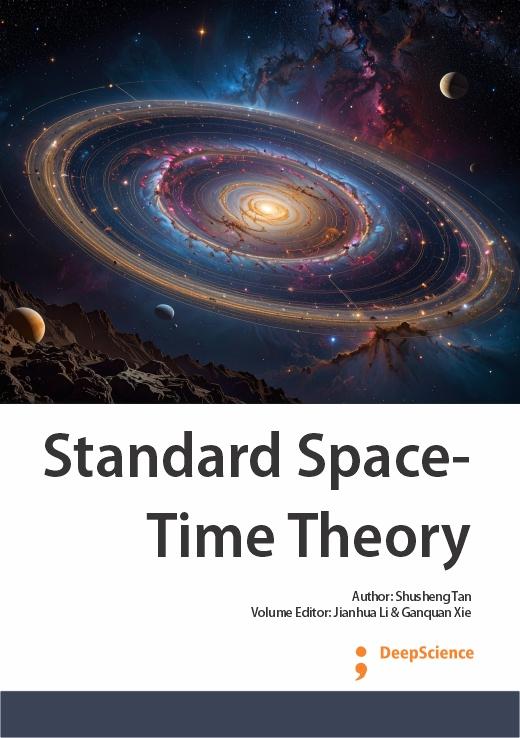
Standard Space-Time Theory
##plugins.pubIds.doi.readerDisplayName##
https://doi.org/10.70593/978-93-7185-338-5
Keywords:
Space-Time Theory, Absolute Reference Frame, Generalized Galilean Transformation (GGT), Relativistic Kinematics, Relativistic Dynamics, Quantum Nonlocality, Superluminal PhenomenaSynopsis
Natural scattering is visible by light with positive frequency. No natural scattering is invisible by light with positive frequency. Visible natural sciences and invisible social and ideological sciences are called ordinary sciences. Invisible natural sciences and visible social and ideological sciences are novel super sciences. Main Contents include 1. Positive Space and Negative Space and Invisible Science; 2, Isotropic electromagnetic invisible GLHUA sphere; 3, Anisotropic electromagnetic invisible GLHUA cloak etc. 12 chapters. Standard Space - time theory is one new theory of Super Science. Einstein was a great genius. His special theory of relativity has become one of the two main foundations of modern physics. The special theory of relativity fully reveals the relativity of the motion of matter which is not revealed by Newtonian’s Mechanics, that is, the dependence of the space-time property of matter on the motion of matter. It explained many experimental facts that could not be explained by classical physics, and included the knowledge that physics has actually reached at the turn of the 19th and 20th centuries in his theoretical system and its understanding, so it has opened up the way for physics research. Einstein’s work has done outstanding contributions to help shape the world in which we live today. In 1999, the American weekly Time named him “The Great Man of the Century”, Einstein became the symbol of the highest human wisdom of the 20th century. Nevertheless, science always moves forward and never stays at the same level. In the last half century, especially in the past 30 years, theoretical thinking and experimental tests have revealed the difficulties and challenges of the special theory of relativity. Bohm (He was an acknowledged world authority on quantum mechanics) said: “I don’t think anybody can necessarily expect everything to turn out the way he expects it. Quite a few things turned out that way for Einstein, but he can’t have everything right!” [1] The discovery of cosmic background radiation confirms the existence of the absolute inertial reference frame. An experimental test of Bell’s inequality found that “Einstein was wrong!” There is no doubt that there is a superluminal causal connection or influence between two entangled particles. It can be asserted that the non-locality must be an important feature of the microcosm. This opens up the way for the gestation, development and establishment of the new theory.
References
W. F. Edwards, special theory of relativity in anisotropic space, Am. J. Phys., 1963,31:482~489.
J. A. Winne, Phil. Sci., 1970, 37: 81~99; 37: 223~238
A. Einstein, On Special and General Relativity, Shanghai: Science and Technology Press, 1964, P. 19. (In Chinese)
Newton, Mathematical Principles of Natural Philosophy, University of California Press. 1934, page
7~12.
M. Schlick, Philosopher Mach. Communication of natural syndrome differentiation, 1988, 10 (1): 16~18.
Tan Shusheng, Meditation on Modern Materialism Philosophy. Changsha: Hunan Education Press, 2017. Chap.7. (In Chinese)
A. Einstein, Einstein’s works. Volume I. Beijing: Commercial Press, 1977, P455, 292, 438, 598. (In Chinese)
Fokker B., Theory of Space, Time and Gravity, Beijing: Science Press, 1965, P.228; 19~20.(In Chinese)
A. Einstein, The significance of relativity, Li haoze, Beijing: Science Press, 1966, P. 16. (In Chinese)
Fokker B., Theory of Space, Time and Gravity, Beijing: Science Press, 1965, 231~232. (In Chinese)
S. Weinberg, Gravitation and Cosmology, Beijing: Science Press, 1980, 102~104. (In Chinese)
P. A. M. Dirac, Why Do We Believe in Einstein’s Theory, Problems in philosophy of natural science, 1983 (3): 13
Downloads
Published
6 December 2025
Copyright (c) 2025 Shusheng Tan; Jianhua Li, Ganquan Xie
Details about the available publication format: E-Book
E-Book
ISBN-13 (15)
978-93-7185-338-5
Details about the available publication format: Book (Paperback)
Book (Paperback)
ISBN-13 (15)
978-93-7185-128-2
How to Cite
Tan, S. . (2025). Standard Space-Time Theory. Deep Science Publishing. https://doi.org/10.70593/978-93-7185-338-5
Download Citation







 WhatsApp +91 7977171947