

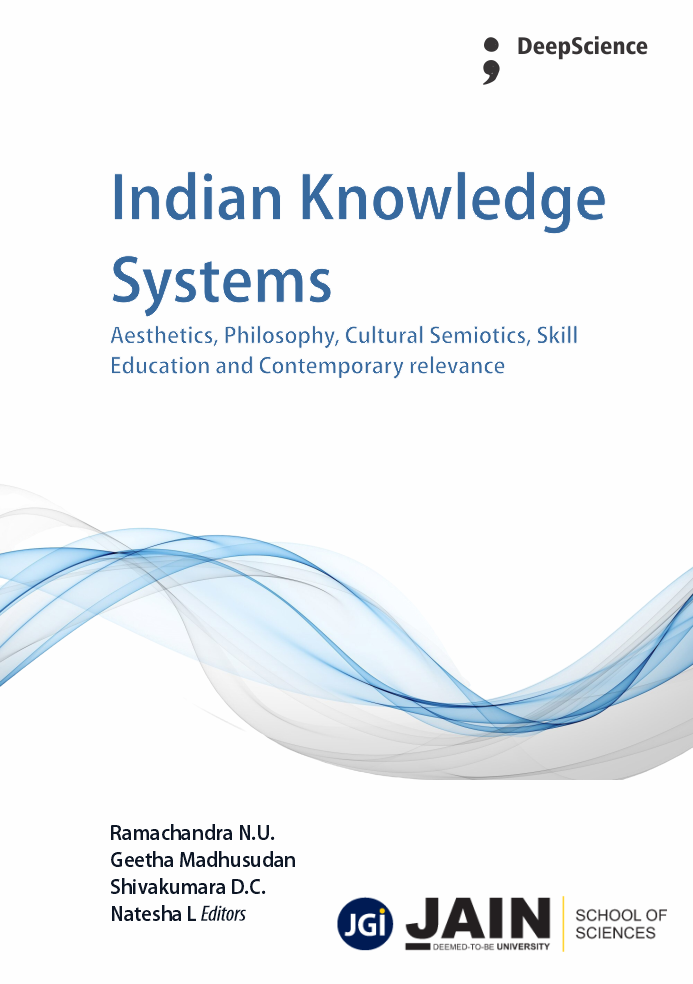
Indian Knowledge System: Aesthetics, Philosophy, Cultural Semiotics , Skill Education and Contemporary Relevance
##plugins.pubIds.doi.readerDisplayName##
https://doi.org/10.70593/978-93-7185-779-6
Keywords:
Indian Aesthetics, Rasa Theory, Embodied Cognition, Cultural Translation, Design Pedagogy, Nanobiotechnology, AyurvedaSynopsis
‘रसो वै सः’ - That is rasa where the work and place encounters divine presence, tradition encounters creativity, and investigation confronts marvel.
The Indian Aesthetics is not just a philosophy of life. It is into an intrinsic philosophy of beauty, wisdom, ethics and science. Under this type of an educational system, students, who learn the chemistry of Kalamkari, the structure logic of Vastusastra are not only unravelling a history; they are demonstrating the applicability and topicality of our forebears to the contemporary society that lives under siege because of various issues that may be wellness, development, communication or education. The traditional wisdom of the indigenous Indian Knowledge System (IKS), particularly the holistic skill taxonomy namely 64 Kalas (Chatushasti Kalā) with contemporary national policy instruments: The National Skills Qualifications Framework (NSQF), the National Credit Framework (NCrF) and the like accross global academia emphasise on skills, offering a holistic development approach of gaining it, which is related quite well with the competency-based learning. This is an attempt to explore and promote such application skill based knowledge through IKS to mould global citizens.
Chapters
-
Indian Knowledge Systems and the 64 Kalas view for Sustainable Skill Ecosystems: A Policy Analysis and Statistical Assessment of NSQF-NCrF Alignment with Outcome-Based Education
-
From Dhanurveda to Dharma-Rajya: Indigenous Military Philosophy in Baahubali
-
Ghoomar: A Rajasthani Folk Art as an Expression of Indian Aesthetic Philosophy
-
Remediating the Sacred: Building of Collective Spiritual Memory in the Digital World
-
Aesthetics of Fractal Patterns in Kandariya Mahadev Temple
-
Rasa Siddhānta Approach of Literary Techniques, Psychological Resonance and the Aesthetics of Experience in the Short Fiction of Setusali Vasumati Udupa and Sunanda Prakash Kadame
-
The Artistic and Architectural Marvels of Ajanta and Ellora Caves: A Scholarly Review
-
The Psychology of Rasa: Understanding Emotional Responses to Art and Performance
-
Bharata’s Beauty Today: Translating Classical Indian Aesthetics and its Modern Applications
-
Ayurvedic Formulations as Templates for Nanobiotechnology in Drug Delivery
-
From Shakti to Genome: An Advaitic Exploration of Consciousness, and the Aesthetics of Bioscience.
-
The Science Behind Kalamkari Art: “Traditional Art and Modern Chemistry
-
The Evolution of Indian Aesthetic Thought from Vedic to Classical Periods
-
Traditional Indian Folk Theatre: Yakshagana
-
Sanskrit Village in India
-
Integrating Ayurveda and Modern Nutrition: A Review on the Health Benefits of the South Indian Diet
References
Mahanta, V. S. (2019). Traditional methods of food habits and dietary preparations in Ayurveda—the Indian system of medicine. Journal of Pharmacognosy and Phytochemistry, 8(4), 1378-1383.
Patil, N. G., & Acharya, R. (2015). Exploring Ayurvedic knowledge on food and health for providing innovative solutions to contemporary healthcare. Journal of Traditional and Complementary Medicine, 5(4), 233-241.
Saroj, B. K., Mishra, D. S., & Kumar, B. (2024). Concept of Agni and Its Importance in Ayurveda: A Review. Quest Journals Journal of Research in Pharmacy and Science, 10(5), 01-06.
Sreedhar, M. L., & Shailaja, U. K. (2015). Ayurvedic Concept of Food and Nutrition. The International Journal of Ayurveda and Allied Sciences, 2(2), 107-111.
Anderson, J. W. et al. (2009). Health benefits of dietary fiber. Nutrition Reviews, 67(4), 188–205.
Basch, E. et al. (2003). Therapeutic applications of fenugreek. Alternative Medicine Review, 8(1), 20–27.
Day, L., & Swanson, B. G. (2013). Functionality of protein–starch combinations in foods. Food Reviews International, 29(3), 253–270.
Downloads
Published
18 November 2025
Copyright (c) 2025 Ramachandra N U; Asmita Kulkarni, Hima S, Ganesh Rajput, Shruti Sneha, Priyanshu Gowda B, A.N. DeepaShree, Nagul Yogendra S.J, Sweta M , Rakshitha Chaithra V, Deepthi B.C., Charan R, Rakesh M, Rehana Khan; Geetha Madhusudan, Shivakumara D. C. , Natesha L; Trivedi Nikunj P, Aishwarya J.S, Rakhi K. Shah, Sathish Kumar H, Kamda Singh Deo , Davasam Sanjana, Punith K B, Pruthvishree M, Yashaswini
Details about the available publication format: E-Book
E-Book
ISBN-13 (15)
978-93-7185-779-6
Details about the available publication format: Book (Paperback)
Book (Paperback)
ISBN-13 (15)
978-93-7185-709-3
How to Cite
N U, R., Geetha Madhusudan, Shivakumara D. C., & Natesha L (Eds.). (2025). Indian Knowledge System: Aesthetics, Philosophy, Cultural Semiotics , Skill Education and Contemporary Relevance. Deep Science Publishing. https://doi.org/10.70593/978-93-7185-779-6
Download Citation






 WhatsApp +91 7977171947