

From Dhanurveda to Dharma-Rajya: Indigenous Military Philosophy in Baahubali
Synopsis
S. S. Rajamouli’s Baahubali: The Beginning (2015) and Baahubali: The Conclusion (2017) have been frequently praised on their splendid visual fantasy and mythical world-making. Nevertheless, the reason behind their grand combats and heroic drama is an advanced interaction with the native Indian knowledge systems - at least of warcraft (Dhanurveda), statecraft (Arthashastra), warrior morale (Kshatra-dharma) and the state of a moral (Dharma-rajya). The films not only form Mahishmati as an imaginary realm but also as a civilizational place where war is perceived as an ethical obligation, where the kingship is embedded with moral power and where victory was justified not by their (military) victory but by the reinforcing of the social justice.
This essay analyses the ways in which Baahubali movies translate and remake the indigenous militaryphilosophies on screen using the textual traditions of the Mahabharata, Ramayana, Dhanurveda, and Arthashastra of Kautilya. The films are dramatizing an ancient political controversy: Is might right because it is strong that it is ethical that orders its rule? through the opposition of the two characters, Amarendra Baahubali and Bhallaladeva.
Downloads
Pages
13-16
Published
18 November 2025
Copyright (c) 2025 Ramachandra N U; Asmita Kulkarni, Hima S, Ganesh Rajput, Shruti Sneha, Priyanshu Gowda B, A.N. DeepaShree, Nagul Yogendra S.J, Sweta M , Rakshitha Chaithra V, Deepthi B.C., Charan R, Rakesh M, Rehana Khan; Geetha Madhusudan, Shivakumara D. C. , Natesha L; Trivedi Nikunj P, Aishwarya J.S, Rakhi K. Shah, Sathish Kumar H, Kamda Singh Deo , Davasam Sanjana, Punith K B, Pruthvishree M, Yashaswini
How to Cite
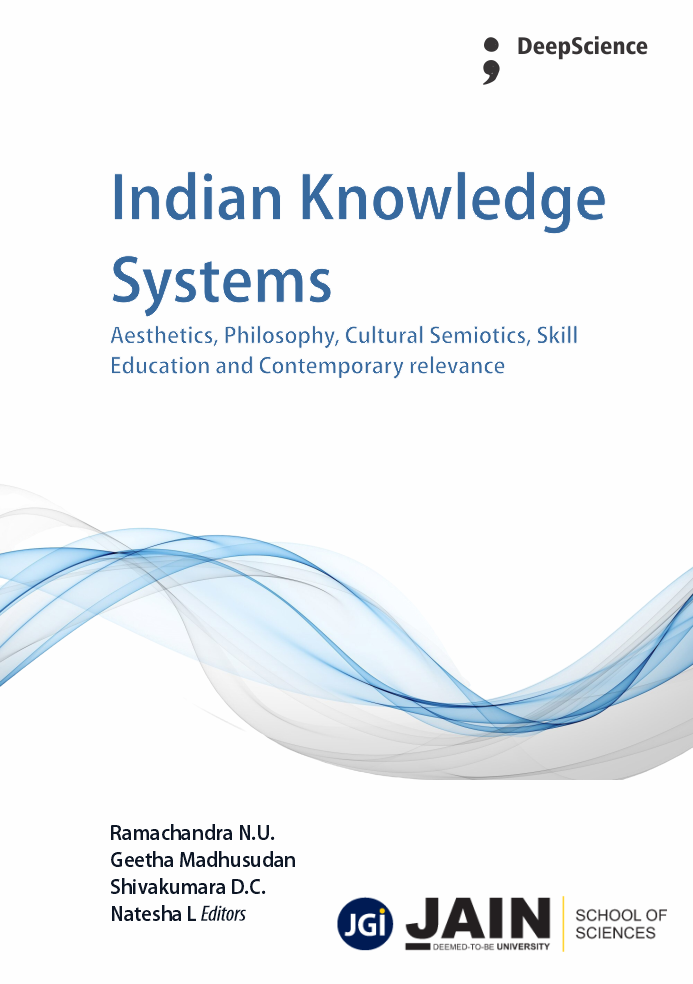
Trivedi Nikunj P, & Aishwarya J.S. (2025). From Dhanurveda to Dharma-Rajya: Indigenous Military Philosophy in Baahubali. In R. N U, Geetha Madhusudan, Shivakumara D. C., & Natesha L (Eds.), Indian Knowledge System: Aesthetics, Philosophy, Cultural Semiotics , Skill Education and Contemporary Relevance (pp. 13-16). Deep Science Publishing. https://doi.org/10.70593/978-93-7185-779-6_2
Download Citation







 WhatsApp +91 7977171947