

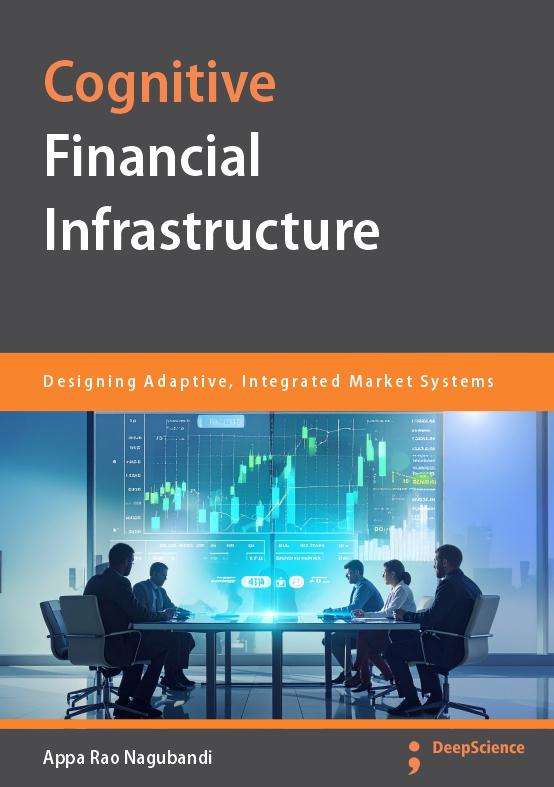
Cognitive Financial Infrastructure: Designing Adaptive, Integrated Market Systems
##plugins.pubIds.doi.readerDisplayName##
https://doi.org/10.70593/978-93-7185-062-9
Keywords:
Financial Infrastructure, Market Platforms, Risk Modeling, Financial Systems, Artificial Intelligence, Finance, Adaptive Financial SystemsSynopsis
Markets were once places. Then they became systems. Now, they are becoming organisms. For centuries, financial infrastructure evolved in layers, exchanges, clearinghouses, banks, regulators, each solving a problem of coordination, trust, and scale. These systems were designed for a world where information moved slowly, decisions were periodic, and risk could be measured after the fact. That world no longer exists. Today’s markets operate in a state of continuous awareness. Data flows in real time. Signals emerge from behavior, networks, and machines as much as from human intent. Capital no longer travels alone; it moves with metadata, constraints, identity, and embedded logic. Financial infrastructure is no longer just plumbing. It is cognition at scale.
This book explores the rise of cognitive financial infrastructure, systems that do not simply process transactions but interpret environments, adapt to change, and coordinate action across institutions, platforms, and jurisdictions. These infrastructures sense volatility before it becomes crisis, allocate liquidity dynamically, enforce policy through code, and learn from systemic feedback. But intelligence in markets is not only technical. It is structural. When infrastructures become adaptive, the boundaries between market participants, intermediaries, and regulators begin to blur. Governance shifts from static rulebooks to dynamic frameworks. Stability emerges not from rigidity, but from responsiveness. The challenge is not whether markets will become intelligent, they already are. The question is how we design that intelligence: who shapes it, what values it encodes, and how power is distributed within it.
This book is a guide to understanding, building, and governing the next generation of market systems, integrated, adaptive, and aware.
Chapters
-
Foundations of Cognitive Financial Infrastructure
-
Architecture of Integrated Market Platforms
-
Data Engineering for Real-Time Financial Intelligence
-
Adaptive System Design for Dynamic Market Environments
-
Intelligent Risk Modeling and Decision Frameworks
-
Workflow Orchestration Across Financial Operations
-
Secure, Resilient, and Compliant Platform Engineering
-
Operational Intelligence and Continuous Optimization
-
Governance, Transparency, and Trust in Intelligent Financial Systems
-
Future Directions in Autonomous Market Infrastructure
References
Stonebraker, M., & Hellerstein, J. M. (2018). What goes around comes around. IEEE Data Engineering Bulletin, 41(2), 3–12.
Gama, J., Žliobaitė, I., Bifet, A., Pechenizkiy, M., & Bouchachia, A. (2020). A survey on concept drift adaptation. ACM Computing Surveys, 46(4), 44.
Ransbotham, S., Kiron, D., Gerbert, P., & Reeves, M. (2020). Reshaping business with artificial intelligence. MIT Sloan Management Review, 61(4), 1–17.
Varian, H. R. (2019). Artificial intelligence, economics, and industrial organization. In A. Agrawal, J. Gans, & A. Goldfarb (Eds.), The economics of artificial intelligence: An agenda (pp. 399–419). University of Chicago Press
Brynjolfsson, E., Rock, D., & Syverson, C. (2021). The productivity J-curve. American Economic Journal: Macroeconomics, 13(1), 333–372.
Chen, H., Chiang, R. H. L., & Storey, V. C. (2012). Business intelligence and analytics. MIS Quarterly, 36(4), 1165–1188.
Downloads
Published
12 February 2026
Copyright (c) 2026 Appa Rao Nagubandi
Details about the available publication format: E-Book
E-Book
ISBN-13 (15)
978-93-7185-062-9
Details about the available publication format: Book (Paperback)
Book (Paperback)
ISBN-13 (15)
978-93-7185-871-7
How to Cite
Nagubandi, A. R. . (2026). Cognitive Financial Infrastructure: Designing Adaptive, Integrated Market Systems. Deep Science Publishing. https://doi.org/10.70593/978-93-7185-062-9
Download Citation









 WhatsApp +91 7977171947