

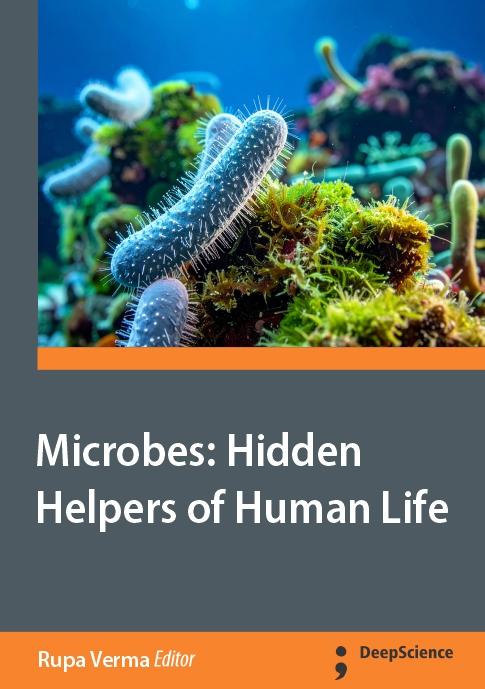
Microbes: Hidden Helpers of Human Life
##plugins.pubIds.doi.readerDisplayName##
https://doi.org/10.70593/978-93-7185-482-5
Keywords:
Microbes, Gut Microbiota, Microorganisms, Biodegradation, Microbiome, MedicineSynopsis
Some of the strongest allies are the invisible ones in the world of nature and its enormous complicity. Microbes - small living beings that cannot be seen with the naked eye have silently determined the health, industry and the environment of a man throughout centuries. Nevertheless, the efforts made by them are always in the shadow because they are regarded as disease causing agents. This book, the Microbes: Hidden Helpers of Human Life attempts to give light to the astonishing part of the microscopic companions in our day to day lives.
In the human body, gut microbes create a prolific ecosystem which affects the mechanisms of digestion, immunity and even psycho-emotional health. They are silent builders of health and convert food into energy and save us against the bad designers. In addition to the body, biodegradable microbes are the recyclers of nature and they take apart waste materials and other pollutants in order to bring about balance back to the ecosystems. They remind us of the fact that sustainability starts at a microscopic level where life is renewed by death and regeneration.
No less interesting are the microbes that are used in our kitchens and bakeries to enrich them. Through the ingenuity of human beings, yeasts and bacteria are used to transform simple substances to bread, cheese and fermented dainties. They craft their art in the chemistry of taste, feel and food, transforming the simple meals into traditions and activities of their cultural experience.
It is an adventure into the unknown microorganized world, not in the form of danger, but of assistance. Delaying into their many different uses in human health, environmental sustainability and food production we find out a truth of humbling and inspirational importance; without them, in one form or other, life as we know it would not be possible.
Hopefully, these Chapters of the Book prompt the readers to realize that microbes are an important part of biology, who are critical to human survival and development.
Chapters
-
Gut Microbiota in Anxiety and Depression
-
Vanillin production from microorganisms
-
Biodegradation for Future Sustainability
-
Augmenting Polythene Degradation Potential in Bacteria Using Physical Mutagens
-
Microbes in the Gut of Human - Exploring the gut microbes in human health and diseases
-
The Human Gut Microbiome: A window into wellness
-
Microbes in Medicine: Exploring the Beneficial Roles of Microorganisms in Healthcare
-
Microbes in Bakery: Their Role, Benefits, and Risks
References
D'Andrea, Alessandro. Structure theory of finite conformal algebras. Diss. Massachusetts Institute of Technology, 1998.
Habets, Florence, et al. "Impact of climate change on the hydrogeology of two basins in northern France." Climatic change 121 (2013): 771-785.
Borgdorff, Piet, and Geert Jan Tangelder. "Migraine: Possible role of shear‐induced platelet aggregation with serotonin release." Headache: The Journal of Head and Face Pain 52.8 (2012): 1298-1318.
Powell, David R., et al. "Diacylglycerol lipase α knockout mice demonstrate metabolic and behavioral phenotypes similar to those of cannabinoid receptor 1 knockout mice." Frontiers in Endocrinology 6 (2015): 86.
Abraha, Iosief, et al. "Efficacy of non-pharmacological interventions to prevent and treat delirium in older patients: a systematic overview. The SENATOR project ONTOP series." PloS one 10.6 (2015): e0123090.
Foster, Jane A., and Karen-Anne McVey Neufeld. "Gut–brain axis: how the microbiome influences anxiety and depression." Trends in neurosciences 36.5 (2013): 305-312.
Everett, D., et al. "Role of bulk viscosity in deuteron production in ultrarelativistic nuclear collisions." Physical Review C 106.6 (2022): 064901.
Downloads
Published
13 December 2025
Copyright (c) 2025 Rupa Verma; Anjali Kumari, Makhdum Alam, Roshni Sharma, Washim Firdousi, Pinky Raj Sahu, Ladly Rani, Shiwangi Sinha, Nibha Kujur, Shashwati Gosh Sachan, Abhijit Dutta, Ahmad Hussain, Kriti Kumari Lal, Sakshi Gupta
Details about the available publication format: E-Book
E-Book
ISBN-13 (15)
978-93-7185-482-5
Details about the available publication format: Book (Paperback)
Book (Paperback)
ISBN-13 (15)
978-93-7185-258-6
How to Cite
Verma, R. (Ed.). (2025). Microbes: Hidden Helpers of Human Life. Deep Science Publishing. https://doi.org/10.70593/978-93-7185-482-5
Download Citation







 WhatsApp +91 7977171947