

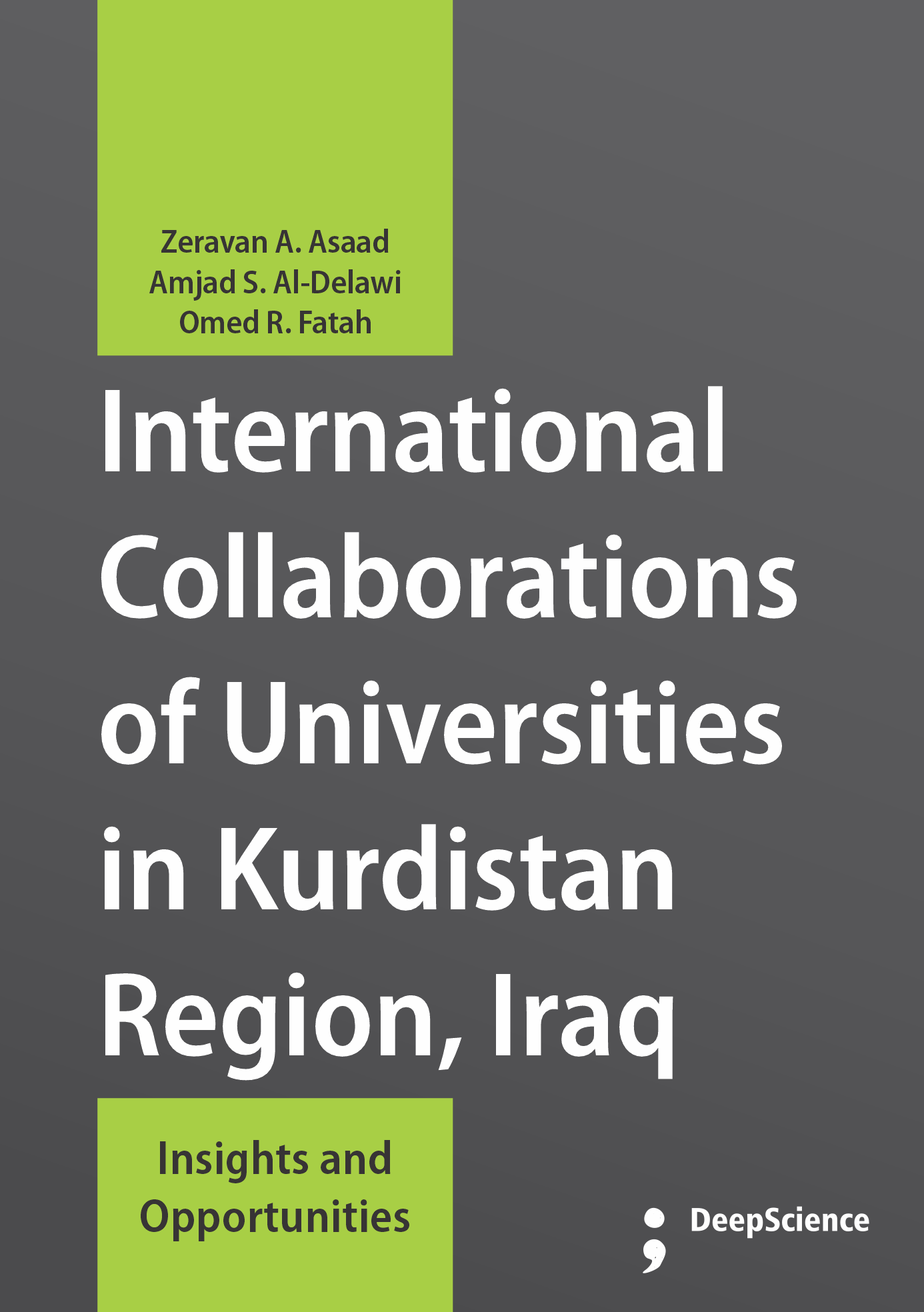
International Collaborations of Universities in Kurdistan Region, Iraq: Insights and Opportunities
##plugins.pubIds.doi.readerDisplayName##
https://doi.org/10.70593/978-93-7185-492-4
Keywords:
Scopus Database, Scientific Research, Education, Higher Education , Research Methodology, International CollaborationsSynopsis
The book helps to fill a serious gap in the literature by categorically examining the aspects of scientific collaboration and research performance within the framework of the Kurdistan Region of Iraq by providing an analysis of scientific collaboration and research performance among the private universities. Using the information provided in the Scopus database, it analyses the research productivity, visibility, efficiency and patterns of collaboration both nationally, regionally and internationally, with comparative reflection on the countries on the periphery. The dataset consists of Scopus-indexed articles associated with 13 privately-owned universities, and has the date of the first publication in 2009 up to December 2024. The data were collected by hand in April-May 2025 to guarantee accuracy and consistency of the institutions. One of the quantitative methods of analysis is the use of bibliometric indicators such as the total documents, number of citations per document, h-index, productivity index, the efficiency ratio, and the measures of the international collaboration. The analysis shows that the research output has grown significantly since the introduction of the National University Ranking (NUR) Project in 2015, and the publication volume has grown over three times in 2 years. Nevertheless, scientific collaboration continues to be largely limited to the major institutions of higher learning where there is an insignificant participation of industry, government agencies, and foreign partners. In addition, collaboration patterns are similar between the private universities and the public institutions, and the participation of local researchers is constrained and collaborative networks are not diversified. Although the number of publications in the case of the private universities is lower compared to the public universities, the research impact and efficiency are relatively higher in the former as shown in terms of citation measures. The paper highlights how vital strategic policy interventions are to ensure international cooperation, build better university-industry-government connections, and improve research capacity development. The findings can be helpful to policy makers, university administrators and other stakeholders to design specific initiatives to enhance the quality of research, internationalization, and sustainable scientific cooperation in the higher education system in the Kurdistan Region.
References
Aref S, Friggens D, Hendy S. Analysing scientific collaborations of New Zealand institutions using Scopus bibliometric data. In: ACM International Conference Proceeding Series. Association for Computing Machinery; 2018. doi:10.1145/3167918.3167920
Montoya FG, Alcayde A, Baños R, Manzano-Agugliaro F. A fast method for identifying worldwide scientific collaborations using the Scopus database. Telematics and Informatics. 2018 Apr 1;35(1):168–85. doi:10.1016/j.tele.2017.10.010
Royal Society. Knowledge, networks and nations : global scientific collaboration in the 21st century. London: Royal Society Science Policy Centre; 2011.
Farias Borges LF, Fischer B, Mazoni A, Bascur JP. The complex interplay between international collaboration and scientific impact: evidence from the Scopus database. Cogent Education. 2025;12(1). doi:10.1080/2331186X.2025.2563708
Freitas JL, Rosas FS. Scientific Collaboration at National Institute of the Atlantic Forest (Brazil) on Scopus Database: Analysis of Institutional Domain. Front Res Metr Anal. 2020;5. doi:10.3389/frma.2020.601442
Downloads
Published
27 March 2026
Copyright (c) 2026 Zeravan A. Asaad, Amjad S. Al-Delawi, Omed R. Fatah
Details about the available publication format: E-Book
E-Book
ISBN-13 (15)
978-93-7185-492-4
Details about the available publication format: Book (Paperback)
Book (Paperback)
ISBN-13 (15)
978-93-7185-950-9
How to Cite
Asaad, Z. A. ., Al-Delawi, A. S. ., & Fatah, O. R. . (2026). International Collaborations of Universities in Kurdistan Region, Iraq: Insights and Opportunities. Deep Science Publishing. https://doi.org/10.70593/978-93-7185-492-4
Download Citation





 WhatsApp +91 7977171947