

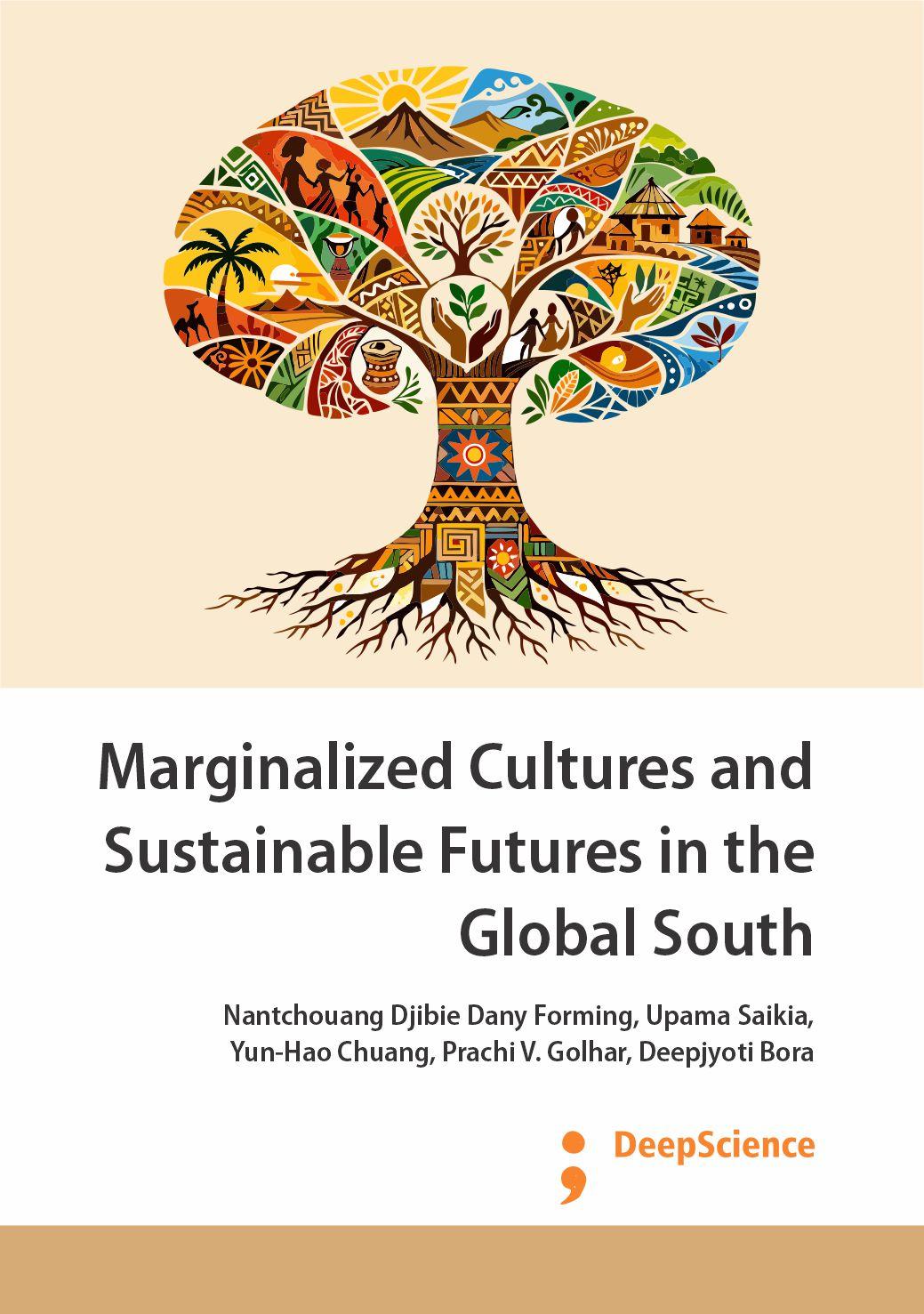
Marginalized Cultures and Sustainable Futures in the Global South
##plugins.pubIds.doi.readerDisplayName##
https://doi.org/10.70593/978-93-7185-208-1
Keywords:
Marginalized Cultures, Sustainable Development, Social Exclusion, Migration, Environmental Sustainability, Social Justice, Inclusive GovernanceSynopsis
The interdisciplinary edited volume Marginalized Cultures and Sustainable Futures in the Global South investigates how different Global South regions experience the interplay between sustainable development and their respective marginalization and cultural identity. The book assembles academic papers which investigate how historically marginalized groups use their colonial heritage and existing social and political barriers to fight for dignity and recognition and sustainable development.
The volume conducts a critical examination of various themes which include migration and repatriation and caste and ethnic marginality and social exclusion and environmental sustainability and cultural resilience and grassroots resistance. Through their theoretical analysis and empirical study and case-based discussion the chapters present evidence of how marginalized groups experience different structural inequality systems in various socio-political environments. The book demonstrates that marginalization affects people through economic factors and deep cultural and social and symbolic elements which determine their identity development and sense of belonging and ability to access chances.
This volume centralizes agency and resilience as its core essential elements. The book demonstrates how marginalized communities actively participate in creating sustainable development pathways through their adaptive processes and local knowledge systems and daily acts of resistance. The study demonstrates how inclusive governance and participatory development and culturally sensitive policy frameworks work together to achieve sustainability and solve inequality problems.
The book presents a comprehensive understanding of sustainability through its analysis of social justice and cultural diversity from multiple academic fields including sociology and political science and geography and environmental studies and literary analysis. The study demonstrates that Global South nations need their marginalized populations to participate in decision-making channels together with their economic and environmental growth needs to achieve sustainable development.
The volume targets researchers and students and policymakers and practitioners who study development studies and social justice and cultural studies and sustainability. The research enables academic and policy debates to progress because it shows how marginalized communities experience their daily lives and how these communities can achieve sustainable development through equitable solutions.
References
Wesumperuma D. Indian immigrant plantation workers in Sri Lanka: a historical perspective, 1880–1910. Kelaniya (Sri Lanka): Vidyalankara Press; 1986. p. 22.
Phadnis U, Kumar L. The Sirimavo–Shastri Pact of 1964: problems and prospects of implementation. India Q. 1975;31(3):249–269.
Department of Census and Statistics (Sri Lanka). Colombo: Department of Census and Statistics
Palanithurai G, Mohanasundaram P. Dynamics of Tamil Nadu politics in Sri Lankan ethnicity. Madras: Northern Book Centre; 1993.
The Agreement on the legal status of persons of Indian origin in Ceylon (APIOC). Ceylon; 1964
Government of India. Statement by Shri R.L. Bhatia, Minister of State, Ministry of External Affairs, Rajya Sabha; 3 May 1995.
Downloads
Published
9 January 2026
Copyright (c) 2026 Nantchouang Djibie Dany Forming, Upama Saikia, Yun-Hao Chuang, Prachi V. Golhar, Deepjyoti Bora
Details about the available publication format: E-Book
E-Book
ISBN-13 (15)
978-93-7185-208-1
Details about the available publication format: Book (Paperback)
Book (Paperback)
ISBN-13 (15)
978-93-7185-535-8
How to Cite
Forming, N. D. D. ., Saikia, U. ., Chuang, Y.-H. ., Golhar, P. V. ., & Bora, D. . (Eds.). (2026). Marginalized Cultures and Sustainable Futures in the Global South. Deep Science Publishing. https://doi.org/10.70593/978-93-7185-208-1
Download Citation







 WhatsApp +91 7977171947