

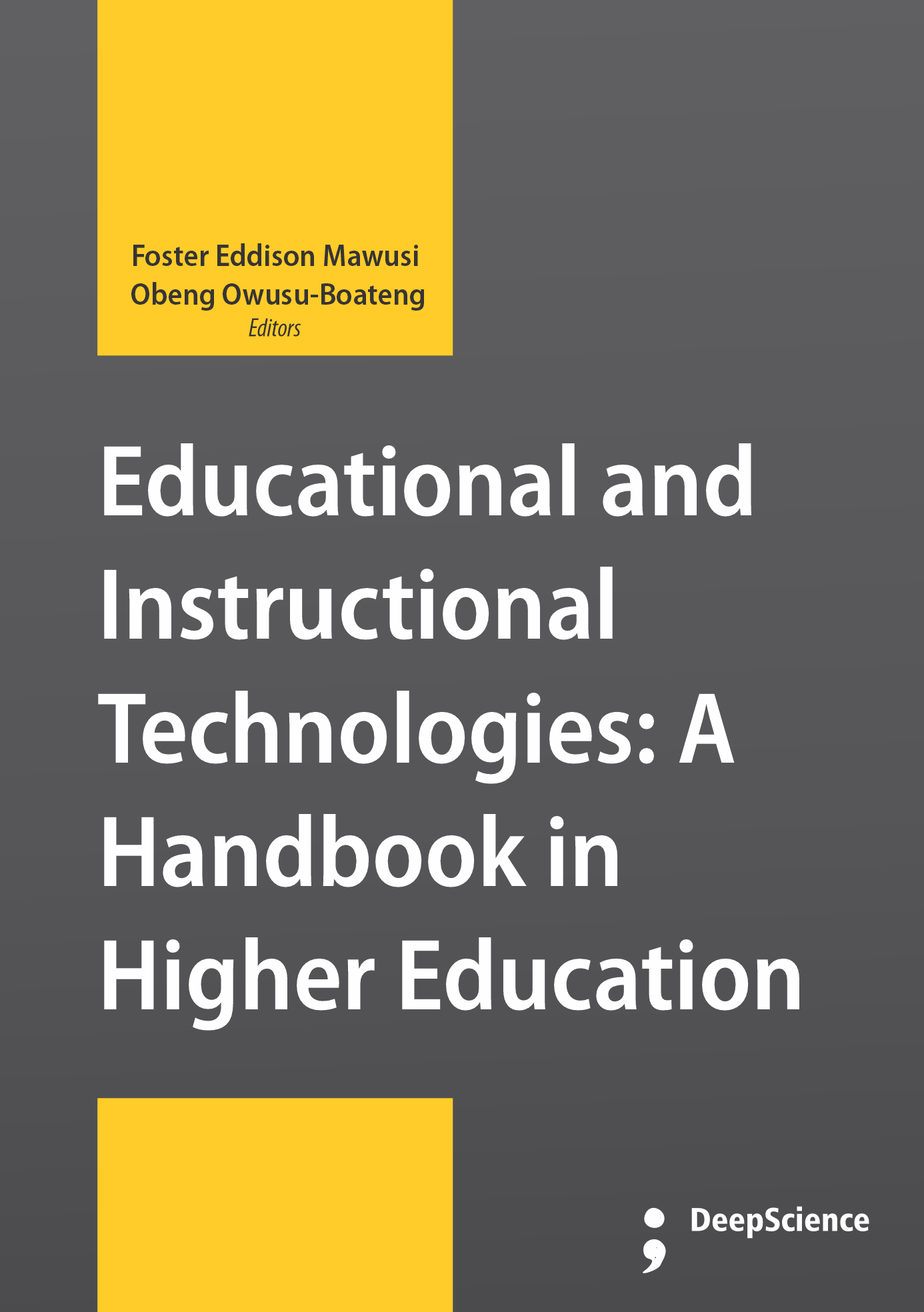
Educational and Instructional Technologies: A Handbook in Higher Education
##plugins.pubIds.doi.readerDisplayName##
https://doi.org/10.70593/978-93-7185-268-5
Keywords:
Instructional Technologies, Higher Education, Digital Tools, Gamification, Classroom Technology, Learning Environments, Cognitive AttributesSynopsis
The growing digital technologies have greatly changed the education landscape of higher education, and they have had an impact on knowledge creation, sharing and consumption in institutions of higher education. Universities and Colleges are becoming more and more digitalized whereby teaching, research and collaboration is aided by the emergent technological tools. The developments pose opportunities as well as challenges to the educators in an attempt to create effective learning experiences that would equip students to become members of a technology driven society. In this dynamic environment, the consideration of educational and instructional technologies has been necessary to enhance the practice of teaching, the access of knowledge and the quality of learning in higher learning institutions.
Educational and Instructional Technologies: A Handbook in Higher Education represents a compilation of the scholarly debate that focuses on the influence of emerging technologies in reshaping the modern educational practice. The book addresses the pertinent major themes in seven chapters namely: technological trends defining education, gamification and digital learning tools and the incorporation of Information and Communication Technologies in teaching and learning settings. The handbook is aimed at assisting the faculty, academic staff and educational researchers to gain an understanding of how technology can be used to help learners engage, construct knowledge by working together, and develop a flexible learning environment that meets the needs of higher education in today’s world.
References
Barron, B. (2006). Interest and self-sustained learning as catalysts of development: A learning ecology perspective. Human Development, 49(4), 193–224. https://doi.org/10.1159/000094368
Bergmann, J., & Sams, A. (2012). Flip your classroom: Reach every student in every class every day. International Society for Technology in Education.
Bishop, J. L., & Verleger, M. A. (2013, June 23–26). The flipped classroom: A survey of the research. 120th ASEE Annual Conference & Exposition, Atlanta, GA, United States. https://peer.asee.org/22585
Bransford, J. D., Brown, A. L., & Cocking, R. R. (Eds.). (2000). How people learn: Brain, mind, experience and school. National Academies Press. https://doi.org/10.17226/9853
Brown, J. S., & Duguid, P. (2000). The social life of information. Harvard Business School Press.
Brynjolfsson, E., & McAfee, A. (2014). The second machine age: Work, progress and prosperity in a time of brilliant technologies. W. W. Norton.
Downloads
Published
29 March 2026
Copyright (c) 2026 Foster Eddison Mawusi, Obeng Owusu-Boateng
Details about the available publication format: E-Book
E-Book
ISBN-13 (15)
978-93-7185-268-5
Details about the available publication format: Book (Paperback)
Book (Paperback)
ISBN-13 (15)
978-93-7185-054-4
How to Cite
Mawusi, F. E. ., & Owusu-Boateng, O. . (Eds.). (2026). Educational and Instructional Technologies: A Handbook in Higher Education. Deep Science Publishing. https://doi.org/10.70593/978-93-7185-268-5
Download Citation






 WhatsApp +91 7977171947