
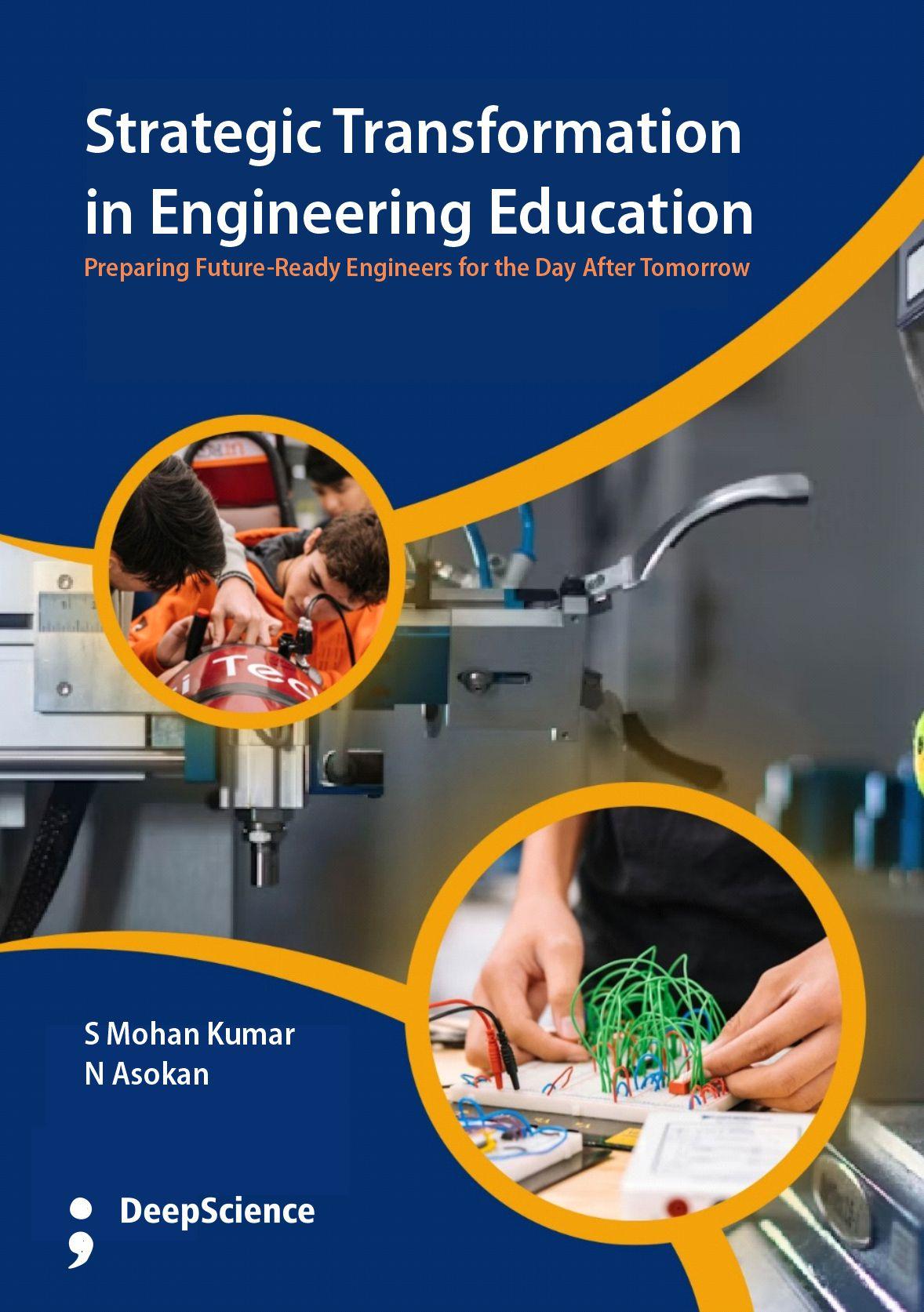
Strategic Transformation in Engineering Education: Preparing Future-Ready Engineers for the Day After Tomorrow
##plugins.pubIds.doi.readerDisplayName##
https://doi.org/10.70593/978-93-7185-832-8
Keywords:
Education, Faculty Development, Curriculum Development, Faculty Training, Technology Integration, Digital PedagogySynopsis
The book is a synthesis of literature on institutional strategies and faculty development in engineering education, which deals with curriculum development, industry relationships, diversity programs, teaching approaches, professional development, and mentoring programs. The objective was to evaluate how institutionally the process of curriculum reform, diversity, faculty development standards, mentorship structures, effective academia-industry relations, comparative models of teaching, and integration of policies are addressed. Quantitative, qualitative and mixed-method studies in different parts of the world were systematically analyzed and found high quality curriculum innovation that was in line with industry requirements and inclusive pedagogies. Nevertheless, it still depends on conventional lectures and unsystematic incorporation of diversity, equity, and inclusion. Structured mentoring and communities of practice improve the quality of teaching but have scalability and alignment problems. Collaboration with industry enhances relevance of curriculum and preparedness of the students, but there are still barriers to collaboration. The educational methods are not widely applicable across cultures. The results show the necessity of scalable, context-sensitive models that can sustain inclusive curricula and faculty development that can be sustained and relevant to the industry. These insights guide policy and institutional transformation in order to develop equitable and innovative engineering education across the world.
The book has correlative synthesis of studies on strategic change in engineering education addressing the development of the curriculum, faculty preparation, and technology adoption to meet the changing needs of the industry. The goals were to review curriculum strategies in accordance with new competencies, benchmark faculty development models that promote pedagogical and technological innovations, find the effective ways of technology integration, and investigate cross-disciplinary approaches and change management. The analysis of qualitative, quantitative, and mixed-method studies focused on active learning and the application of AI and digital tools. It was discovered that AI, project-based, and competency-based interdisciplinary curricula contribute to student engagement and learning. Formalized, continuous faculty development, including mentoring and active communities enhance teaching, although it is institutionally infeasible and scalable. Personalized learning is supported by widespread AI, virtual reality, and adaptive platforms but it has infrastructural and ethical issues. Active-learning models that are interdisciplinary ready graduates to Industry 4.0 and 5.0, but they have resistance and scalability issues. These findings highlight the intricacy of the change at a systemic level and the importance of continuous involvement and evaluation of stakeholders. The synthesis points at the value of longitudinal, comparative research that would confirm models of sustainability and would inform policymakers and teachers to adopt evidence-based practices when operating in dynamic educational settings.
The book also represents a synthesis of literature on technology integration and curriculum development in digital pedagogy training of faculty development with special focus on the practical use in higher education. Its goal was to evaluate the strategies of integrating technology, model curriculum designs, emerging digital tools, instructional methods, and influence of implementation in different higher education environments. Qualitative and mixed-method systematic review and design-based studies conducted across the world based on the practical and theoretical consistency. Findings indicate that blended learning and teaching design models like ADDIE and TPACK can be successfully used in the development of the faculty to promote digital skills and pedagogic change based on the concepts of constructivist and adult learning theories. Limitations in institutional support, resource constraint and inappropriateness between technology and pedagogy are the major challenges that impede adoption. Mentoring, collaborative communities and continuous support are some of the factors that facilitate motivation and integration of technology among the faculty. The effects of training are high faculty confidence, better teaching skills, and more student interaction, but long-term impact is difficult to measure. The synthesis highlights the necessity of holistic, institution-specific faculty development programs integrating technical capabilities, pedagogic sophistication, and institutional encouragement to implement digital pedagogy in post-secondary education. The learnings are used in future endeavors to design sustainable and efficient technology-based pedagogy.
The incorporation of liberal arts in the engineering curriculum improves the critical thinking, communication and ethical reasoning of the students. It also promotes holistic problem-solving and interpersonal skills that are needed in order to succeed professionally. Nevertheless, such issues as more curriculum work, and inadequate training of faculty to teach interdisciplinarily exist. It is important to tackle these barriers in order to integrate and achieve better education results. The book, in its turn, synthesizes studies on the introduction of liberal arts into engineering programs to close the gaps in the knowledge of how such an introduction enhances critical thinking, communication, and moral reasoning especially when it comes to the overload of curricula and the development of faculty. The research focused on the advantages of integration of liberal arts, curriculum benchmarking models, teacher preparedness, pedagogical methods and governance and assessment systems. A qualitative and quantitative method systemic review of the research mainly in the North America context and international settings compared interdisciplinary approaches. Results indicate that an incorporation of liberal arts leads to improved critical thinking, ethical awareness, and communications skills due to project based, interdisciplinary instruction, but evidence of improved empathy is not available. There are different models of curricula such as standalone courses, electives and fully integrated programs though the issue of creating a balance between technical and liberal art material is a challenge. Preparation through faculty development and collaborative teaching is enhanced, but constrained by lack of training and organizational rewards. Effective governance and institutional support of sustainable integration is usually fragmented. The practices of assessment are not standardized and longitudinal. These results support the importance and difficulty of applying liberal arts to engineering. The study guides curriculum design, teacher development, and policy in favor of interdisciplinary education and making engineers capable of ethical and communicative leadership in multi-faceted societal situations.
References
Abadi, N., & Elbaz, D. (2023). Enhancing civil engineering education through innovative stem methodologies. International academic journal of innovative research, 10 (4), 19-24. https://doi.org/10.71086/iajir/v10i4/iajir1028
Abildinova, G., Abdykerimova, E., Assainova, A., Mukhtarkyzy, K., & Abykenova, D. (2024). Preparing educators for the digital age: Teacher perceptions of active teaching methods and digital integration. Frontiers in Education, 9 , . https://doi.org/10.3389/feduc.2024.1473766
Abildinova, G., Zh, K., Abykenova, D. B., Assainova, A., & Sembayev, T. (2024). Білім берудегі оқытудың белсенді және цифрлық әдістері. Habaršy - Abaj atyndaġy Almaty universitetì. Fizika-matematika seriâsy, 85 (1), . https://doi.org/10.51889/2959-5894.2024.85.1.015
Adams, S., Watson, K., & Malave, C. O. (1996). Foundation coalition at texas a&m university: Utilizing tqm and od to manage curricula change. https://doi.org/10.1109/FIE.1996.567799
Ahmed, S., Naudhani, T., & Wazir, S. (2025). The role of faculty development in enhancing teaching quality in higher education in pakistan. Social science research archives., 3 (3), 1895-1908. https://doi.org/10.70670/sra.v3i3.1024
Downloads
Published
26 March 2026
Copyright (c) 2026 S Mohan Kumar, N Asokan
Details about the available publication format: E-Book
E-Book
ISBN-13 (15)
978-93-7185-832-8
Details about the available publication format: Book (Paperback)
Book (Paperback)
ISBN-13 (15)
978-93-7185-677-5
How to Cite
Kumar, S. M. ., & N Asokan. (2026). Strategic Transformation in Engineering Education: Preparing Future-Ready Engineers for the Day After Tomorrow. Deep Science Publishing. https://doi.org/10.70593/978-93-7185-832-8
Download Citation




 WhatsApp +91 7977171947