

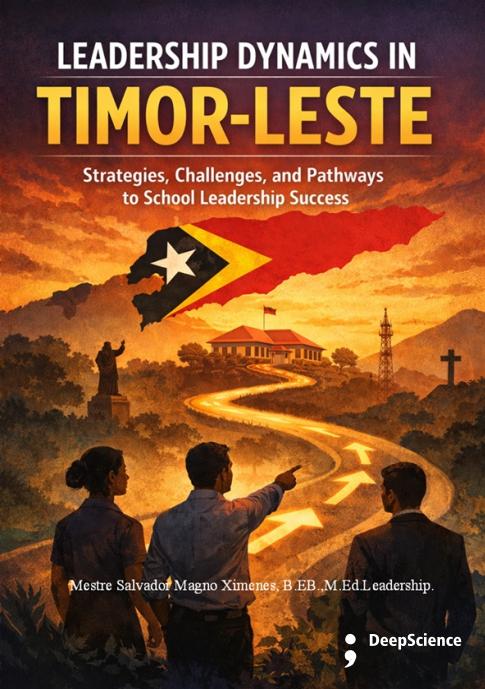
Leadership Dynamics in Timor-Leste: Strategies, Challenges, and Pathways to School Leadership Success
##plugins.pubIds.doi.readerDisplayName##
https://doi.org/10.70593/978-93-7185-603-4
Keywords:
Leadership, Effective leadership, Professional development, Capacity building, Policy frameworks , Education, Higher educationSynopsis
This book is being written in response to one of the most evident and persistent realities in the Timor-Leste education system: that school leadership is a factor, and it works within the complex historical, cultural, and structural factors, that are frequently underestimated in policy and research. Timor-Leste has, over the past decades, made enormous promises toward reconstruction of its education system since independence, but the increase in access and curriculum change has not necessarily been accompanied by a continued investment in leadership capacity at the school level. Consequently, there is a high likelihood that most school administrators will lead the change process without being sufficiently prepared to do so, without contextual guidance, or without institutional networking. This book attempts to fill this gap.
This book presents a simple thesis statement that concentrate on school leaders in Timor-Leste. Good leadership in schools in Timor-Leste is not agreeable to imported models or generic leadership competencies. Rather, it should be perceived as a dynamic process that is influenced by post-conflict realities, linguistic diversity, insufficiency of resources, deep community, and changing national education reforms, like Eskola Foun (tetum language). Consequently, a leader's success depends on their skills, how they build relationships, delegate tasks, and align school activities with local and national needs.
This book is a compilation of theoretical approaches, facts, and practice-based interventions to analyse the role played by leadership in schools in real situations in Timor-Leste. It relies on the democratic, transformational, instructional, distributed, and community-based models of leadership and critically analyses their applicability and constraints in a developing and post-conflict environment. Instead of viewing these models as challenging models, the book reveals how successful leaders tend to use various leadership styles to address the various problems that face them on a daily basis, like teacher motivation, student engagement, parental involvement, and accountability pressures.
This book is largely concerned with the experience of school leaders. Principals, vice-principals, and senior teachers navigate the delicate balance between policy expectations and the realities of the classroom. They deal with staff of varying degrees of qualification, advocate for language of instruction issues, and collaborate with communities in which schools are viewed not only as learning institutions but also as social and moral centers. By foregrounding these realities, the book does not focus on idealised accounts but rather exposes leadership as adaptive, relational, and work context-sensitive.
The other significant contribution of this book is that it focuses on leadership development and capacity building. Training for leadership in Timor-Leste has been quite irregular, short-lived, or highly centralised. This book is a critical review of current professional development programs; it demonstrates the significance of long-term mentoring, peer learning networks, reflective practices, and school-based leadership development. It claims that the best leadership development is an ongoing, collaborative, and school improvement-linked process.
This book has been structured to take the readers through the conceptual knowledge to a practical level. Chapters discuss the historical and policy context of school leadership in Timor-Leste, followed by chapters that identify the leadership challenges related to resource constraints, teacher performance, supervision, and community engagement. Subsequent chapters introduce novel approaches, case-based knowledge, and avenues for enhancing leadership practice, such as the elaboration of national leadership competency frameworks and local support systems.
This book targets a broad readership, with a specific focus on school leaders in Timor-Leste. School leaders will find practical insights and reflective tools useful in their daily work. Integration of theory and practice will be beneficial to teacher educators and university students, especially in preparation to take up leadership positions. The evidence and analysis discussed here can be used by policymakers and stakeholders in the education sector to design leadership policies and professional development programs that are more sensitive to local realities.
Ultimately, this book does not attempt to provide simplified solutions. Leadership success with respect to Timor-Leste is a long-term process that requires dedication, education, and teamwork. Nonetheless, this book aims to contribute to the ongoing debate about how schools can be led more ethically and sustainably by grounding leadership discussions in the Timorese context and incorporating the voices and experiences of those directly involved. Hopefully, the work will assist current and future leaders in creating not only administratively practical but also inclusive, resilient, and meaningful learning for all students and schools.
References
Avolio, B. J., Walumbwa, F. O., & Weber, T. J. (2009). Leadership: Current theories, research, and future directions. Annual review of psychology, 60(1), 421-449.
Adan, M. Y. (2025). The role of peace education in promoting social justice and sustainable peace in post-conflict societies: A 4Rs framework analysis. Frontiers in Political Science, 7, 1650027.
Anderson, L. W. (2019). Effective school leadership for the 21st century. Routledge.
Alli, A., Lin, T., Thorndyke, L., Parekh, R., & Núñez, A. (2021). Advancing Women to Leadership Positions Through Individual Actions and Institutional Reform. Pediatrics, 148 Suppl 2. https://doi.org/10.1542/peds.2021-051440d
Beck, M., & Araujo, S. (2013). Timor-Leste: The now in the not yet of school leadership. In School Level Leadership in Post-conflict Societies (pp. 165-180). Routledge.
Beck, M. (2022). Overview of education in Timor-Leste. In International Handbook on Education in South East Asia (pp. 1-19). Singapore: Springer Singapore.
Downloads
Published
18 March 2026
Copyright (c) 2026 Salvador Magno Ximenes
Details about the available publication format: E-Book
E-Book
ISBN-13 (15)
978-93-7185-603-4
Details about the available publication format: Book (Paperback)
Book (Paperback)
ISBN-13 (15)
978-93-7185-878-6
How to Cite
Ximenes, S. M. . (2026). Leadership Dynamics in Timor-Leste: Strategies, Challenges, and Pathways to School Leadership Success. Deep Science Publishing. https://doi.org/10.70593/978-93-7185-603-4
Download Citation







 WhatsApp +91 7977171947