

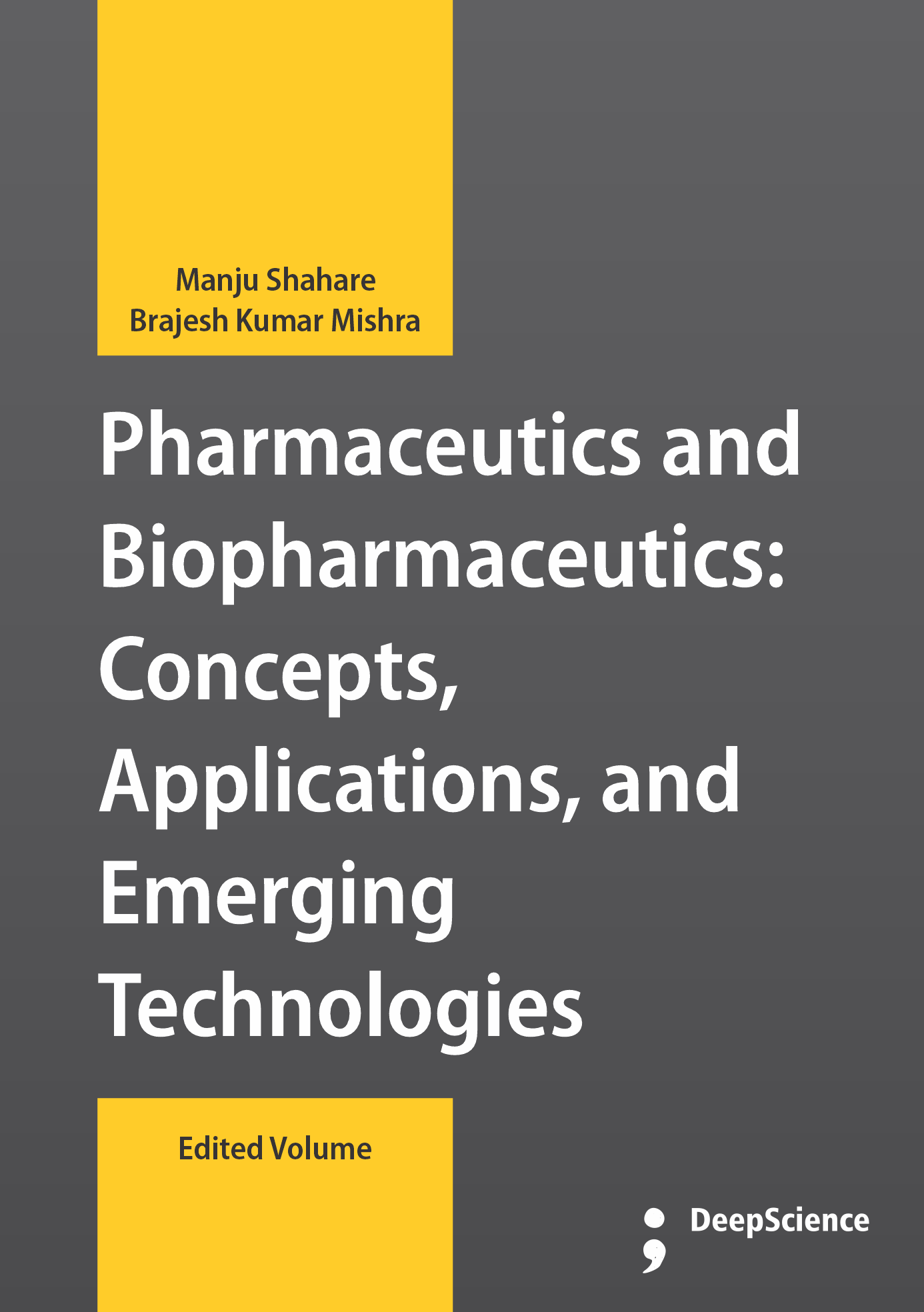
Pharmaceutics and Biopharmaceutics: Concepts, Applications, and Emerging Technologies
##plugins.pubIds.doi.readerDisplayName##
https://doi.org/10.70593/978-93-7185-277-7
Keywords:
Pharmaceutics, Biopharmaceutics, Drug Absorption, Drug Development, Drug Formulation, Dosage Design, NanotechnologySynopsis
Pharmaceutics and biopharmaceutics as the disciplines play a crucial role in facilitating the transition of a drug through discovery to successful clinical use. Although pharmaceutics is concerned with the strict science of designing, formulating and developing stable effective dosage-forms, biopharmaceutics studies the dynamics between these formulations and the human body. Combined they are at the basis of modern medicine and make sure that therapeutic agents reach the needy in a safe and predictable manner.
The book Pharmaceutics and Biopharmaceutics: Concepts, Applications, and emerging technologies is structured in a manner aimed at treating these two disciplines that go hand in hand. This text is a transition between the foundations of formulation and the importance of vital excipients to complicated pharmacokinetics of absorption, distribution, metabolism, and excretion (ADME). These fundamental concepts can help researchers and students base their predictions of drug behavior on better understanding therapeutic performance and are thus likely to emerge as the key concepts.
In addition to that, this text explores the revolutionary role of new technologies. We delve into how the development in nanotechnology like in liposomes and nanocarriers is reshaping the concept of drug delivery at the targeted and reducing side effects in the system. In addition, the book deals with the trend that is the transition to personalized medicine, in which the pharmaceutical treatment is more and more specific to a certain genetic and physiological profile of a person.
We hope that this work will prove as an unnecessary guide as well as a stimulus to further innovation and enable the audience to understand the manner in which the pharmaceutical care could be advanced and the global health be improved.
References
Bertram-Ralph, E., & Amare, M. (2023). Factors affecting drug absorption and distribution. Anaesthesia & Intensive Care Medicine, 24(4), 221–227. https://doi.org/https://doi.org/10.1016/j.mpaic.2022.12.023
Bhandare, A., & Nannor, K. M. (2024). Bioavailability in drug design and development: A comprehensive review. World Journal of Pharmaceutical Research, 13(17), 145–168. https://doi.org/10.20959/wjpr202417-33652
Charoo, N. A. (2020). Converging generic drug product development: bioequivalence design and reference product selection. Clinical Pharmacokinetics, 59(11), 1335–1355. https://doi.org/10.1007/s40262-020-00912-z
Lourenço, D., Miranda, M., Sousa, J. J., & Vitorino, C. (2024). Therapeutic-driven framework for bioequivalence assessment of complex topical generic drug products. International Journal of Pharmaceutics, 661, 124398. https://doi.org/10.1016/j.ijpharm.2024.124398
Madla, C. M., Gavins, F. K. H., Trenfield, S. J., & Basit, A. W. (2021). Special Populations. In Biopharmaceutics: From Fundamentals to Industrial Practice. Wiley Online Library. https://doi.org/https://doi.org/10.1002/9781119678366.ch13
Odi, R., Franco, V., Perucca, E., & Bialer, M. (2021). Bioequivalence and switchability of generic antiseizure medications (ASMs): a re‐appraisal based on analysis of generic ASM products approved in Europe. Wiley Online Library, 62(2), 285–302. https://doi.org/https://doi.org/10.1111/epi.16802
Stielow, M., Witczyńska, A., Kubryń, N., Fijałkowski, Ł., Nowaczyk, J., & Nowaczyk, A. (2023a). The bioavailability of drugs—the current state of knowledge. Mdpi.Com, 28(24), 8038. https://doi.org/10.3390/molecules28248038
Downloads
Published
20 March 2026
Copyright (c) 2026 Manju Shahare; Brajesh Kumar Mishra
Details about the available publication format: E-Book
E-Book
ISBN-13 (15)
978-93-7185-277-7
Details about the available publication format: Book (Paperback)
Book (Paperback)
ISBN-13 (15)
978-93-7185-593-8
How to Cite
Shahare, M. ., & Mishra, B. K. . (Eds.). (2026). Pharmaceutics and Biopharmaceutics: Concepts, Applications, and Emerging Technologies. Deep Science Publishing. https://doi.org/10.70593/978-93-7185-277-7
Download Citation







 WhatsApp +91 7977171947