

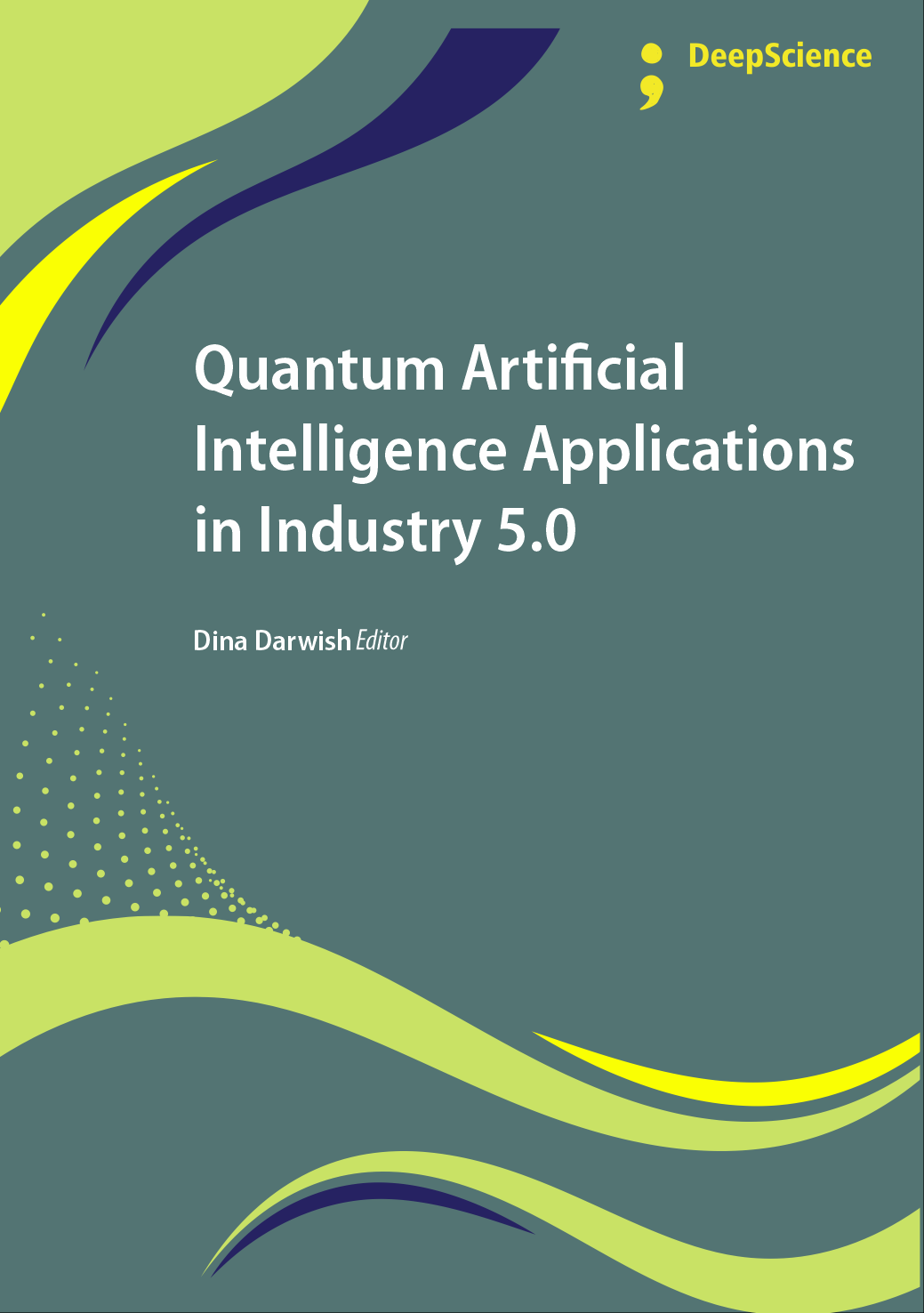
Quantum Artificial Intelligence Applications in Industry 5.0
##plugins.pubIds.doi.readerDisplayName##
https://doi.org/10.70593/978-93-7185-732-1
Keywords:
Quantum Artificial Intelligence, Industry 5.0, Quantum Computing, Artificial Intelligence, Cybersecurity, Machine LearningSynopsis
Utilizing the capabilities of both human-centred artificial intelligence and quantum computing, quantum artificial intelligence transforms how firms operate in Industry 5.0. This enables you to perform complex simulations, optimize fast, and make smarter decisions for robust, customized, and long-lasting systems.
This is particularly evident in fields where quantum computing can manage massive information and complex patterns that traditional computer cannot, such as drug development, logistics, and new materials. It assists Industry 5.0 in achieving its objectives, which go beyond automation, which was the main focus of Industry 4.0. It does this via fostering sustainability, developing stress-tolerant systems, and facilitating human-machine collaboration (Augmented Intelligence).
The following are some of Industry 5.0's most significant effects: optimization Logistics, supply chain optimization, and industrial optimization may all be greatly accelerated with the use of quantum machine learning (QML). Over time, this improves productivity and reduces waste.
More precise predictive maintenance and complex analysis are made possible by quantum artificial intelligence, freeing up workers to focus on more worthwhile and innovative projects. This facilitates genuine collaboration between humans and AI.
Researchers can more easily concentrate on potential compounds when they model the interactions between molecules. This facilitates the development of novel medications and antibiotics. Drug development and healthcare are two industries that employ this technology.
Complex quantum simulations are used in advanced materials and simulation to expedite the discovery and development of novel materials. Real-time threat detection and quantum-resistant encryption can improve the security of factory networks.
By using a lot of data to determine what each individual needs, personalization enables you to create experiences and products that are quite distinct for each person.
Quantum algorithms allow you to do more in less time. Additionally, quantum-inspired techniques can improve the performance of standard algorithms to provide superior outcomes.
Large, extremely complicated datasets can be processed by quantum computers. This enables them to identify subtle patterns that conventional AI is unable to detect and train AI models far more quickly.
Keeping up with the latest algorithms and hardware limitations is never easy. It is crucial to consider ethical concerns and ensure that technology is accessible to all people worldwide.
By fusing human creativity with machine intelligence, the integration might result in the creation of more intelligent and independent systems. This could contribute to a more stable future.
References
Kirchhoff G. ¨ Uber den Zusammenhang zwischen Emission und Ab sorption von Licht und W¨arme. Monatsberichte der Akademie der Wis senschaften zu Berlin, 1860, p.783–787.
Kirchhoff G. “On the relation between the radiating and the absorbing powers of different bodies for light and heat”. Phil. Mag., vol .20, 1860, p.1–21.
Hertz, H.R. "Ueber sehr schnelle electrische Schwingungen", Annalen der Physik, vol. 267, no. 7, 1887, p. 421–448.
Planck, M. “The Theory of Heat Radiation”. Translated by Masius, M. (2nd ed.). P. Blakiston's Son & Co, 1914.
Louis de B. Mathematics Genealogy Project. North Dakota State University. Retrieved 2025.
Planck, M., "Ueber das Gesetz der Energieverteilung im Normalspectrum", Annalen der Physik, vol. 309, no.3, 1901, p.553–63.
Downloads
Published
13 March 2026
Copyright (c) 2026 Dina Darwish
Details about the available publication format: E-Book
E-Book
ISBN-13 (15)
978-93-7185-732-1
Details about the available publication format: Book (Paperback)
Book (Paperback)
ISBN-13 (15)
978-93-7185-948-6
How to Cite
Darwish, D. . (Ed.). (2026). Quantum Artificial Intelligence Applications in Industry 5.0. Deep Science Publishing. https://doi.org/10.70593/978-93-7185-732-1
Download Citation






 WhatsApp +91 7977171947