

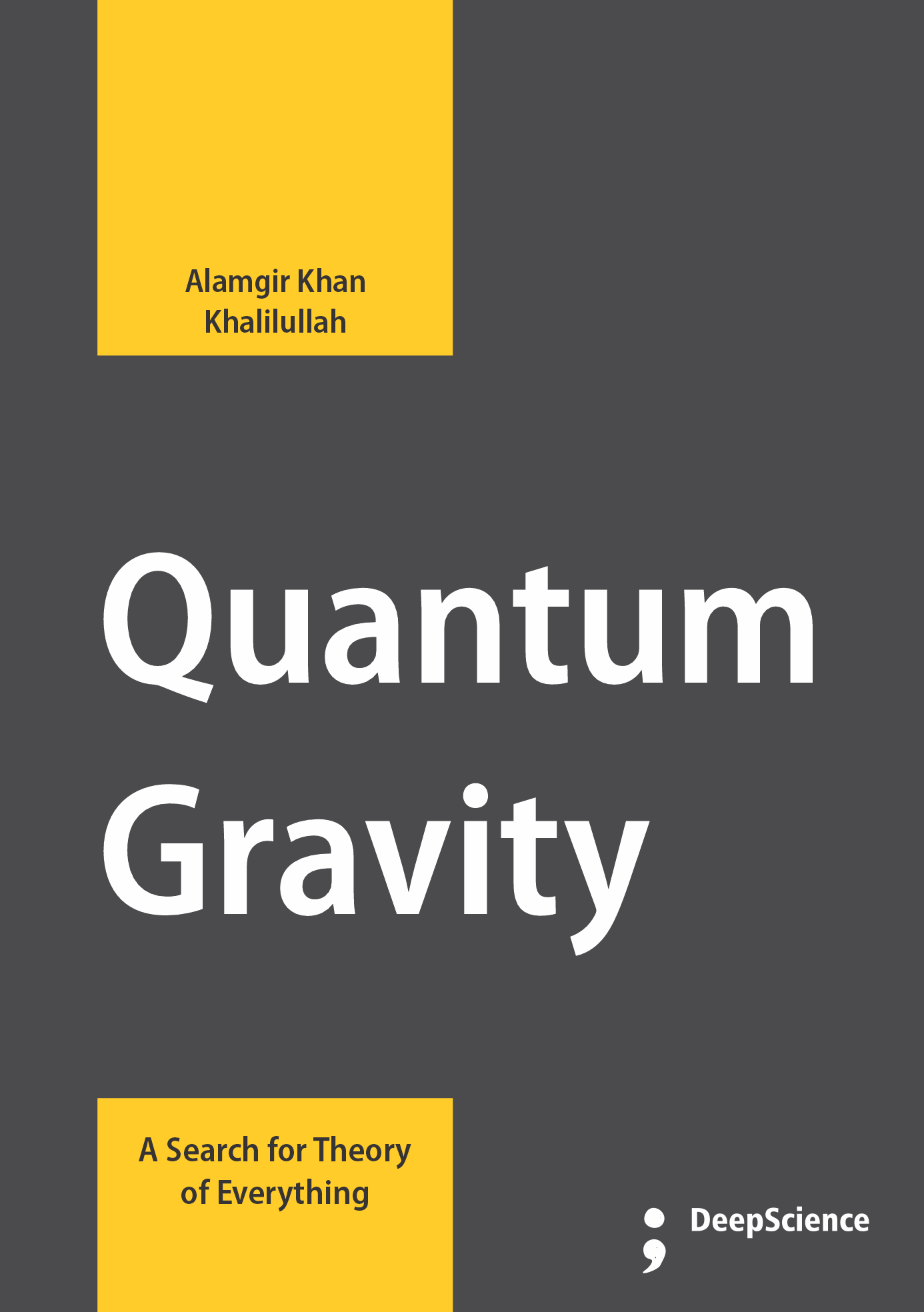
Quantum Gravity: A Search for Theory of Everything
##plugins.pubIds.doi.readerDisplayName##
https://doi.org/10.70593/978-93-7185-275-3
Keywords:
Quantum Gravity, Gravitation, Electromagnetic field, Relativity, Quantum mechanics, Loop quantum gravity, String theorySynopsis
This book presents a coherent and conceptually motivated exploration of fundamental physics, tracing the intellectual journey from the early geocentric worldview of Claudius Ptolemy to modern unification efforts such as M-theory. Rather than offering a purely technical treatment, it emphasizes the evolution of ideas that have shaped our understanding of the universe, highlighting how each scientific revolution in physics has historically arisen from the inability of existing theoretical frameworks to account for newly observed phenomena or internal conceptual inconsistencies. The scope of this work spans classical mechanics, relativity, quantum theory, and modern attempts at grand unification. Beginning with the transformation from Aristotelian cosmology to the heliocentric understandings of Nicolaus Copernicus and the dynamical laws of Issac Newton, the discussion progresses through the conceptual breakthroughs of Albert Einstein in relativity and the probabilistic foundations of quantum mechanics developed by pioneers such as Max Plank and Neils Bohr. The story concludes in modern theoretical frameworks including string theory and higher dimensional models that seek to reconcile gravity with quantum field theory. The target readership includes advanced undergraduate and graduate students in physics, interdisciplinary researchers, and intellectually curious readers who seek conceptual clarity rather than dense mathematical derivations. While mathematical structure is acknowledged as essential, the primary focus remains on physical meaning, logical development, and philosophical implications. The aim is to make the deep continuity of physical thought accessible without losing academic consistency. This book distinguishes from existing texts is its importance on conceptual continuity and critical reflection. Instead of presenting physical theories as isolated achievements it frames them as stages in an ongoing scientific dialogue each successful within its domain yet incomplete in a deeper sense. By foreground processing the motivations, conceptual tensions, and unresolved paradoxes that drive theoretical progress, this book clarifies why a complete “ Theory of everything” remains incomplete and what intellectual transformation such a theory would require. Ultimately, this book invites readers to view physics not just as a collection of equations, but as a dynamic and evolving human effort one that continually reshapes our understanding of reality and our place within the cosmos.
References
Hestenes D. New foundations for classical mechanics. Dordrecht: Springer Netherlands; 1999 Sep 30.https://doi.org/10.1007/0-306-47122-1_7
Benacquista MJ, Romano JD. Classical mechanics. Springer International Publishing; 2018 Feb 27. https://doi.org/10.1007/978-3-319-68780-3
Moritz H. Introduction to classical mechanics. InTheory of Satellite Geodesy and Gravity Field Determination 2005 Oct 20 (pp. 9-68). Berlin, Heidelberg: Springer Berlin Heidelberg. https://doi.org/10.1007/BFb0010548
Magid, Leonard M., and Hermann A. Haus. "Electromagnetic Fields, Energy, and Waves." (1973): 57-59. https://doi.org/10.1063/1.3128054
Rachidi F, Tkachenko S. Electromagnetic field interaction with transmission lines: from classical theory to HF radiation effects. WIT press; 2008. https://doi.org10.1002/9781118057926
Soffel MH, Han WB. Applied general relativity. Astronomy and Astrophysics Library. Springer Nature Switzerland, Cham. 2019 Oct. https://doi.org/10.1007/978-3-030-19673-8
Khriplovich IB. General Relativity. New York, NY: Springer New York; 2005 Nov 16. https://doi.org/10.1007/0-387-27406-5_6
Downloads
Published
4 March 2026
Copyright (c) 2026 Alamgir Khan, Khalilullah
Details about the available publication format: E-Book
E-Book
ISBN-13 (15)
978-93-7185-275-3
Details about the available publication format: Book (Paperback)
Book (Paperback)
ISBN-13 (15)
978-93-7185-226-5
How to Cite
Khan, A. ., & Khalilullah. (2026). Quantum Gravity: A Search for Theory of Everything. Deep Science Publishing. https://doi.org/10.70593/978-93-7185-275-3
Download Citation









 WhatsApp +91 7977171947