

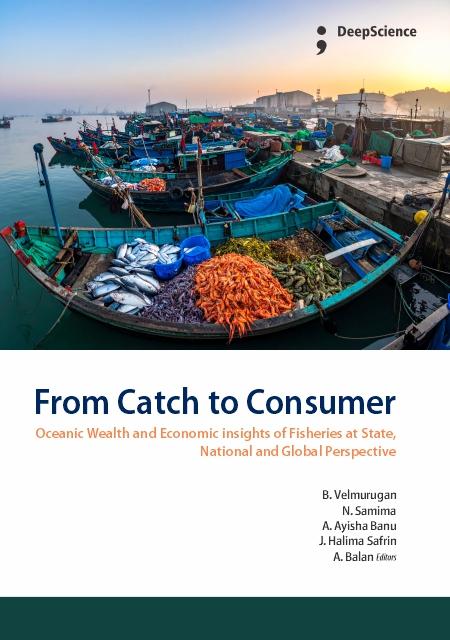
From Catch to Consumer: Oceanic Wealth and Economic insights of Fisheries at State, National and Global Perspective
##plugins.pubIds.doi.readerDisplayName##
https://doi.org/10.70593/978-93-7185-342-2
Keywords:
Consumer, Fisheries, Oceanic Wealth, Fish Production, Marketing, Sustainability, AquacultureSynopsis
This book offers a comprehensive exploration of the functional and structural elements of the nation’s fish marketing channels and production systems. India's coastal and inland communities depend strongly on fisheries for their economic development, food security and for their livelihood with the extensive coastline, healthy marine resources and numerous inland water bodies. Tamil Nadu maintains an important position in country's fish production and marketing. The state fishing industry provides an enormous contribution to employment, income from exports, nutritional security and the overall development of the rural economy. In addition to highlighting the new opportunities in the fishery sector, such as advancements in technology, value addition, and potential to export. This review seeks to analyze patterns of production, cost and returns, marketing mechanism effectiveness, price distribution and the function of intermediaries in the sector and furnish pathways toward sustainability that balance ecological health, economic viability and social justice. It’s assess the challenges facing capture fisheries and the growing importance of sustainable aquaculture, particularly in developing nations and also presents a overview of the economic importance and trade potential of tuna fisheries at the global level with special reference to India. This review is intended to support students, researchers and policymakers in promoting sustainable and economically viable tuna fisheries. The purpose of fish processing technology is to give consumers a thorough understanding of both traditional and advanced methods for processing such as chilling, freezing, drying, curing, smoking, canning and innovative methods such as irradiation, modified atmosphere packaging and the development of ready-to-eat products. To enhance the value and sales potential of the product, focus has been placed on hygienic processing, quality control, food safety regulations and the implementation of proper technologies and also provides the significance of processing technology to improving seafood industry incomes, strengthening competition for export and helping the development of sustainable fisheries.
References
Sharma, H, M. Swain and S. S Kalamkar (2016), “Evaluation and Assessment of Economic Losses on Account of Inadequate Post-Harvest Infrastructure Facilities for Fisheries Sector in Gujarat State”, Report No. 163, Agro-Economic Research Centre, Sardar Patel University, Vallabh Vidyanagar, Anand, Gujarat.
Ahmed K. K., Alamgir M., Kibria M. G., Haque M. E. (1999) Reservoir Fisheries of Bangladesh. Aquacult. Asia 4, 8–12.
Williams, K. C., Barlow, C. G., Rodgers, L. J., & Ruscoe, I. (2002). Potential of meat meal to replace fish meal in extruded dry diets for barramundi, Lates calcarifer (Bloch). I. Growth performance. Aquaculture Research, 34(1), 23-32. https://doi.org/10.1046/j.1365-2109.2003.00785.x
Byrd KA, Thilsted SH, Fiorella KJ. Fish nutrient composition: a review of global data from poorly assessed inland and marine species. Public Health Nutr 2021;24(3):476–86. doi:10.1017/S1368980020003857.
Thilsted SH, Thorne-Lyman A, Webb P, Bogard JR, Subasinghe R, Phillips MJ, et al. Sustaining healthy diets: the role of capture fisheries and aquaculture for improving nutrition in the post-2015 era. Food Policy 2016;61:126–31. doi:10.1016/j.foodpol.2016.02.005.
Government of India (2023). Pradhan Mantri Matsya Sampada Yojana (PMMSY) Progress Report.
Downloads
Published
10 February 2026
Copyright (c) 2026 B. Velmurugan, N. Samima, A. Ayisha Banu, J. Halima Safrin, A. Balan
Details about the available publication format: E-Book
E-Book
ISBN-13 (15)
978-93-7185-342-2
Details about the available publication format: Book (Paperback)
Book (Paperback)
ISBN-13 (15)
978-93-7185-390-3
How to Cite
B. Velmurugan, N. Samima, A. Ayisha Banu, J. Halima Safrin, & A. Balan. (2026). From Catch to Consumer: Oceanic Wealth and Economic insights of Fisheries at State, National and Global Perspective. Deep Science Publishing. https://doi.org/10.70593/978-93-7185-342-2
Download Citation






 WhatsApp +91 7977171947