

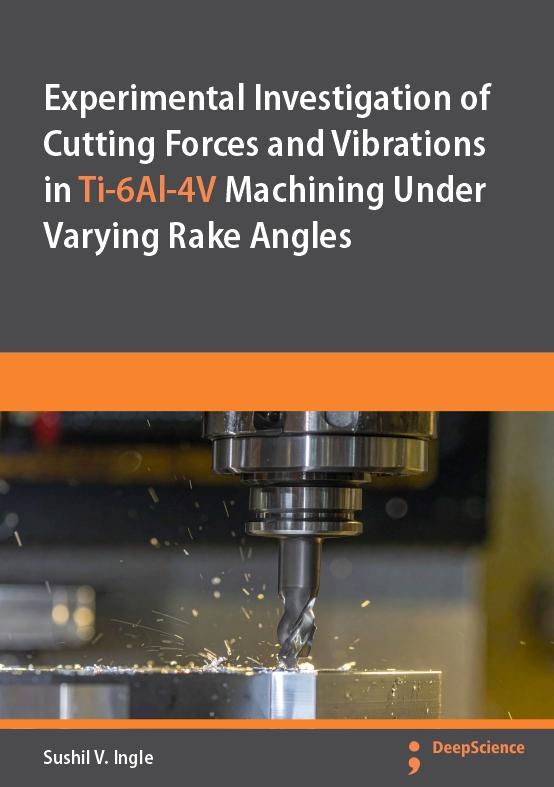
Experimental Investigation of Cutting Forces and Vibrations in Ti-6Al-4V Machining Under Varying Rake Angles
##plugins.pubIds.doi.readerDisplayName##
https://doi.org/10.70593/978-93-7185-905-9
Keywords:
Cutting Forces, Vibrations, Machine, Rake Angles, MCDM, Topsis, VIKORSynopsis
Titanium and its alloys have outstanding corrosion resistance, superior biocompatibility, notable tissue inertness, good weld-ability, and other properties [1, 2]. These alloys have several uses in a variety of industries, including the chemical processing industry, the oil and gas industry, the marine and aviation industries, and the medical sector [3]. The aforementioned intrinsic qualities and practicality of titanium alloys compel researchers to investigate and scrutinize a variety of these alloys' machining features. Recent years have seen increased interest from other commercial and industrial sectors in the studies on the machinability characteristics of these alloys. On the other hand, restricted use of titanium alloys is caused by their high initial cost and extraction process challenges. Additionally, due to lower productivity, these alloys can only be machined at a limited range of cutting rates (about 30-60 m/min) due to their high chemical affinity and poor heat conductivity [2].
Titanium alloys are challenging to manufacture because the thin chips create a small surface area between the cutting tool and the work piece. High cutting temperatures are a result of titanium alloys' inadequate heat conductivity and excessive stress created by the narrow contact area. This study focuses on the optimization of the impact on tool life, surface roughness, crater wear, and flank wear. The process variables for turning Ti-6Al-4V alloy take tool life, surface roughness, crater wear, and flank wear into consideration. Results were analyzed using Taguchi-based SAW, VIKOR, TOPSIS, and Electre techniques. The outcomes of the experiment demonstrate that Ti-6Al4V alloy has been successfully turned using CIMCOOL 360 coolant with a 15% concentration. By selecting the best alternative at cutting speed = 80 rpm, feed rate = 0.18mm/rev, depth of cut = 0.12mm, and rake angle = 14 degrees, where the surface roughness and tool life are, respectively, 0.716μm and 48.3998 min, the research work shows the importance of the suitability of TOPSIS in solving the Multiple Criteria Decision Making (MCDM). From ANOVA results, for surface finish, it is noticed that the process parameter rake angle is having Rank 01 for all levels. Thus rake angle is the major influencing parameter to achieve a better quality of surface roughness. While in the case of flank wear it is crystal clear that process parameter DOC is having Rank 01 for all levels. Thus DOC is the most influencing parameter to achieve lesser flank wear and better quality of tool life.
References
Elektronen-rastermikroskop D, Grundlagen T, Man V, et al. Das Elektronen-Rastermikroskop. Theoretische Grundlagen. 1938;553–572.
Mcmullan D. The Early Development of the Scanning Electron Microscope. 2008;1–25.
Frederic G, Voort V. Color metallography Vol. 9 ASM handbook. 2018;9.
Goldstein J, Lyman CE, Newbury DE, et al. Scanning Electron Microscopy and THIRD EDITION.
Burns TJ, Davies MA. On repeated adiabatic shear band formation during high-speed machining. Int J Plast. 2002;18:487–506.
Marchand A, Duffy J. An experimental study of the formation process of adiabatic shear bands in a structural steel. J Mech Phys Solids. 1988;36:251–283.
Gao Y, Wang G, Liu B. Chip formation characteristics in the machining of titanium alloys: A review. Int J Mach Mach Mater. 2016;18:155–184.
Gao Y, Wang G. Chip formation characteristics in the machining of titanium alloys : A review Chip formation characteristics in the machining of titanium alloys : a review Yanfeng Gao * and Gui Wang Binbin Liu. 2016.
Downloads
Published
2 March 2026
Copyright (c) 2026 Sushil V. Ingle
Details about the available publication format: E-Book
E-Book
ISBN-13 (15)
978-93-7185-905-9
Details about the available publication format: Book (Paperback)
Book (Paperback)
ISBN-13 (15)
978-93-7185-424-5
How to Cite
Ingle, S. V. . (2026). Experimental Investigation of Cutting Forces and Vibrations in Ti-6Al-4V Machining Under Varying Rake Angles. Deep Science Publishing. https://doi.org/10.70593/978-93-7185-905-9
Download Citation






 WhatsApp +91 7977171947