

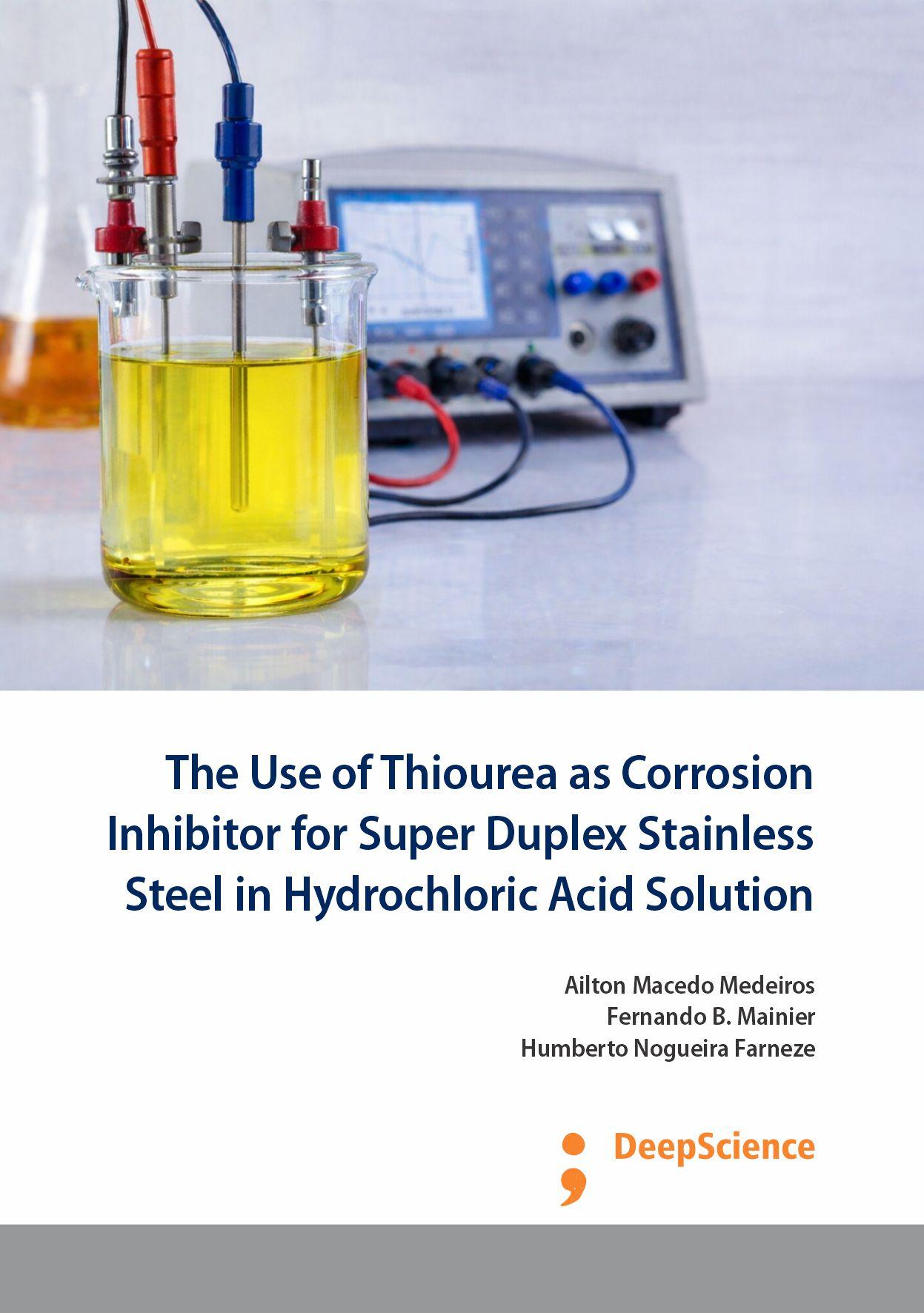
The Use of Thiourea as Corrosion Inhibitor for Super Duplex Stainless Steel in Hydrochloric Acid Solution
##plugins.pubIds.doi.readerDisplayName##
https://doi.org/10.70593/978-93-7185-980-6
Keywords:
Super Duplex Stainless Steel, Corrosion Inhibitors, Thiourea, Hydrochloric AcidSynopsis
The global market for duplex stainless steels is on the rise, driven by various industrial sectors, and is expected to reach US$2.88 billion by 2028. Recently, there has been a significant increase in the use of new alloys, special coatings, and new corrosion inhibitor formulations in oil and gas production. Duplex and super duplex stainless steel have stood out in the manufacture of special valves, fittings, flanges, and other components, replacing traditional carbon steel. Given these applications, duplex stainless steels are critical to this technological area.
Based on this scenario, this book offers knowledge of the corrosive effects on super duplex stainless alloys, especially in acidic environments. The purpose of this research is to analyze the corrosion resistance of UNS S32760 super duplex stainless-steel coupons in hydrochloric acid with and without a thiourea-based organic corrosion inhibitor to simulate conditions in the oil and natural gas industry. Gravimetric tests showed that adding thiourea significantly reduced the mass loss of the coupons, particularly in solutions with higher thiourea concentrations. Electrochemical analyses confirmed the results of the gravimetric tests, showing that the corrosion rates were within the low corrosivity parameters established by the NACE SP-0775 standard.
References
Feliciano FF, Leta FR, & Mainier FB. Texture digital analysis for corrosion monitoring. Corrosion Science, 2015: 93: 138-147. https://doi.org/10.1016/j.corsci.2015.01.017.
Singh A. Introductory Chapter: Protection of stainless steels in corrosive media. In: Stainless Steels. IntechOpen, 2022, 188. https://doi.org/10.5772/intechopen.106668.
Mainier FB, Alencar Junior AAM, Barros EF. Chemical removal of iron sulfide deposit in pipes from oil and sour gas production. J. Chem. Technol. Metall. 2024; 59(1):165-72. https://doi.org/10.59957/jctm.v59.i1.2024.19.
Boussa M, Bencherif D. Optimization of the producing wells (acidizing-PLT). In: SPE Oklahoma City Oil and Gas Symposium/Production and Operations Symposium; 2003 Mar 23–25; Oklahoma City, Oklahoma. SPE-8091.
Mainier FB, Mainier RJ. Chemical removal of carbonate scale in pipes from oil and gas production. Chem. Mater. Sci. - Dev Innov. BP International, 2024; 4: 119-40. https://doi.org/10.9734/bpi/cmsdi/v4/1053.
Mukhametshin VS. Justification for increasing the performance of hydrochloric acid treatment in wells of fields with carbonate reservoir. IOP Conf Ser Mater Sci Eng. 2020; 905(1):012083. https://doi.org/10.1088/1757-899X/905/1/012083.
Al-Ameri A, Gamadi T. Optimization of acid fracturing for a tight carbonate reservoir. Petroleum. 2020; 6(1):70-9. https://doi.org/10.1016/j.petlm.2019.01.003
Downloads
Published
22 February 2026
Copyright (c) 2026 Ailton Macedo Medeiros, Fernando B. Mainier, Humberto Nogueira Farneze
Details about the available publication format: E-Book
E-Book
ISBN-13 (15)
978-93-7185-980-6
Details about the available publication format: Book (Paperback)
Book (Paperback)
ISBN-13 (15)
978-93-7185-783-3
How to Cite
Medeiros, A. M. ., Mainier, F. B. ., & Farneze, H. N. . (2026). The Use of Thiourea as Corrosion Inhibitor for Super Duplex Stainless Steel in Hydrochloric Acid Solution. Deep Science Publishing. https://doi.org/10.70593/978-93-7185-980-6
Download Citation










 WhatsApp +91 7977171947