

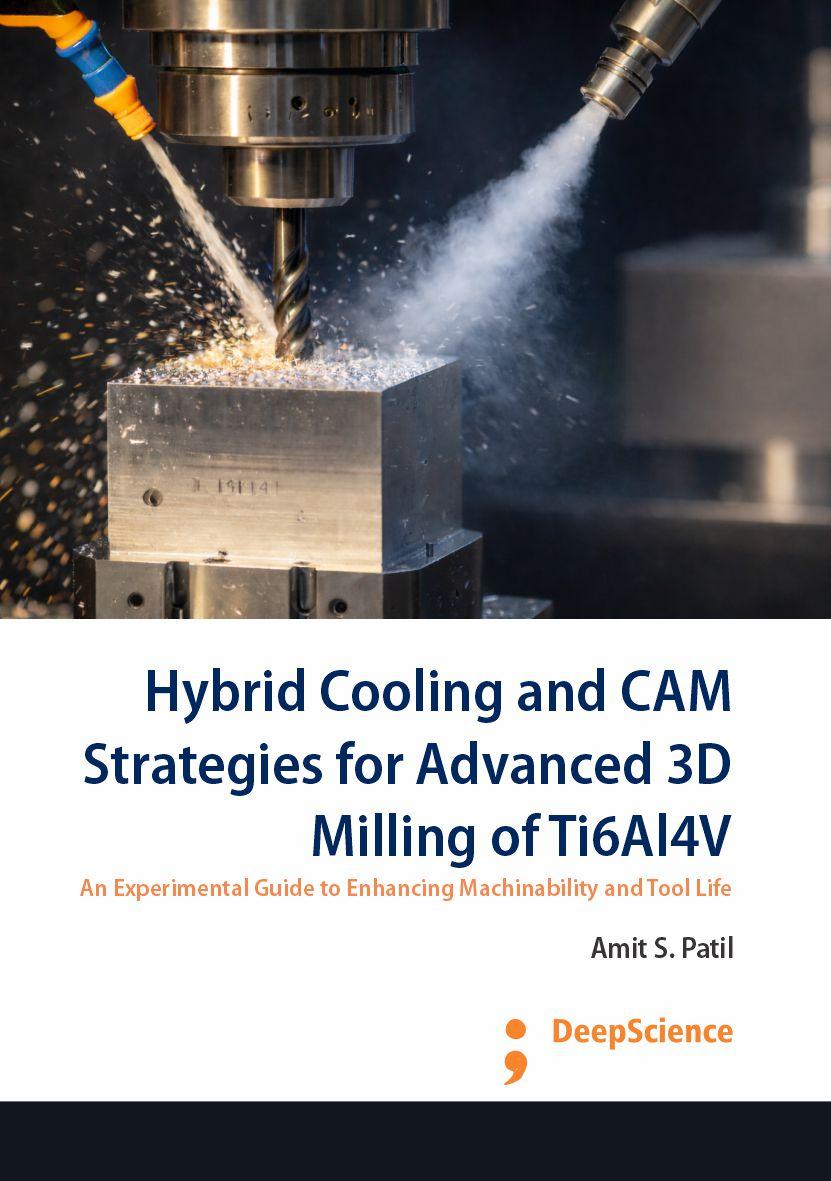
Hybrid Cooling and CAM Strategies for Advanced 3D Milling of Ti6Al4V: An Experimental Guide to Enhancing Machinability and Tool Life
##plugins.pubIds.doi.readerDisplayName##
https://doi.org/10.70593/978-93-7185-944-8
Keywords:
Machinability, Shearing parameters, Tool life, Surface quality, Computer-Aided Machining, Machining efficiency, Thermal conductivitySynopsis
This study develops 3D milling solutions for enhancing machinability, emphasizing tool life and surface quality. The comparative experimental examination included various degrees of machining process parameters and classic and innovative cooling approaches inside the framework of Computer-Aided Machining strategies. The findings from real-time experimentation were reviewed using Multi-Criteria Decision-Making procedures to secure the optimal set of process parameters for obtaining recurring outcomes in Ti6Al4V milling about performance parameters like tool wear and surface quality. According to the study, the cutting speed, feed rate, and depth of cut are the main shearing characteristics that substantially affect the flank and crater wear. PVD TiAlN and PVD TiAlN+TiN coated cutting inserts show acceptable performance among other cutting tools in every aspect. The innovative Hybrid Nano Flood cooling techniques primarily absorb frictional and latent heat from the machining zone without altering their phase, improving the heat transfer rate and compensating for Ti6Al4V's weak thermal conductivity. In addition, using different milling tool paths for open pocket and hole milling indicates that shearing parameters were systematically employed within the cooling envelope. Sub-features of the tool path like engage/disengage, cut patterns, and stepover are crucial for regulating the initial intact vibrations and pressure reaching the cutting edge and avoiding catastrophic damage to the tool. The tool's manoeuvring style contributes to chip evacuation and feeds stray markings. Overall, the Computer-Aided tool path is a critical process parameter in the 3D milling of Titanium Alloy Grade 5 to improve machining efficiency.
References
Leyens, C., and Peters, M., 2003, Titanium and Titanium Alloys, WILEY-VCH Verlag GmbH & Co. KGaA, Weinheim, GmbH, Germany.
Ralph, B., 2008, “Titanium Alloys: An Atlas of Structures and Fracture Features,” Mater. Charact., 59(3), p. 348.
Ezugwu, E. O., Machining, H. S., Alloys, A., and Ezugwu, E. O., 2004, “High Speed Machining of Aero-Engine Alloys,” J. Brazilian Soc. Mech. Sci. Eng., 26(1), pp. 1–11.
Ezugwu, E. O., and Wang, Z. M., 1997, “Titanium Alloys and Their Machinability - A Review,” J. Mater. Process. Technol., 68(3), pp. 262–274.
Pramanik, A., 2014, “Problems and Solutions in Machining of Titanium Alloys,” Int. J. Adv. Manuf. Technol., 70(5–8), pp. 919–928.
Ali, S., Polytechnique, N., Songmene, V., and Sup, T., 2014, “Machining of Titanium Alloys - Book,” Zerspannung Der Titanwerkstoffe., 29(JANUARY 2014), pp. 58–62.
Wang, Z., Nakashima, S., and Larson, M., 2014, “Energy Efficient Machining of Titanium Alloys by Controlling Cutting Temperature and Vibration,” Procedia CIRP, 17, pp. 523–528.
Downloads
Published
20 February 2026
Copyright (c) 2026 Amit S. Patil
Details about the available publication format: E-Book
E-Book
ISBN-13 (15)
978-93-7185-944-8
Details about the available publication format: Book (Paperback)
Book (Paperback)
ISBN-13 (15)
978-93-7185-456-6
How to Cite
Patil, A. S. . (2026). Hybrid Cooling and CAM Strategies for Advanced 3D Milling of Ti6Al4V: An Experimental Guide to Enhancing Machinability and Tool Life. Deep Science Publishing. https://doi.org/10.70593/978-93-7185-944-8
Download Citation







 WhatsApp +91 7977171947