

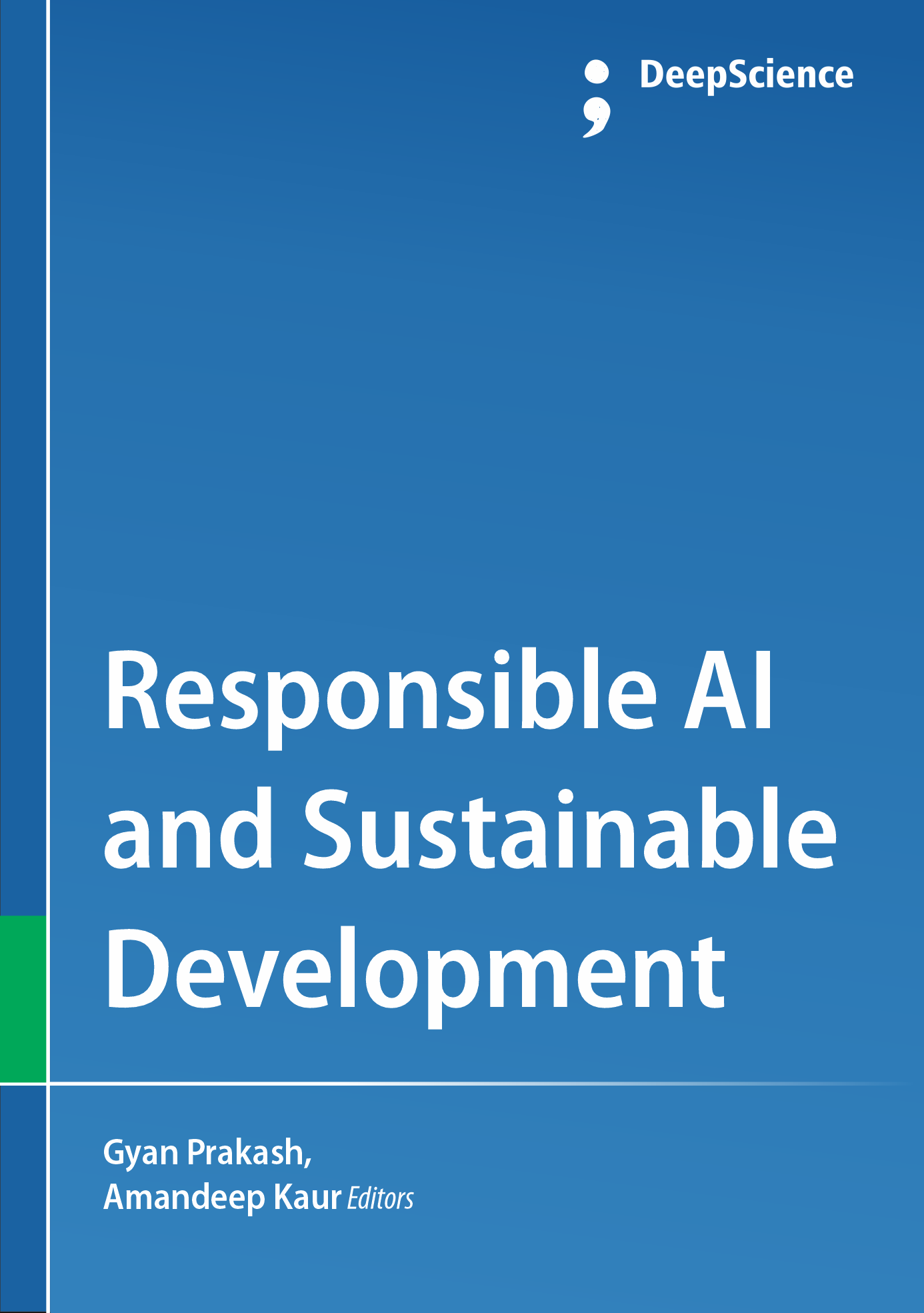
Responsible AI and Sustainable Development
##plugins.pubIds.doi.readerDisplayName##
https://doi.org/10.70593/978-93-7185-916-5
Keywords:
Responsible AI, Sustainable Development, Artificial Intelligence, Climate Resilience, Health, Education, Industry 5.0Synopsis
Human-Centered Artificial Intelligence and Ethics
Explainable and Transparent AI
Human-in-the-loop and Trustworthy AI Systems
Affective Computing and Personalized User Experiences
Fairness, Bias Mitigation, and Responsible AI
Ethical and Societal Dimensions of AI Adoption
AI for Sustainable Development and Climate Resilience
AI for Smart and Renewable Energy Systems
Environmental Monitoring and Climate Modeling
Sustainable Agriculture and Resource Optimization
Low-Carbon and Green AI Technologies
AI for Disaster Risk Reduction and Resilient Infrastructures
Intelligent Solutions for Health, Education, and Society
AI in Healthcare: Diagnostics, Mental Health, and Assistive Tech
AI-Enhanced Education and Skill Development
Smart Cities, Public Safety, and Urban Well-being
Inclusive Technologies for Marginalized and Rural Communities
Social Good Applications of AI
Digital Transformation and Industry 5.0
AI in Manufacturing, Supply Chains, and Industrial Automation
Human-Machine Collaboration and Augmented Workspaces
Federated and Edge AI for Real-Time Decision Making
Digital Twins and Predictive Maintenance
Sustainable and Human-Centric Industry 5.0 Solutions
References
Blease, Charlotte, and Cosima Locher. 2025. “The Rise of Artificial Intelligence in Mental Health: The Potential and the Pitfalls.” JMIR Mental Health 12 (1): e75078. https://mental.jmir.org/2025/1/e75078.
Choi, H., S. Park, and J. Lee. 2025. “Neuro-Inclusive Design Patterns for AI-Driven Interaction.” Disability and Rehabilitation: Assistive Technology 20 (4): 112–28.
Guha, Shion, et al. 2025. “Trauma-Informed Conversational Agents for Mental Health: Understanding User Perspectives.” Proceedings of the CHI Conference on Human Factors in Computing Systems. https://doi.org/10.1145/3544548.3581196.
Iftikhar, Zainab, Amy Xiao, Jeff Huang, Harini Suresh, and Sean Ransom. 2025. “How LLM Counselors Violate Ethical Standards in Mental Health Practice: A Practitioner-Informed Framework.” Proceedings of the Eighth AAAI/ACM Conference on AI, Ethics, and Society. https://doi.org/10.1609/aies.v8i2.36632.
Niu, X., et al. 2024. “PersonalCareNet: A Hybrid Deep Learning Framework with Explainable AI for Healthcare Risk Prediction.” BMC Medical Informatics and Decision Making 24 (1): 45.
Peters, D., R. A. Calvo, and R. M. Ryan. 2025. “Human-Centered Artificial Intelligence for Digital Well-Being (HCAI-DW): A Framework for Benevolent Autonomy.” JMIR Human Factors 12: e69533.
Pfohl, Stephen R., et al. 2025. “A Five-Step Framework for Evaluating Bias in Large Language Models for Healthcare.” NPJ Digital Medicine 8 (1): 1–10.
Downloads
Published
24 February 2026
Copyright (c) 2026 Gyan Prakash; Amandeep Kaur
Details about the available publication format: E-Book
E-Book
ISBN-13 (15)
978-93-7185-916-5
Details about the available publication format: Book (Paperback)
Book (Paperback)
ISBN-13 (15)
978-93-7185-610-2
How to Cite
Kaur, A. . (2026). Responsible AI and Sustainable Development (G. . Prakash , Ed.). Deep Science Publishing. https://doi.org/10.70593/978-93-7185-916-5
Download Citation







 WhatsApp +91 7977171947