

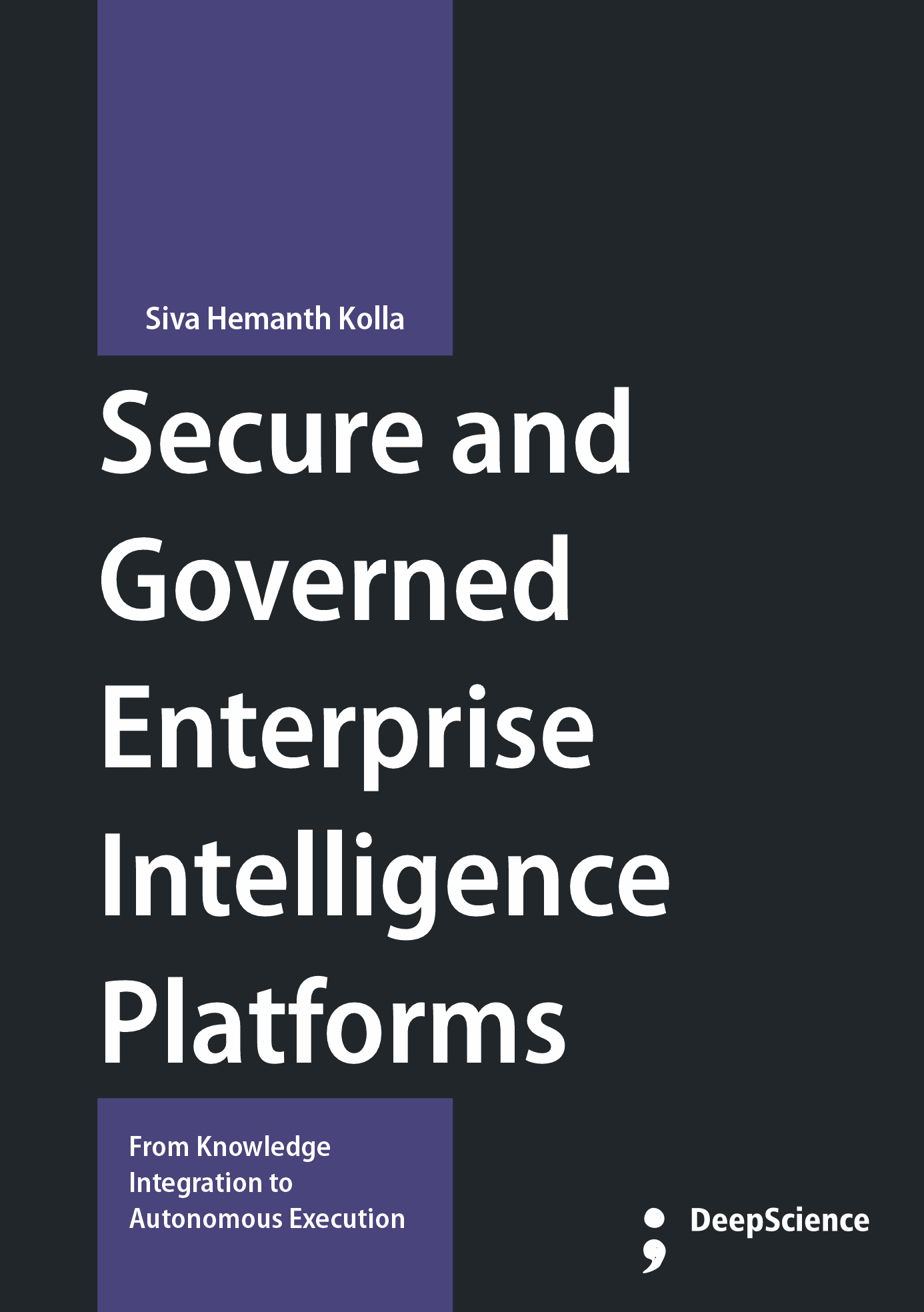
Secure and Governed Enterprise Intelligence Platforms: From Knowledge Integration to Autonomous Execution
##plugins.pubIds.doi.readerDisplayName##
https://doi.org/10.70593/978-93-7185-975-2
Keywords:
Data Integration, Automated Workflows, API, Governance Models, Responsible AI, Risk Management, Operational ResilienceSynopsis
The enterprise of the twenty-first century is, at its core, an information enterprise. Every decision made, every strategy pursued, and every competitive advantage gained flows from an organization's ability to gather, interpret, and act upon knowledge faster, smarter, and more reliably than those around it. Yet for decades, the promise of truly unified organizational intelligence has remained frustratingly out of reach, buried beneath silos of incompatible systems, fragmented data architectures, and governance frameworks that struggle to keep pace with technological change. This book was born from a recognition that something fundamental has shifted. The convergence of large language models, retrieval-augmented generation, agentic reasoning systems, and enterprise-grade security infrastructure has created a new category of platform one capable not merely of surfacing information, but of reasoning across it, orchestrating complex workflows, and executing decisions with a degree of autonomy that would have seemed improbable just a few years ago.
But capability without governance is a liability. Autonomy without accountability is a risk no serious enterprise can afford to take. That tension between the transformative power of intelligent automation and the non-negotiable demands of security, compliance, and human oversight sits at the heart of everything discussed in these pages. This book is written for technology leaders, enterprise architects, data governance professionals, and the growing class of practitioners who find themselves at the crossroads of artificial intelligence and organizational strategy. It is neither a purely technical manual nor a high-level survey of trends. Rather, it attempts to bridge those two worlds offering rigorous architectural guidance alongside the broader strategic and ethical thinking that responsible deployment demands.
The journey from knowledge integration to autonomous execution is not a straight line. It is messy, iterative, and deeply context-dependent. The goal of this book is to make that journey clearer, safer, and ultimately more rewarding for everyone who undertakes it.
Chapters
-
Foundations of Secure and Governed Enterprise Intelligence
-
Architectural Patterns for Enterprise Knowledge Platforms
-
Data Integration and Contextual Knowledge Engineering
-
Designing Secure Access and API Management Frameworks
-
Orchestrating Intelligent Agents and Automated Workflows
-
Governance Models for Responsible and Controlled AI Systems
-
Risk Management, Compliance, and Policy Enforcement
-
Monitoring, Observability, and Operational Resilience
-
Scaling Autonomous Execution Across Enterprise Services
-
Future Directions in Trusted and Self-Regulating Enterprise Intelligence Systems
References
Stahl, B. C., Timmermans, J., & Mittelstadt, B. (2021). Ethics of computing: A systematic literature review. ACM Computing Surveys, 54(2), 1–38.
Floridi, L., Cowls, J., Beltrametti, M., et al. (2022). The European approach to artificial intelligence: AI Act and beyond. Philosophy & Technology, 35(1), 1–17.
Zetzsche, D. A., Buckley, R. P., Arner, D. W., & Barberis, J. (2020). Regulating a revolution. Fordham Journal of Corporate & Financial Law, 23(1), 31–103.
Kshetri, N., & Voas, J. (2022). Blockchain-enabled financial services. IEEE Security & Privacy, 20(1), 35–43.
Bai, T., Zheng, Z., Ren, K., & Shi, S. (2024). Cloud-native machine learning systems. IEEE Software, 41(1), 50–58.
Aitha, A. R., & Jyothi Babu, D. A. (2025). Agentic AI-Powered Claims Intelligence: A Deep Learning Framework for Automating Workers Compensation Claim Processing Using Generative AI. Available at SSRN 5505223.
Chen, Y., & Zhang, L. (2022). Data engineering for real-time analytics. IEEE Transactions on Services Computing, 15(4), 2288–2302.
Downloads
Published
18 February 2026
Copyright (c) 2026 Siva Hemanth Kolla
Details about the available publication format: E-Book
E-Book
ISBN-13 (15)
978-93-7185-975-2
Details about the available publication format: Book (Paperback)
Book (Paperback)
ISBN-13 (15)
978-93-7185-156-5
How to Cite
Kolla, S. H. . (2026). Secure and Governed Enterprise Intelligence Platforms: From Knowledge Integration to Autonomous Execution. Deep Science Publishing. https://doi.org/10.70593/978-93-7185-975-2
Download Citation









 WhatsApp +91 7977171947