

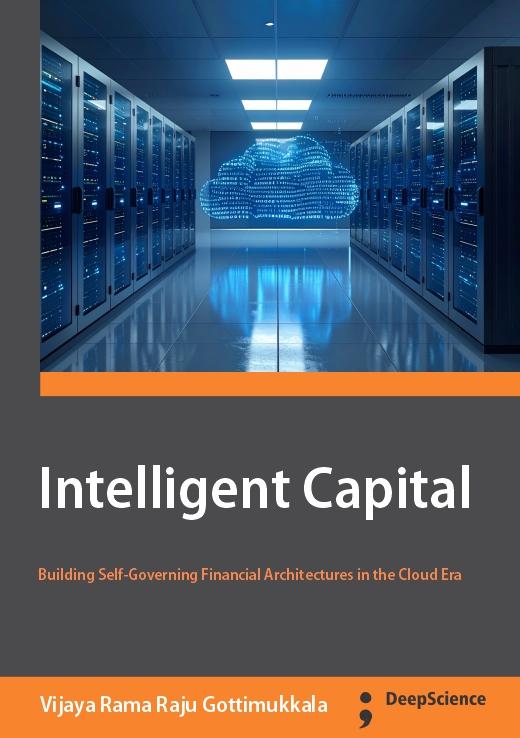
Intelligent Capital: Building Self-Governing Financial Architectures in the Cloud Era
##plugins.pubIds.doi.readerDisplayName##
https://doi.org/10.70593/978-93-7185-144-2
Keywords:
Financial Architectures, Financial Systems, Cloud-Native Architectures, Scalability, Resilience, Digital Transformation, FinanceSynopsis
We are entering an age where capital is no longer merely accumulated, it is architected. Money used to sit in vaults, accounts, and portfolios, waiting for human instruction. Today, it lives in code, flows through networks, reacts to data, and increasingly makes decisions without asking permission first. The cloud did not just change where software runs; it changed how value itself behaves.
This book explores a simple but radical idea: financial systems can be designed to govern themselves.
For centuries, finance has depended on layers of human coordination — bankers, regulators, analysts, brokers, and institutions acting as the nervous system of capital. But cloud infrastructure, artificial intelligence, and programmable financial primitives are dissolving those layers. Capital can now be embedded with logic, policy, and adaptive behavior. It can assess risk in real time, allocate resources dynamically, enforce compliance automatically, and evolve based on environmental signals.
This shift is not merely technological. It is architectural. When financial structures become software-defined, they inherit the properties of modern systems: scalability, modularity, automation, and resilience. But they also inherit new vulnerabilities, governance questions, and ethical tensions. Who is responsible when autonomous capital acts? How do we encode trust? What does regulation mean when systems operate across jurisdictions at machine speed? “Intelligent Capital” is not a prediction of a distant future. It is a map of a transition already underway from human-operated finance to self-governing financial architectures.
The goal of this book is not to celebrate automation, nor to resist it, but to understand it deeply enough to design it wisely. Because in the cloud era, the most powerful financial institution may no longer be an organization.
Chapters
-
From Legacy Rails to Intelligent Infrastructure: The Evolution of Financial Systems
-
Autonomous Agents in Finance: Designing Decision-Making Systems That Learn and Adapt
-
Cloud-Native Architectures: Scalability, Resilience, and the New Financial Stack
-
Real-Time Settlement: Engineering Sub-Second Transaction Processing at Global Scale
-
Beyond Borders: Architecting Cross-Jurisdictional Payment Networks in a Fragmented World
-
The Governance Paradox: Regulating Systems That Regulate Themselves
-
Machine Intelligence for Risk: Deep Learning Models in Credit, Fraud, and Market Prediction
-
Generative AI as Financial Co-Pilot: Automation, Augmentation, and the Human-Machine Interface
-
Security by Design: Zero-Trust Architectures and Privacy-Preserving Computation in Finances
-
The Self-Governing Enterprise: Digital Transformation and the Future of Financial Institutions
References
Baryannis, G., Dani, S., & Antoniou, G. (2019). Predictive analytics and artificial intelligence in supply chain management: Review and implications. Computers & Industrial Engineering, 137, 106024.
Amistapuram, K. (2025). Agentic AI for Next-Generation Insurance Platforms: Autonomous Decision-Making in Claims and Policy Servicing. Journal of Marketing & Social Research, 2, 88-103.
Nagabhyru, K. C., Rani, M., Reddy, D. S., & Krishnaraj, V. (2025, August). Machine Learning-Driven Fault Detection in Electric Vehicles via Hybrid Reinforcement Learning Model. In 2025 2nd International Conference on Intelligent Algorithms for Computational Intelligence Systems (IACIS) (pp. 1-6). IEEE.
Blier-Wong, C., Cossette, H., & Marceau, E. (2021). Tree-based machine learning models for insurance ratemaking. North American Actuarial Journal, 25(3), 383–407.
Charpentier, A., Denuit, M., & Trufin, J. (2021). Explainable machine learning in insurance pricing. Scandinavian Actuarial Journal, 2021(7), 565–594.
Downloads
Published
10 February 2026
Copyright (c) 2026 Vijaya Rama Raju Gottimukkala
Details about the available publication format: E-Book
E-Book
ISBN-13 (15)
978-93-7185-144-2
Details about the available publication format: Book (Paperback)
Book (Paperback)
ISBN-13 (15)
978-93-7185-266-1
How to Cite
Gottimukkala, V. R. R. . (2026). Intelligent Capital: Building Self-Governing Financial Architectures in the Cloud Era. Deep Science Publishing. https://doi.org/10.70593/978-93-7185-144-2
Download Citation








 WhatsApp +91 7977171947