

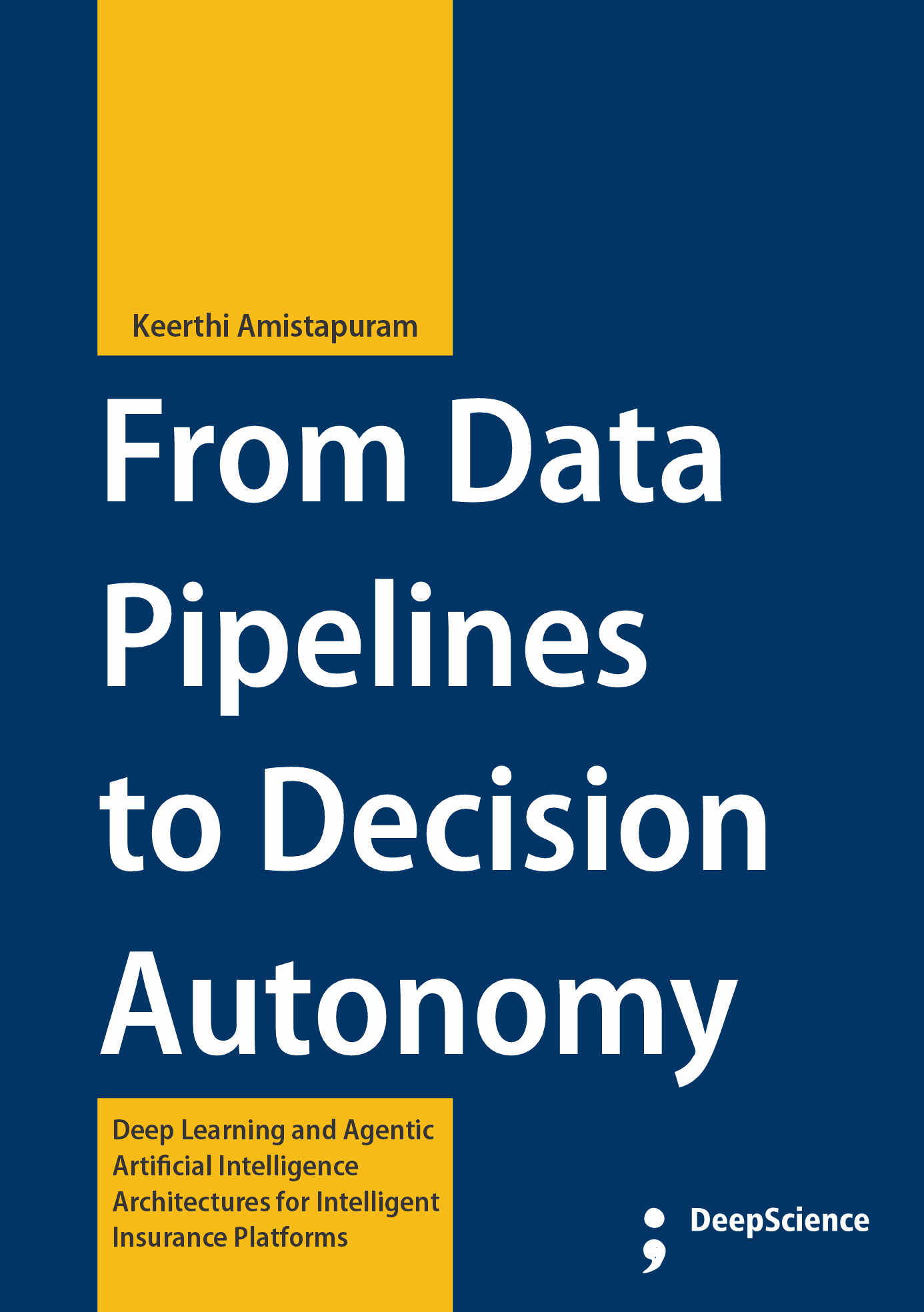
From Data Pipelines to Decision Autonomy: Deep Learning and Agentic AI Architectures for Intelligent Insurance Platforms
##plugins.pubIds.doi.readerDisplayName##
https://doi.org/10.70593/978-93-7185-416-0
Keywords:
Deep Learning, Agentic Artificial Intelligence, Insurance, Digital Transformation, Risk Modeling, Predictive Analytics, Fraud Detection SystemsSynopsis
The insurance industry stands at a pivotal crossroads. Traditional actuarial models and rule-based systems, while foundational, are increasingly insufficient to navigate the complexities of modern risk assessment, fraud detection, and customer personalization. The convergence of deep learning, cloud-native architectures, and agentic AI systems has opened unprecedented opportunities to transform insurance from a reactive, process-heavy industry into a proactive, intelligence-driven ecosystem. This book emerged from years of hands-on experience designing and deploying machine learning systems across healthcare, financial services, and retail sectors, each demanding precision, scalability, and ethical responsibility. What became evident was that the future of insurance lies not merely in automating existing workflows, but in building platforms capable of autonomous decision-making, continuous learning, and adaptive risk management.
From Data Pipelines to Decision Autonomy bridges the gap between theoretical AI concepts and practical implementation. We explore how raw, distributed data transforms into actionable intelligence through robust pipelines, how deep learning models uncover hidden patterns in claims and underwriting, and how agentic AI architectures enable systems to reason, plan, and act with minimal human intervention. Each chapter is structured to serve both technical practitioners and strategic decision-makers. You'll find architectural blueprints for building scalable data platforms on GCP and AWS, MLOps frameworks for deploying models in production, and real-world case studies demonstrating measurable business impact. We address the critical challenges of model explainability, regulatory compliance, and ethical AI deployment considerations that cannot be afterthoughts in an industry built on trust.
Whether you're a data engineer architecting your first insurance data lake, a machine learning engineer optimizing fraud detection models, or an executive navigating digital transformation, this book provides the technical depth and strategic vision needed to build truly intelligent insurance platforms.
The journey from data to autonomous decisions begins here.
Chapters
-
Foundations of Intelligent Insurance Systems and Digital Transformation
-
Data Engineering for Insurance AI: Building Scalable and Reliable Data Pipelines
-
Deep Learning Techniques for Risk Modeling and Predictive Analytics
-
Generative AI in Insurance: Synthetic Data, Scenario Simulation, and Knowledge Generation
-
Principles of Agentic AI and Autonomous Decision-Making Systems
-
Designing Agentic AI Architectures for Insurance Platforms
-
Fraud Detection Systems Using Deep Learning and Behavioral Intelligence
-
Cloud-Native Infrastructure and DevOps Practices for AI-Driven Insurance Systems
-
Automation, MLOps, and Continuous Learning in Production AI Environments
-
Governance, Ethics, and the Future of Autonomous Insurance Intelligence Systems
References
Henckaerts, R., Antonio, K., Côté, M.-P., & Verbelen, R. (2021). Boosting insights in insurance tariff plans with tree-based machine learning methods. North American Actuarial Journal, 25(2), 255–285.
Huang, Y., Li, J., & Wang, Q. (2024). Predictive reliability modeling for system-on-chip designs using machine learning. IEEE Transactions on Reliability, 73(1), 45–58
Rongali, S. K. (2025, August). Deep Learning for Cybersecurity in Healthcare: A Mulesoft-Enabled Approach. In 2025 International Conference on Artificial Intelligence and Machine Vision (AIMV) (pp. 1-6). IEEE..
Kietzmann, J., Paschen, J., & Treen, E. (2023). Artificial intelligence in advertising and marketing: A systematic literature review. Journal of Business Research, 156, 113451.
Segireddy, A. R. (2025). GENERATIVE AI FOR SECURE RELEASE ENGINEERING IN GLOBAL PAYMENT NETWORK. Lex Localis: Journal of Local Self-Government, 23.
Makridakis, S., Spiliotis, E., & Assimakopoulos, V. (2022). Statistical and machine learning forecasting methods: Concerns and ways forward. PLOS ONE, 17(3), e0265480.
FinOps Strategies for AI-Enabled Real-Time Compliance Platforms in Cloud Native Environments. (2025). MSW Management Journal, 35(2), 2080-2088.
Pesantez-Narvaez, J., Guillen, M., & Alcañiz, M. (2019). Predicting motor insurance claims using telematics data—XGBoost versus logistic regression. Risks, 7(2), 70.
Downloads
Published
10 February 2026
Copyright (c) 2026 Keerthi Amistapuram
Details about the available publication format: E-Book
E-Book
ISBN-13 (15)
978-93-7185-416-0
Details about the available publication format: Book (Paperback)
Book (Paperback)
ISBN-13 (15)
978-93-7185-212-8
How to Cite
Amistapuram, K. . (2026). From Data Pipelines to Decision Autonomy: Deep Learning and Agentic AI Architectures for Intelligent Insurance Platforms. Deep Science Publishing. https://doi.org/10.70593/978-93-7185-416-0
Download Citation









 WhatsApp +91 7977171947