

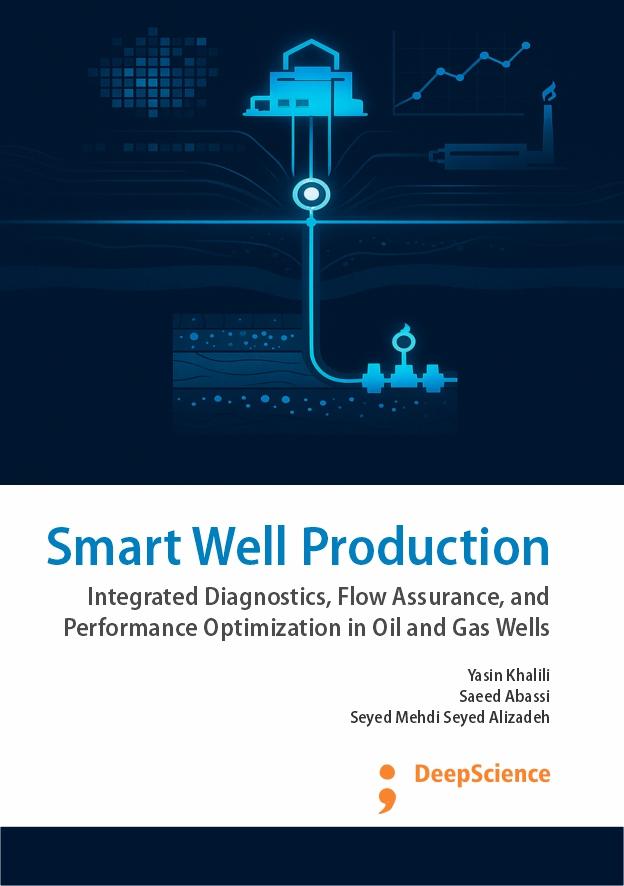
Smart Well Production: Integrated Diagnostics, Flow Assurance, and Performance Optimization in Oil and Gas Wells
##plugins.pubIds.doi.readerDisplayName##
https://doi.org/10.70593/978-93-7185-111-4
Keywords:
Smart Well, Flow Assurance, Oil and Gas Wells, Production Enhancement, Predictive Modeling, Artificial Intelligence, Machine LearningSynopsis
Smart Well Production: Integrated Diagnostics, Flow Assurance, and Performance Optimization in Oil & Gas Wells presents an integrated, systems approach to optimizing hydrocarbon recovery with provision for operational reliability, efficiency, and sustainability in modern oil and gas production environments. As reservoirs grow more complex from deepwater frontiers to unconventional shales and mature fields traditional siloed well management is inadequate. It is bringing disciplines together to marry reservoir engineering, production diagnostics, flow assurance, artificial lift, and digital transformation into a unified strategy for intelligent well performance management (IWPM).
The text begins with rudimentary ideas of wellbore hydraulics, multiphase flow, and PVT behavior, and then moves through cutting-edge technologies such as permanent downhole gauges (PDGs), distributed fiber-optic sensing (DTS/DAS), and real-time surveillance systems. It gives great space to predictive modeling, uncertainty quantification, and digital twins, showing the way data-driven insight can prevent flow assurance failure and improve system-wide performance.
The theme of the book is the shift away from reactive triage toward proactive optimization-enabled by combined nodal analysis, closed-loop control, and machine learning algorithms that detect anomalies as problems before they happen. The book outlines practical measures to curb hydrate and wax formation, liquid loading, sand generation, and conformance-related issues, which are significantly supported by practical case studies, which are based on offshore, onshore, deepwater, and unconventional settings. Later chapters explore the innovations in digital technology, such as cloud-based analytics systems, autonomous well architectures, robotic intervention systems, and artificial-intelligence-enhanced decision-making in the conceptualization of smart wells, which are proposed to be the key to the future low-carbon energy businesses. One of the primary motifs is sustainable practice, although the special attention is paid to the monitoring of emissions, chemical optimization, and energy efficiency, which are all the components of the production excellence that cannot be neglected. The paper is benchmarked to appeal to petroleum engineers, completion specialists, flow-assurance analysts and digital-oilfield practitioners, incorporating the theoretical subtleties with a writhingly proven implementation. Each of the chapters also has pedagogical tools (such as tables, figures, worked-out examples, and best-practice checklists) to make the process of teaching easier and more approachable to practice.
Smart Well Production is not only a technical manual but also a strategic manual for turning plain wells into smart, smart wells with self-diagnosis, self-optimization, and autonomous operation paving the way for the future of autonomous fields and cognitive reservoir management.
References
Brown, K. E. (1984). The technology of artificial lift methods, Volume 4.
Adukwu, O. (2023). Optimisation of gas-lifted system using nonlinear model predictive control (Doctoral dissertation, Universidade de São Paulo).
Edouard, M. N., Okere, C. J., Dong, P., Ejike, C. E., Emmanuel, N. N., & Muchiri, N. D. (2022). Application of fiber optics in oil and gas field development—a review. Arabian Journal of Geosciences, 15(6), 539.
Tariq, Z., Aljawad, M. S., Hasan, A., Murtaza, M., Mohammed, E., El-Husseiny, A., ... & Abdulraheem, A. (2021). A systematic review of data science and machine learning applications to the oil and gas industry. Journal of Petroleum Exploration and Production Technology, 11(12), 4339-4374.
Mirza, M. A., Ghoroori, M., & Chen, Z. (2022). Intelligent petroleum engineering. Engineering, 18, 27-32.
Shan, Y., Tian, K., Li, R., Guan, Y., Ou, J., Guan, D., & Hubacek, K. (2025). Global methane footprints growth and drivers 1990-2023. Nature Communications, 16(1), 8184.
Kamal, M. M. (2021, April). Future need of petroleum engineering. In SPE Western Regional Meeting (p. D011S001R002). SPE.
Fanchi, J. R., & Christiansen, R. L. (2016). Introduction to petroleum engineering. John Wiley & Sons.
Ershaghi, I., & Paul, D. L. (2017, October). The Changing Shape of Petroleum Engineering Education. In SPE Annual Technical Conference and Exhibition? (p. D021S011R003). SPE.
DiCarlo, J., Eustes, A., & Steeger, G. (2019, September). A history of operations research
Downloads
Published
12 February 2026
Copyright (c) 2026 Yasin Khalili, Saeed Abassi, Seyed Mehdi Seyed Alizadeh
Details about the available publication format: E-Book
E-Book
ISBN-13 (15)
978-93-7185-111-4
Details about the available publication format: Book (Paperback)
Book (Paperback)
ISBN-13 (15)
978-93-7185-080-3
How to Cite
Khalili, Y. ., Abassi, S. ., & Alizadeh, S. M. S. . (2026). Smart Well Production: Integrated Diagnostics, Flow Assurance, and Performance Optimization in Oil and Gas Wells. Deep Science Publishing. https://doi.org/10.70593/978-93-7185-111-4
Download Citation







 WhatsApp +91 7977171947