

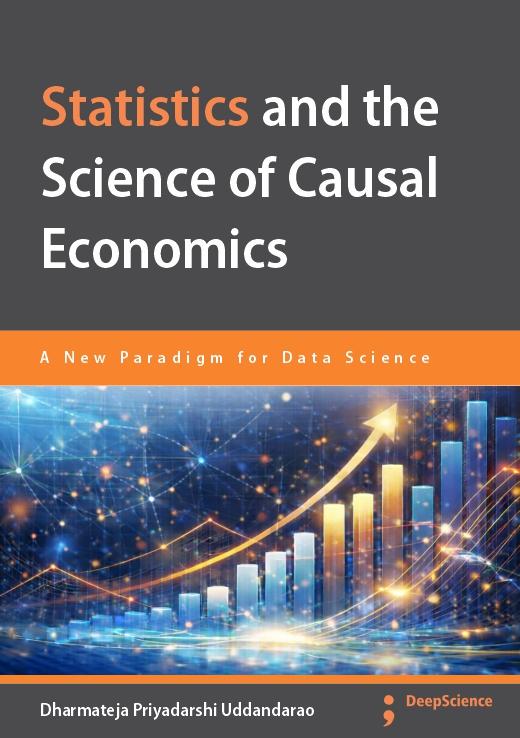
Statistics and the Science of Causal Economics: A New Paradigm for Data Science
##plugins.pubIds.doi.readerDisplayName##
https://doi.org/10.70593/978-93-7185-895-3
Keywords:
Causal Inference, Causal Economics, Econometrics, Counterfactual Analysis, Causal Machine Learning, Structural Causal Models, Instrumental VariablesSynopsis
Right now is a very important time when data is the most important thing to think about when making choices. Organizations, governments, and researchers have gathered more information than ever before, but many still have trouble with a basic question: How do we go from knowing what happened to understanding why it happened and, more importantly, what will happen if we intervene? This book comes from a simple but deep realization: the most common predictive models in modern data science are good at making predictions, but they don't really help us answer the most important questions about cause and effect in economics and policy.
The change from correlation to causation marks a major shift in the way modern data scientists think. For a long time, the most common way to do statistics was by using associations. These techniques are good at finding patterns, but they don't say what makes those patterns happen. A predictive model may accurately forecast that students engaged in tutoring sessions will attain superior examination results; however, it cannot ascertain whether augmented tutoring will genuinely improve outcomes or if high-achieving students simply choose to attend tutoring more frequently. The main point of this book is to help people figure out the difference between making predictions and understanding what causes things to happen.
The motivation for this initiative stems from the recognition of numerous policy failures and business decisions that, despite utilizing sophisticated predictive analytics, produced unsatisfactory or even harmful results. When policymakers use correlational data to make decisions, they risk putting in place programs that waste money or, even worse, hurt the people they want to help. The COVID-19 pandemic made this problem very clear. Governments all over the world had a hard time figuring out the cause-and-effect relationships between lockdowns, mask mandates, and vaccination campaigns because they were flooded with correlational data that often pointed in different directions.
People from all walks of life will find this book useful. They all need to be able to think about economic events in terms of cause and effect. There is a full framework for graduate students in economics, statistics, and data science that links classical econometrics with modern machine learning. Researchers conducting empirical studies will identify robust methodologies for distinguishing causal effects from both experimental and observational data. Policy analysts who need to look at interventions will get tools that will help them do reliable impact assessments. Causal inference changes the tools data scientists use to analyze data, which is what they need to do to go from prediction to prescription. Business analysts can make smart choices by using frameworks to figure out not only what customers do, but also how they respond to changes in prices, marketing, and product features.
The way this book is written shows that the author has a clear idea of how to teach. We start with the basics: explaining why causality is important and introducing the counterfactual reasoning that is the basis for all causal inference. We then put together the statistical and econometric tools we need for reliable causal analysis, always making sure to point out the assumptions that are needed for valid inference. The middle chapters talk about more advanced ways to use observational data to find causal relationships. These include directed acyclic graphs, matching techniques, and causal machine learning. We then apply these ideas to dynamic situations with time-dependent effects and complicated feedback loops that make analysis harder. Lastly, we show how these methods can help people make decisions in the real world about things like policy, business, healthcare, and environmental economics.
This book is different from others because it combines three areas that are usually kept separate. We can use classical econometrics to figure out how to think about structures and how to make causal inferences. Modern machine learning offers flexible, data-driven methodologies for estimating various treatment effects and managing high-dimensional confounding variables. Statisticians and computer scientists created causal inference theory, which helps us clarify our assumptions and think about how to intervene. By merging these perspectives, we establish a cohesive framework for outcome-driven decision-making that is both theoretically robust and practically applicable.
I emphasize the necessity of transparency regarding the challenges associated with deriving causal conclusions throughout this work. We can test models against actual results when we predict, but when we make causal claims, we have to guess about things we can't see. This book doesn't promise easy answers or step-by-step instructions that will always lead to the truth. Instead, it gives readers the tools they need to make their assumptions clear, check how likely they are to be true, and do sensitivity analyses to see how those assumptions affect the conclusions. This honest admission of uncertainty is not a weakness but a strength; it is the foundation for responsible, credible causal analysis.
As we move closer to a future driven by AI, the importance of causal reasoning will only grow. Automated decision systems are having a bigger and bigger impact on the economy. This includes personalized medicine, algorithmic hiring and lending, and ads that are aimed at specific people. If we don't understand the causes, these systems could keep biases going, optimize for the wrong goals, and have big effects that we didn't mean to happen. The last chapter talks about how causal economics can help make AI systems that are fair, open, and accountable, and that really help people.
I hope this book will do more than just show you how to use data and make choices; I hope it will also change how you think about them. To go from thinking about the future to thinking about the past, you need to do more than just learn new ways of doing things. We need to completely change how we ask questions, plan analyses, and make sense of results. I really think that this change, no matter how hard it is, is needed to make a future where data science really helps people by helping them make decisions based on facts.
Chapters
-
From Prediction to Causality in Data Science
-
Counterfactual Thinking and What-If Analysis
-
Statistical and Econometric Foundations of Causal Economics
-
Causal Modeling with Observational Data
-
Outcome-Driven Causal Inference
-
Causality Over Time and Economic Dynamics
-
Applications of Causal Economics to Real-World Decisions
References
Lo, V. S., & Pachamanova, D. A. (2023). From meaningful data science to impactful decisions: The importance of being causally prescriptive. Data Science Journal, 22(1).
Heckman, J. J., & Pinto, R. (2022). The econometric model for causal policy analysis. Annual review of economics, 14(1), 893-923.
Lamsaf, A., Carrilho, R., Neves, J. C., & Proença, H. (2025). Causality, machine learning, and feature selection: a survey. Sensors, 25(8), 2373.
Cox Jr, L. A. (2024). Objective causal predictions from observational data. Critical Reviews in Toxicology, 54(10), 895-924.
Ahrens, A., Aitken, C., & Schaffer, M. E. (2020). Using machine learning methods to support causal inference in econometrics. In Behavioral predictive modeling in economics (pp. 23-52). Cham: Springer International Publishing.
Horton, A. (2024). Causal Economic Machine Learning (CEML):" Human AI". AI, 5(4).
Wyrembek, M., Baryannis, G., & Brintrup, A. (2025). Causal machine learning for supply chain risk prediction and intervention planning. International Journal of Production Research, 1-20.
Pichler, M., & Hartig, F. (2023). Can predictive models be used for causal inference?. arXiv preprint arXiv:2306.10551.
Downloads
Published
10 February 2026
Copyright (c) 2026 Dharmateja Priyadarshi Uddandarao
Details about the available publication format: E-Book
E-Book
ISBN-13 (15)
978-93-7185-895-3
Details about the available publication format: Book (Paperback)
Book (Paperback)
ISBN-13 (15)
978-93-7185-294-4
How to Cite
Uddandarao, D. P. . (2026). Statistics and the Science of Causal Economics: A New Paradigm for Data Science. Deep Science Publishing. https://doi.org/10.70593/978-93-7185-895-3
Download Citation







 WhatsApp +91 7977171947