

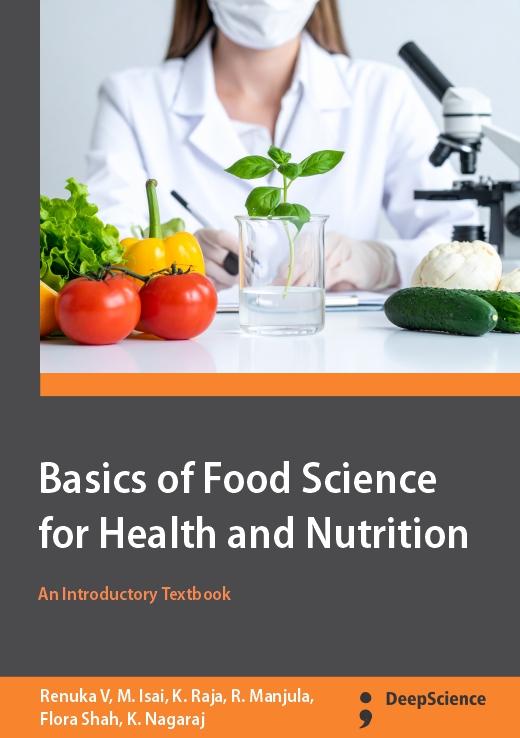
Basics of Food Science for Health and Nutrition: An Introductory Textbook
##plugins.pubIds.doi.readerDisplayName##
https://doi.org/10.70593/978-93-7185-792-5
Keywords:
Food Science, Health, Nutrition, Cooking, Cereal, Pulses, VegetablesSynopsis
Cooking as art has captured the attention of people since time immemorial making simple products enjoyable and nutritious meals. However, one should take a closer look and you will realize that there is a fascinating world behind all the sizzles and the pleasant smell of freshly baked bread whose forces are ruled by the principles of science. The textbook, Basic food science and cooking techniques is based on the assumption that in order to master the art of culinary, one has to have a clear grasp of the science behind it all. We as chefs, home cookers, food lovers and students have found ourselves following recipes, either more successfully or failing. However, what about when a dish does not work out so well? Or when we get the desire to modify a recipe, create something new or find a solution to a cooking issue? Our capacity to change and evolve is not very much in the absence of the knowledge of the reason behind the means. That is the gap that this book will fill, and you will have the knowledge to not only follow recipes but to actually know and work with the ingredients and techniques that you are working with. We will commence our tour of these pages by dissecting the basic building blocks of food carbohydrates, proteins, fats, vitamins and minerals and examining their unusual structures and reactions in various circumstances. Then we will explore some of the most important cooking techniques, both dry-heat cooking, such as roasting and grilling, and moist-heat cooking, such as braising and poaching, and the scientific processes that occur at each of those steps. In addition to single ingredients and methods, we will discuss some even larger concepts such as emulsions, foams, fermentation and the science of flavor which will provide you with a comprehensive set of tools when it comes to culinary explorations. The textbook has been designed to accommodate diverse readers of every kind such as culinary students who want to have a good background, aspiring chefs who want to acquire more knowledge and those who simply want to be good home cookers. It is made easily understandable and comprehensive and it combines ease of use with seriousness so that you can succeed in your cooking career.
References
Potter, N. N., & Hotchkiss, J. H. (2012). Food Science (5th ed.). Springer, New York, USA.
Damodaran, S., Parkin, K. L., & Fennema, O. R. (2017). Fennema’s Food Chemistry (5th ed.). CRC Press, Boca Raton, FL, USA.
Belitz, H. D., Grosch, W., & Schieberle, P. (2009). Food Chemistry (4th ed.). Springer, Berlin, Germany.
McWilliams, M. (2018). Foods: Experimental Perspectives (9th ed.). Pearson Education, New York, USA.
Srilakshmi, B. (2016). Food Science (6th ed.). New Age International Publishers, New Delhi, India.
Swaminathan, M. (2010). Food Science, Chemistry and Experimental Foods. Bappco, Bangalore, India.
Mudambi, S. R., & Rajagopal, M. V. (2017). Fundamentals of Foods, Nutrition and Diet Therapy (6th ed.). New Age International Publishers, New Delhi, India.
Downloads
Published
21 January 2026
Copyright (c) 2026 Renuka V, M. Isai, K. Raja, R. Manjula, Flora Shah, K. Nagaraj
Details about the available publication format: E-Book
E-Book
ISBN-13 (15)
978-93-7185-792-5
Details about the available publication format: Book (Paperback)
Book (Paperback)
ISBN-13 (15)
978-93-7185-809-0
How to Cite
Renuka V, M. Isai, K. Raja, R. Manjula, Shah, F. ., & K. Nagaraj. (2026). Basics of Food Science for Health and Nutrition: An Introductory Textbook. Deep Science Publishing. https://doi.org/10.70593/978-93-7185-792-5
Download Citation






 WhatsApp +91 7977171947