

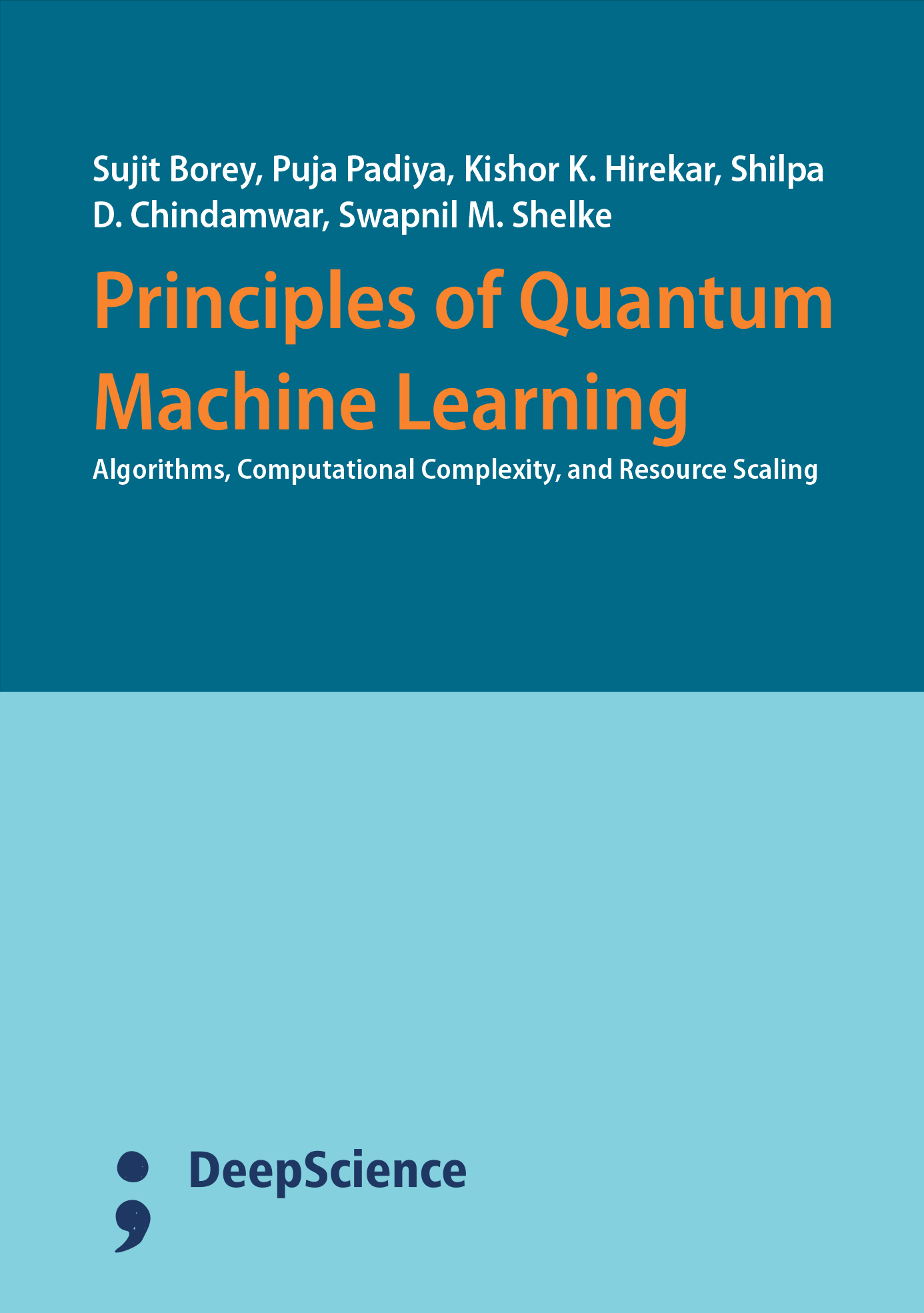
Principles of Quantum Machine Learning: Algorithms, Computational Complexity, and Resource Scaling
##plugins.pubIds.doi.readerDisplayName##
https://doi.org/10.70593/978-93-7185-361-3
Keywords:
Quantum Machine Learning, Algorithms, Resource Scaling, Neural Networks, Artificial Intelligence, Quantum Computing, Quantum DataSynopsis
The intersection of machine learning and quantum computing has been one of the greatest scientific projects in current time. With quantum computing in the offing, the assurance of using quantum mechanical effects in computational learning to transform the world has never been closer. The publication of this book comes at a critical time, when theoretical models are shouldering maturity with capabilities of experimentation, that has brought about great possibilities to implement computational benefits that quantum systems can provide in performing machine learning tasks. Quantum machine learning is one field which has rapidly changed in the last ten years. What was originally viewed as mere theoretical conjecture has now evolved into a living research community which includes rigorous mathematical modeling, novel algorithm design, and more and more complex experimental realisations on the near-term quantum computers. Such change can be characterised by the increasing sophistication of our theory in as well as the revolutionary advances in quantum computing technology, and by the noisy intermediate-scale quantum (NISQ) era.
Chapters in this book chronologically discuss the complex nature of quantum machine learning, including theoretical principles and challenges of practice. All the chapters cover a very important aspect in this growing area leaving the reader not only with an in-depth analysis but also a wide enough point of view to traverse this somewhat complicated inter-disciplinary area. The book is organized in such a way that that it takes the reader through more advanced parts of the quantum machine learning theory and practice. We start by explaining quantum feature maps, and kernel-type methods and laying the mathematical background on which quantum-enhanced learning is based. There we discuss computational complexity, trainability issues, neural network architectures, scaling of resources, sample complexity limits and the issue critical of quantum data encoding.
This book has a variety of audience. The works will also offer exhaustive proposals of key concepts, methodologies and open problems to graduate students and researchers venturing into the field. Individuals who operate quantum computing platforms will have an understanding of the options available when it comes to designing an algorithm and the resources needed, as well as the expectations of its performance. The systematic approach of tackling complexity theorist-foundations and rigorous mathematical analyses will be appreciated by the theorists.
Quantum machine learning is interdisciplinary and requires the services and knowledge of quantum physics, computer science, mathematics, and statistics. Although we do not expect our readers to have the basic knowledge of quantum computing and classical machine learning, we give adequate background and references to accommodate other readers of varying technical background. By 2026, quantum machine learning will be on a important crossroads. NISQ has also provided its own stunning demonstrations and harsh lessons on the difficulty of obtaining useful quantum advantage. Other phenomena like barren plateaus have changed the minds of us on the nature of variational quantum algorithm trainability. Resource-efficient quantum learning has been transformed by the advanced measurement protocols, such as classical shadow tomography. The frontier of the implementable quantum algorithms is constantly being pushed by hardware advances.
The book reflects the picture of the field in this dynamic time, including the latest theoretical developments, their experiments, and new optimal practices. We admit that quantum machine learning is a fast-developing science, and there are certain spheres of our knowledge that will surely become more profound in the nearest future. The transformative potential of quantum machine learning is still achievable only with further achievements in many dimensions: the theory of when and why quantum algorithms are effective, algorithmic innovations to overcome the limitations of near-term hardware, hardware engineering to overcome qubit quality and system scale, and discovering applications when quantum algorithms and methods and methods offer significant superior practical performance.
Hopefully, this book will provide useful guidance to all the existing knowledge and guide to the future innovations. The opportunities are out of the world, yet the challenges are significant. With the ongoing development of quantum hardware capabilities and an ever-increasing theoretical basis, it is quite possible that quantum machine learning will transform the world of approaching the problem of complex computational learning.
References
Abdelwahab HR, Rauf A, Chen D. Business students’ perceptions of Dutch higher educational institutions in preparing them for artificial intelligence work environments. Industry and Higher Education. 2023 Feb;37(1):22-34.
Abrokwah-Larbi K, Awuku-Larbi Y. The impact of artificial intelligence in marketing on the performance of business organizations: evidence from SMEs in an emerging economy. Journal of Entrepreneurship in Emerging Economies. 2024 Jun 13;16(4):1090-117.
Agarwal P, Swami S, Malhotra SK. Artificial intelligence adoption in the post COVID-19 new-normal and role of smart technologies in transforming business: a review. Journal of Science and Technology Policy Management. 2024 Apr 18;15(3):506-29.
Ahmed AA, Agarwal S, Kurniawan IG, Anantadjaya SP, Krishnan C. Business boosting through sentiment analysis using Artificial Intelligence approach. International Journal of System Assurance Engineering and Management. 2022 Mar;13(Suppl 1):699-709.
Alam A, Mohanty A. Business models, business strategies, and innovations in EdTech companies: integration of learning analytics and artificial intelligence in higher education. In2022 IEEE 6th Conference on Information and Communication Technology (CICT) 2022 Nov 18 (pp. 1-6). IEEE.
Alawadhi SA, Zowayed A, Abdulla H, Khder MA, Ali BJ. Impact of artificial intelligence on information security in business. In2022 ASU International Conference in Emerging Technologies for Sustainability and Intelligent Systems (ICETSIS) 2022 Jun 22 (pp. 437-442). IEEE.
Badghish S, Soomro YA. Artificial intelligence adoption by SMEs to achieve sustainable business performance: application of technology–organization–environment framework. Sustainability. 2024 Feb 24;16(5):1864.
Beheshti A, Yang J, Sheng QZ, Benatallah B, Casati F, Dustdar S, Nezhad HR, Zhang X, Xue S. ProcessGPT: transforming business process management with generative artificial intelligence. In2023 IEEE international conference on web services (ICWS) 2023 Jul 2 (pp. 731-739). IEEE.
Bickley SJ, Macintyre A, Torgler B. Artificial intelligence and big data in sustainable entrepreneurship. Journal of Economic Surveys. 2025 Feb;39(1):103-45.
Downloads
Published
19 January 2026
Copyright (c) 2026 Sujit Borey, Puja Padiya, Kishor K. Hirekar, Shilpa D. Chindamwar, Swapnil M. Shelke
Details about the available publication format: E-Book
E-Book
ISBN-13 (15)
978-93-7185-361-3
Details about the available publication format: Book (Paperback)
Book (Paperback)
ISBN-13 (15)
978-93-7185-344-6
How to Cite
Borey, S. ., Padiya, P. ., Hirekar, K. K. ., Chindamwar, S. D. ., & Shelke, S. M. . (2026). Principles of Quantum Machine Learning: Algorithms, Computational Complexity, and Resource Scaling. Deep Science Publishing. https://doi.org/10.70593/978-93-7185-361-3
Download Citation






 WhatsApp +91 7977171947