
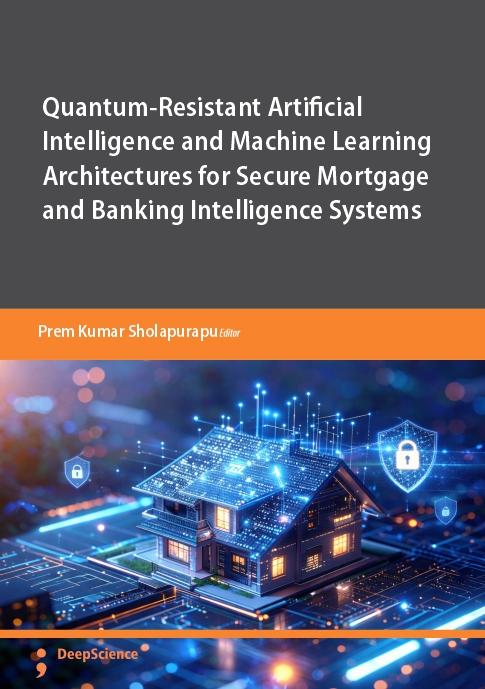
Quantum-Resistant Artificial Intelligence and Machine Learning Architectures for Secure Mortgage and Banking Intelligence Systems
##plugins.pubIds.doi.readerDisplayName##
https://doi.org/10.70593/978-93-7185-228-9
Keywords:
Artificial Intelligence, Machine Learning, Mortgage, Banking, Finance, Quantum Threat ModelsSynopsis
Along with the development of artificial intelligence and financial technologies, the fast convergence of quantum computing is one of the most important technological trends of the twenty-first century. Though artificial intelligence and machine learning have already revolutionized the mortgage and banking intelligence systems- improving credit risk evaluation, fraud level detection, compliance automation and decision-making efficiency purposes, the coming up of large-scale quantum computing is a deep disruptive force of cryptographic principles on which these systems operate. Classical security models securing the financial data over several decades are becoming susceptible to quantum-enabled threats, which is why quantum-resistant architectures providing long-term confidentiality, integrity, and trust are urgently needed. It is on this critical inflection point that this book was driven by the fact that innovation has to be coupled by foresight, strength and responsible system design.
Quantum-Resistant Artificial Intelligence and Machine Learning Architectures of Secure Mortgage and Banking Intelligence Systems is an interdisciplinary and detailed analysis of the manner in which financial AI systems can be kept secure in the post-quantum age. The book combines the most recent findings in quantum threat management, post-quantum cryptography, federated learning, secure training of a model, hybrid authentication, adversarial resilience, explainable AI, and quantum-safe security control performance implications. All the chapters discuss in their own systematic fashion application, techniques, methodologies, challenges, opportunities, impacts, and the future trend of research with a special love given to the mortgage and banking ecosystems where data longevity, regulatory compliance, and systemic stability are the key consideration. The book unites insights in the field of cryptography, machine learning, financial engineering, and governance by shifting the focus of the concept of algorithmic substitution to a broader perspective of security as a system-wide and lifecycle-oriented problem.
The book should be read by researchers, graduate students, practitioners in the industry, and policymakers as well as regulators who are intersectional in artificial intelligence, cybersecurity, and financial services. It will also be used as a reference point to gain an overview of the impact of quantum risks in financial AI systems, as well as as a practical guide to architectural design, evaluation and transition to quantum-resilient systems. Since risky decision-making is becoming more and more reliant on automated intelligence by financial institutions, even passive quantum preparedness is no longer a choice, but rather the key to continuing to trust, maintain compliance and prevent a financial meltdown in the global marketplace. We do hope that this book will lead to additional research, co-operation and judicious action on constructing safe, open, and robust financial intelligence systems of the quantum age.
References
Zhao Y. Artificial intelligence and education: End the grammar of schooling. ECNU Review of Education. 2025 Mar;8(1):3-20.
Yim IH, Su J. Artificial intelligence (AI) learning tools in K-12 education: A scoping review. Journal of Computers in Education. 2025 Mar;12(1):93-131.
S. P. Panda, "Leveraging Generative Models for Efficient Policy Learning in Offline Reinforcement Learning," 2025 IEEE XXXII International Conference on Electronics, Electrical Engineering and Computing (INTERCON), Arequipa, Peru, 2025, pp. 1-6, doi: 10.1109/INTERCON67304.2025.11244701.
Tlili A, Saqer K, Salha S, Huang R. Investigating the effect of artificial intelligence in education (AIEd) on learning achievement: A meta-analysis and research synthesis. Information Development. 2025 Jan
Tedre M, Toivonen T, Kahila J, Vartiainen H, Valtonen T, Jormanainen I, Pears A. Teaching machine learning in K–12 classroom: Pedagogical and technological trajectories for artificial intelligence education. IEEE access. 2021 Jul 19;9:110558-72.
Sholapurapu PK, Omkar J, Bansal S, Gandhi T, Tanna P, Kalpana G. Secure Communication in Wireless Sensor Networks Using Cuckoo Hash-Based Multi-Factor Authentication. In2025 World Skills Conference on Universal Data Analytics and Sciences (WorldSUAS) 2025 Aug 22 (pp. 1-6). IEEE.
Downloads
Published
20 November 2024
Copyright (c) 2024 Prem Kumar Sholapurapu
Details about the available publication format: E-Book
E-Book
ISBN-13 (15)
978-93-7185-228-9
Details about the available publication format: Book (Paperback)
Book (Paperback)
ISBN-13 (15)
978-93-7185-683-6
How to Cite
Sholapurapu, P. K. . (Ed.). (2024). Quantum-Resistant Artificial Intelligence and Machine Learning Architectures for Secure Mortgage and Banking Intelligence Systems. Deep Science Publishing. https://doi.org/10.70593/978-93-7185-228-9
Download Citation





 WhatsApp +91 7977171947