

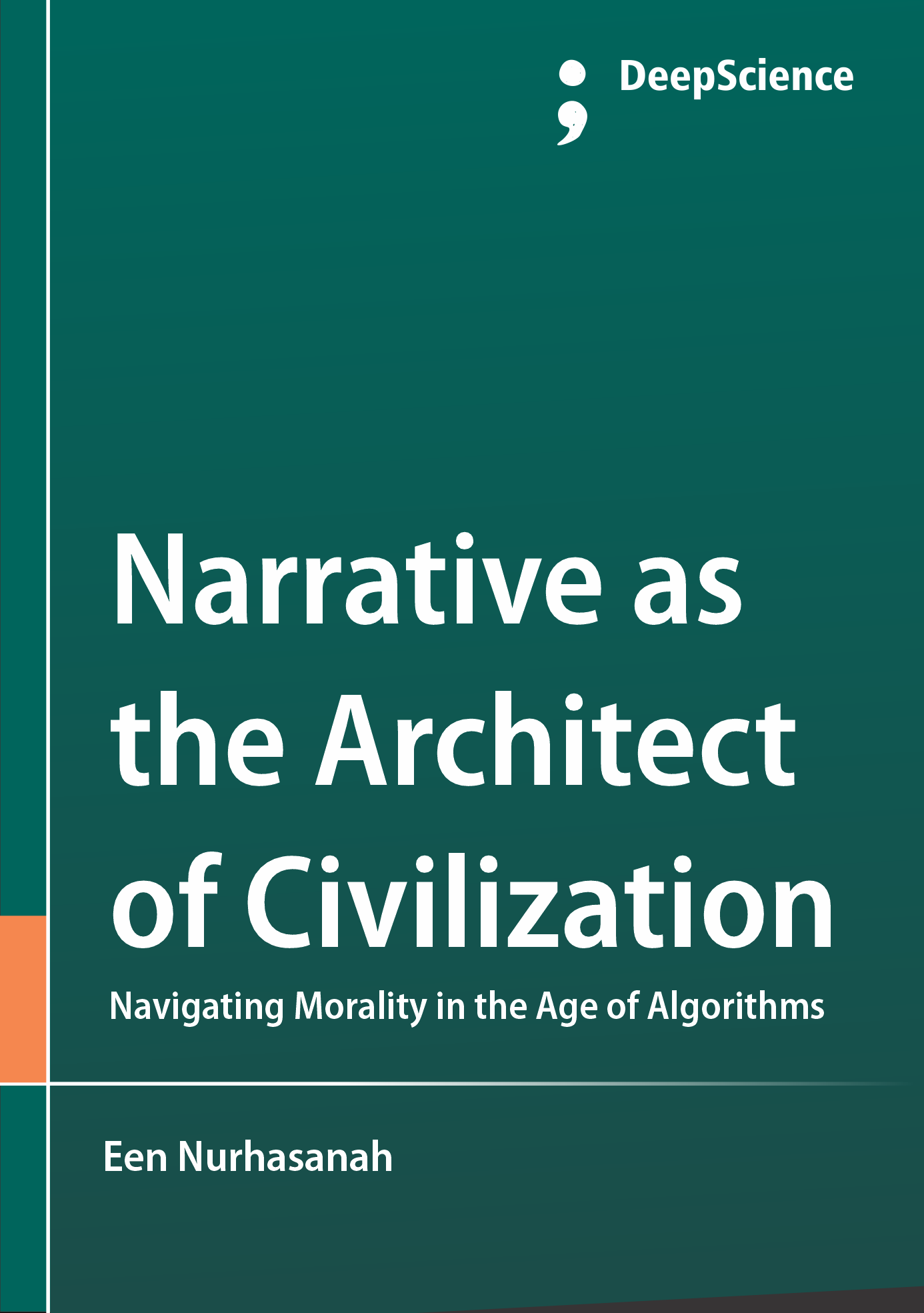
Narrative as the Architect of Civilization: Navigating Morality in the Age of Algorithms
##plugins.pubIds.doi.readerDisplayName##
https://doi.org/10.70593/978-93-7185-939-4
Keywords:
Entertainment Illusion, Education, Storytelling, Stories, Relentless NarrativeSynopsis
The basic point that is put across in the book Narrative as the Architect of Civilization is that narrative is the powerful tool in creating the perception of the world, the most profound beliefs, and the ethical compass of the individuals and groups. Since the time of oral folklores down to the hyper-personalized online impression, narratives have been the engine in creating a silent, yet still a mighty civilization, actively determining our moral compass. Academic and analytical evaluation reveals an illusion of idle amusement in this book in the sense that the stories that we read, or watch no matter how we do it are not an active experience but a narrative creation creating subtly programmed values and perceptions of the world. Hence, the book is an appeal to cease being a mere receiver but being the creator of the self in the time of the narratives that are ruthless.
Stories have been used as imaginative workshops of internalizing moral values by identification and contemplation as early as those of Aesop in his fables, and in Greek tragedy, oral stories in local wisdom. Nevertheless, the present world has seen the paradigm change due to the emergence of new forms of narrative engines, including Netflix, Tik Tok, and the digital games, which have created the era of the unparalleled pace in the spread of cultural information. The algorithms of these services are deeply involved in customizing the experience, which can also form the so-called filter bubbles and "echo chambers" to undermine the plurality of information and further polarization. Users in this one-way and personalized media environment are susceptible to the effects of the so-called narrative threading and narrative transport, which results in the loss of critical thinking and a loss of cognitive independence.
This book hoped in this response to this dilemma by announcing the reader to be an architect of consciousness making him build a solid critical media literacy. This involves an integrated ability to access, read, criticise and construct messages and an essential shift in the naive reading to critical reading which will entail a severe reflection of the mind and accountability on information accuracy. People should also know how to recognise implicit messages and how they might affect them by analysing the context along with comprehending the persuasive processes like the subliminal effects. It should be noted further that to remain cognitively free, one must strike a balance between individual consumption and critical thinking, be proactive in undermining algorithmic suggestions, actively pursue a plurality of opinion, and talk critically about values.
The long-term effects of this empowerment are far-reaching: people become real identity designers and they actively apply their identities, beliefs and values with integrity, resilience and cognitive independence and self-dependence. In addition, it enhances social cohesion in that society consisting of critical and autonomous individuals will be more favorable to conduct positive dialogue, and less affected polarization, as well as, access to the universal moral grammar upon which most tale archetypes are based. Therefore, the criticality of navigating the narrative space is the initial defence against fake news and disinformation. And, finally, it is a call to the active reading, viewing, and thinking, not to look at the world, but to comprehend it in the perspective of conscious and critical narrative, and to bring the whole process of formation of moral and intellectual compass in the life of most devouring narrative.
References
NRN, Hartono B, S.S S. Pengembangan Buku Pengayaan Keterampilan Mengonversi Teks Cerita Pendek Menjadi Teks Drama Bemuatan Nilai-Nilai Kemanusiaan Untuk Siswa Kelas XI SMA. 2017.
Rahmanto B. Modul 1 Konsep Dasar Drama.
Gustiawan R, Mayar F, Desyandri D. Analisis Pembelajaraan Seni Drama Untuk Melatih Kreativitas Pada Siswa Sekolah Dasar Kelas Tinggi. 2023.
Croom AM. The practice of poetry and the psychology of well-being. Journal of Poetry Therapy [Internet]. 2014 Dec 1 [cited 2025 Oct]; 28 (1) : 21. Available from: https://doi.org/10.1080/08893675.2015.980133
Huang Z. Why Story Matters: The Fitness Enhancing Strategies in Storytelling. Lecture Notes in Education Psychology and Public Media [Internet]. 2023 May 17 [cited 2025 Aug]; 7 (1): 208. Available from: https://doi.org/10.54254/2753-7048/7/20220786
Bilandzić H, Busselle RW. Enjoyment of films as a function of narrative experience, perceived realism and transportability. Communications [Internet]. 2011 Jan 1 [cited 2025 Oct];36(1). Available from: https://doi.org/10.1515/comm.2011.002
Mulder HNMD, Hakemulder F, Klaassen F, Junge C, Hoijtink H, Berkum JJAV. Figuring out what they feel: Exposure to eudaimonic narrative fiction is related to mentalizing ability. Psychology of Aesthetics Creativity and the Arts [Internet]. 2021 Sep 30 [cited 2025 Oct]; 16 (2): 242. Available from: https://doi.org/10.1037/aca0000428
Downloads
Published
4 January 2026
Copyright (c) 2026 Een Nurhasanah
Details about the available publication format: E-Book
E-Book
ISBN-13 (15)
978-93-7185-939-4
Details about the available publication format: Book (Paperback)
Book (Paperback)
ISBN-13 (15)
978-93-7185-744-4
How to Cite
Nurhasanah, E. . (2026). Narrative as the Architect of Civilization: Navigating Morality in the Age of Algorithms. Deep Science Publishing. https://doi.org/10.70593/978-93-7185-939-4
Download Citation






 WhatsApp +91 7977171947