

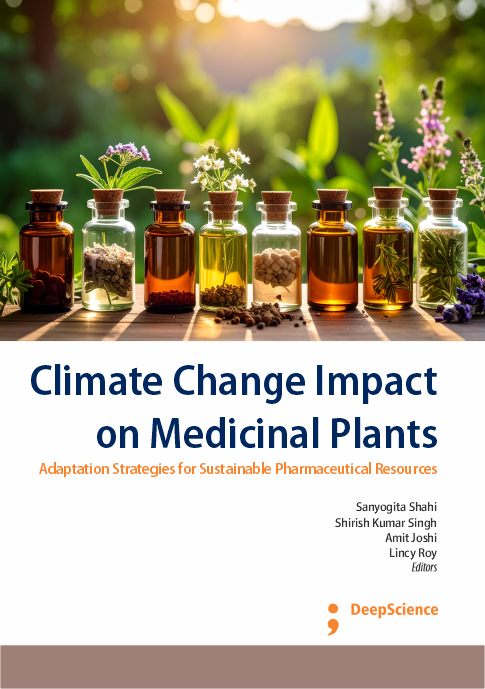
Climate Change Impact on Medicinal Plants: Adaptation Strategies for Sustainable Pharmaceutical Resources
##plugins.pubIds.doi.readerDisplayName##
https://doi.org/10.70593/978-93-7185-109-1
Keywords:
Climate Change, Medicinal Plants, Sustainability , Sustainable Development, Quality Control, Wild Harvesting, EthicsSynopsis
This book discusses the issue of what medicinal plants have to deal with because of the climate change, degradation of the habitat and overexploitation. It dwells on the interface between climate science, ethnobotany and phyma research and the impacts of climatic change on distributions, phenology, and phytochemical composition of medicinal plants. The chapter brings out the role of the indigenous community in conservation and transfer of traditional knowledge by oral traditions and local practices. It also speaks on the exploitation of the medicinal resources by world globalisation and industrialization with the resulting activity of over harvesting and destruction of habitat. The chapter highlights the issue of sustainable development and the dangers of climate change caused by factors like rising temperatures, the changes in rain patterns, desertification, and difficulties in extreme weather activities. It proposes interventions, which combine conservation biology, agricultural science and biotechnology to make sure that medicinal plants could be used as viable options to produce drugs. It also talks about Good Agricultural and Collection Practices (GACP), organic agricultural models, ex situ and in situ conservation strategies, etc. The chapter also looks at the contribution of such policy frameworks as Convention on Biological Diversity (CBD) and Nagoya Protocol in facilitating equitable access and benefit sharing.
This piece of work underscores the relevance of medicinal plants among the rural and tribal societies and the effect of changes brought about by climate on the availability of the plants. This implies that acceptable models of sustainable harvesting, value addition and fair trade can build resilient ecosystems of knowledge and economy. Bio-piracy and the necessity to protect the native intellectual property rights in the form of the transparent benefit-sharing schemes are another subject of the chapter. With the modern technologies, including genomics, proteomics, and metabolomics, scientists are revolutionising the plant metabolic pathways which enables prediction and improvement of stress tolerance in medicinal species. Climate resilient production fields and extraction techniques are being simulated with the help of artificial intelligence and machine learning. Formulations obtained through nanotechnology, and controlled-environment agriculture will be promising solutions to the sustainable production of phytochemicals under the changing climatic conditions. The chapter recommends the use of a multi-layered educational model such as the formal academic curriculum, community awareness programs, and digital platforms to promote an all-inclusive view about the effects of climate change on medicinal plant resources. It further implies that the climate crisis does not only pose a problem to medicinal plants but also allows us to make new and new discoveries and adapt accordingly. The book has urged scientists, educators, policymakers and industries to come up with resilient systems that would balance human health decision with environmental sustainability.
This preface is already an invitation and an introduction at the same time to both think and act as well as to innovate in a responsible manner. The sustainability of the medicinal plants cannot be taken out of the sustainability of life. With climate change redefining our ecosystems, this chapter aims at adding a valuable insight to the creation of a world where nature and medicine live in a state of balance, continuity, and respect to each other.
Chapters
-
Introduction to Medicinal Plants and Pharmaceutical Applications
-
The Urgency of Sustainable Development in Medicinal Plants
-
Botanical Identification, Authentication, and Quality Control
-
Cultivation, Conservation, and Resource Management
-
Ex situ and in situ conservation strategies
-
Wild Harvesting and Resource Management
-
Phytochemical Analysis and Characterization
-
Pharmacological Screening and Efficacy Evaluation
-
Formulation and Development of Herbal Pharmaceuticals
-
Clinical Trials and Regulatory Affairs
-
Traditional Knowledge, Biopiracy, and Benefit Sharing
-
Economic Viability and Value Chains
-
Policy, Legislation, and International Cooperation
-
Emerging Technologies and Approaches
-
Challenges and Opportunities for the Future
References
Saad, B., Zaid, H., Shanak, S., & Kadan, S. (2017). Introduction to medicinal plant safety and efficacy. In Anti-diabetes and anti-obesity medicinal plants and phytochemicals: Safety, efficacy, and action mechanisms (pp. 21-55). Cham: Springer International Publishing. https://doi.org/10.1007/978-3-319-54102-0_2
Pengelly, A. (2020). The constituents of medicinal plants: an introduction to the chemistry and therapeutics of herbal medicine. Routledge. https://doi.org/10.4324/9781003117964.
Schmelzer, G. H., Gurib-Fakim, A., & Schmelzer, G. H. (Eds.). (2008). Medicinal plants (Vol. 11). Prota. Gurib-Fakim, A. (2006). Medicinal plants: traditions of yesterday and drugs of tomorrow. Molecular aspects of Medicine, 27(1), 1-93. https://doi.org/10.1016/j.mam.2005.07.008
Tungmunnithum, D., Thongboonyou, A., Pholboon, A., & Yangsabai, A. (2018). Flavonoids and other phenolic compounds from medicinal plants for pharmaceutical and medical aspects: An overview. Medicines, 5(3), 93.https://doi.org/10.3390/medicines5030093
Bahadur, B., Reddy, K. J., & Rao, M. L. N. (2007). Medicinal plants: an overview. Adv Med plants Univ Press Hyderabad.
Ramawat, K. G., Sonie, K. C., & Sharma, M. C. (2004). Therapeutic potential of medicinal plants: an introduction. In Biotechnology of Medicinal Plants (pp. 1-18). CRC Press.
Downloads
Published
15 July 2025
Copyright (c) 2025 Sanyogita Shahi, Shirish Kumar Singh, Amit Joshi, Lincy Roy; Anubhav Dubey, Rupesh Thakur, Parinita Tripathy, Shibani Mishra, Apurwa Singh, Kanchan Yadav Arya, Rakesh Mishra, Jharna Maiti, Shashi Bala, Aparna Sharma, Akanksha Yadav, Soniya Pandey, Nivedita Shahi, Prashant Prakash, Vidhu Shekhar Nandan, Priyanka Bose, Suryanarayan Kumar Yadav, Ruchi Chandrakar, Rahul Mishra, Nuresh Kumar Khunte
Details about the available publication format: E-Book
E-Book
ISBN-13 (15)
978-93-7185-109-1
Details about the available publication format: Book (Paperback)
Book (Paperback)
ISBN-13 (15)
978-93-7185-852-6
How to Cite
Shahi, S., Singh, S. K., Joshi, A. ., & Roy, L. (Eds.). (2025). Climate Change Impact on Medicinal Plants: Adaptation Strategies for Sustainable Pharmaceutical Resources. Deep Science Publishing. https://doi.org/10.70593/978-93-7185-109-1
Download Citation







 WhatsApp +91 7977171947