
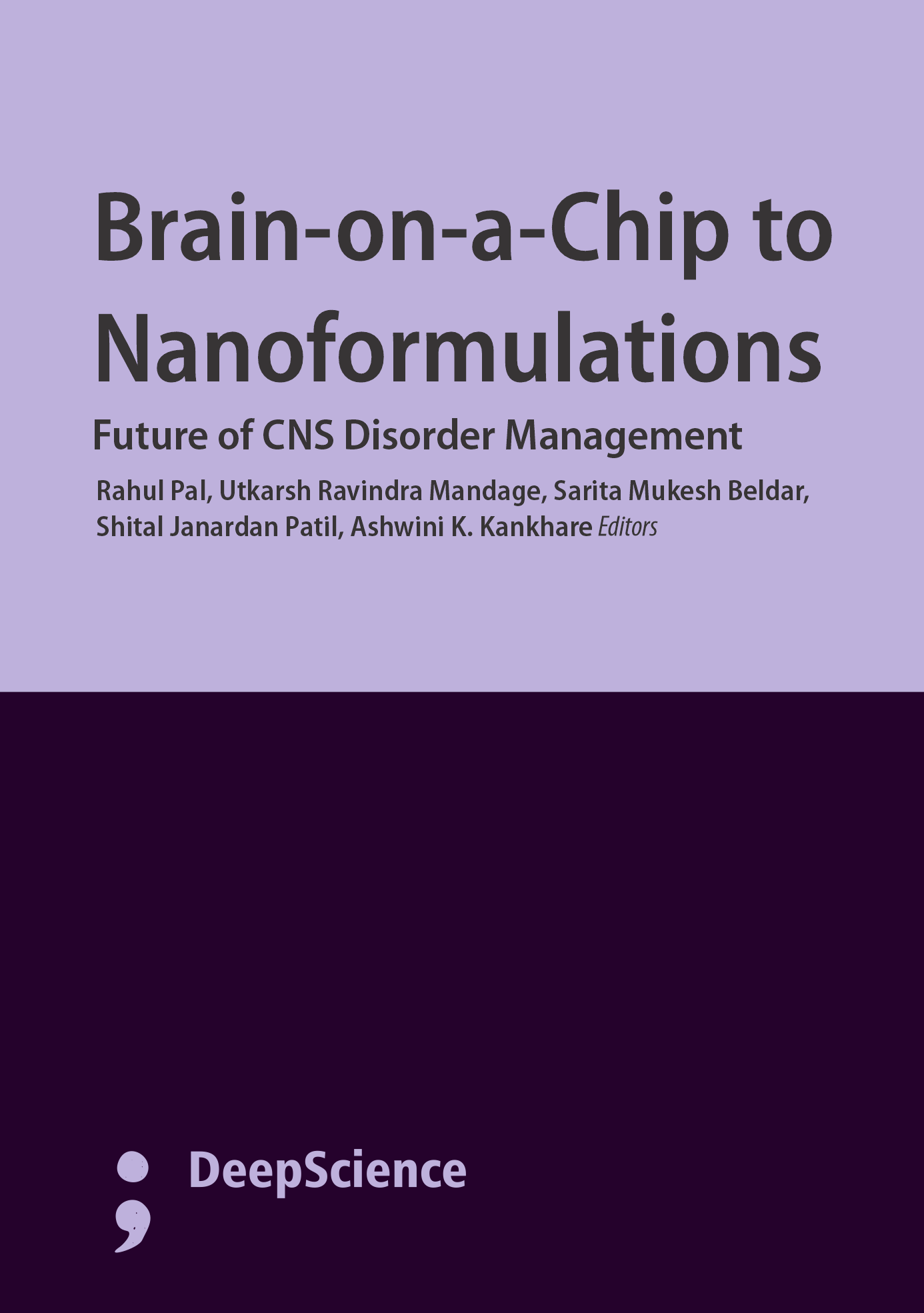
Brain-on-a-Chip to Nanoformulations: Future of CNS Disorder Management
##plugins.pubIds.doi.readerDisplayName##
https://doi.org/10.70593/978-93-7185-102-2
Keywords:
Nanoformulations, Nano Carrier, Nano-Therapeutics, Neuroinflammation, Alzheimer, Neurogenesis, Synaptic DysfunctionSynopsis
Central nervous system (CNS) disorders remain among the most complex and challenging conditions to diagnose and treat due to the intricate architecture of the brain, restrictive biological barriers, and limited translational success of conventional therapeutics. Recent technological breakthroughs are redefining CNS research and therapy, notably the convergence of brain-on-a-chip platforms and advanced nanoformulations. This edited volume, Brain-on-a-Chip to Nanoformulations: Future of CNS Disorder Management, presents a comprehensive and forward-looking overview of how microphysiological systems and nanotechnology-driven drug delivery strategies are transforming the landscape of CNS disorder management.
The book highlights the role of brain-on-a-chip models in recapitulating human brain microenvironments, enabling precise disease modeling, real-time mechanistic insights, and high-predictive drug screening while reducing reliance on animal models. Complementing this, it explores state-of-the-art nanoformulations—including liposomes, polymeric nanoparticles, dendrimers, solid lipid nanoparticles, and stimuli-responsive nanocarriers—designed to overcome the blood–brain barrier, enhance drug bioavailability, and achieve targeted and sustained therapeutic effects.
By integrating preclinical modeling, translational research, regulatory considerations, and emerging clinical perspectives, this volume bridges the gap between in vitro innovation and in vivo application. The book is intended to serve as a valuable reference for researchers, clinicians, pharmaceutical scientists, and biomedical engineers seeking next-generation solutions for neurological and neurodegenerative disorders, positioning brain-on-a-chip technologies and nanoformulations as cornerstone tools in the future of precision CNS therapeutics.
Chapters
-
Brain-On-A-Chip Models: Mimicking CNS Pathophysiology Mechanistically
-
Neurogenesis and Synaptogenesis: Stimulating Regeneration via Nano biomaterial
-
Gene Silencing and Editing In CNS: SiRNA/CRISPR Loaded Nanovectors
-
Autophagy And Apoptosis In CNS Disorders: Dual-Acting Nano Strategies
-
Epigenetic Modulation in the Central Nervous System: Advances in Nano-Delivery of HDAC and DNMT Inhibitors for Neurotherapeutics
References
Sweeney, M.D., Sagare, A.P. and Zlokovic, B.V., 2015. Cerebrospinal fluid biomarkers of neurovascular dysfunction in mild dementia and Alzheimer's disease. Journal of Cerebral Blood Flow & Metabolism, 35(7), pp.1055-1068..
Xie, J., Shen, Z., Anraku, Y., Kataoka, K. and Chen, X., 2019. Nanomaterial-based blood-brain-barrier (BBB) crossing strategies. Biomaterials, 224, p.119491..
Reddy, P.H., Tonk, S., Kumar, S., Vijayan, M., Kandimalla, R., Kuruva, C.S. and Reddy, A.P., 2017. A critical evaluation of neuroprotective and neurodegenerative MicroRNAs in Alzheimer's disease. Biochemical and Biophysical Research Communications, 483(4), pp.1156-1165.
Van Tellingen, O., Yetkin-Arik, B., De Gooijer, M.C., Wesseling, P., Wurdinger, T. and De Vries, H.E., 2015. Overcoming the blood–brain tumor barrier for effective glioblastoma treatment. Drug Resistance Updates, 19, pp.1-12.
Pardridge, W.M., 2005. The blood-brain barrier: bottleneck in brain drug development. NeuroRx, 2(1), pp.3-14.
Abbott, N.J., Patabendige, A.A., Dolman, D.E., Yusof, S.R. and Begley, D.J., 2010. Structure and function of the blood–brain barrier. Neurobiology of disease, 37(1), pp.13-25.]
Grabrucker, A.M., Ruozi, B., Belletti, D., Pederzoli, F., Forni, F., Vandelli, M.A. and Tosi, G., 2016. Nanoparticle transport across the blood brain barrier. Tissue barriers, 4(1), p.e1153568.
Downloads
Published
15 August 2025
Copyright (c) 2025 Habibur Rahman S M, Navjot Kaur Sandhu, Dileep Kumar, Samarendra Singh, Gautam Singh, Abhishek Vijukumar, Srushti Bhimrao Kumbhar, Yamuna Kumar, Divyanshi Saxena, Kuldeep Singh, Arushi, Ayushi, Mukesh Chandra Sharma, Abhishek Ashok Shelke, Deepa V C, Priyadharshini N, Agil kumar M, Mythili S R, Vasanth S, Mohd. Jalaluddin, Ashish Mishra, Binita Ghosh, Karuna Shankar Rathour, A Thanmai, Mansi Srivastava, Mariya Fatima, RamGopal Singh, Mr. Pawan Swami, Jagruti Ravindra Patil; Ms. Ashwini K. Kankhare, Dr. Shital Janardan Patil, Dr. Sarita Mukesh Beldar, Mr. Utkarsh Ravindra Mandage; Ahmad Aleem, Hasnain Raza, Mohd Aftab Siddiqui, B. Medha Gayatri, Dr. R. Prasanthi, A V Vasanthi, Dr. B Siva Jyothi, Pawan Swami, Chanchal S. Chandak, RamGopal Singh, Subhanshi Vishwas, Prisha A. Naidu; Mr. Rahul Pal (Young Scientist)
Details about the available publication format: E-Book
E-Book
ISBN-13 (15)
978-93-7185-102-2
Details about the available publication format: Book (Paperback)
Book (Paperback)
ISBN-13 (15)
978-93-7185-188-6
How to Cite
Pal, R., Mandage, U. R. ., Beldar, S. M. ., Patil, S. J. ., & Kankhare, A. K. . (Eds.). (2025). Brain-on-a-Chip to Nanoformulations: Future of CNS Disorder Management. Deep Science Publishing. https://doi.org/10.70593/978-93-7185-102-2
Download Citation





 WhatsApp +91 7977171947