
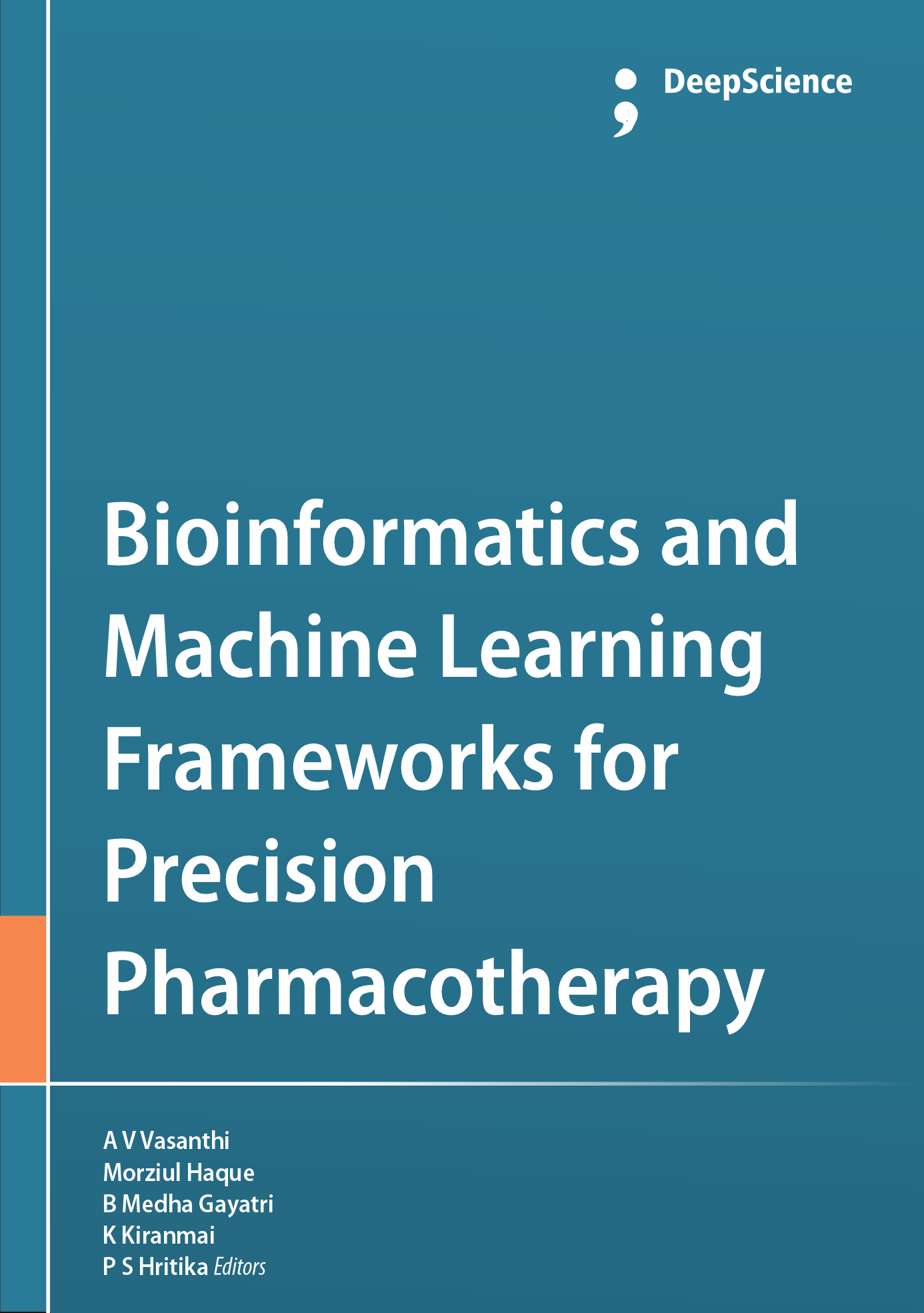
Bioinformatics and Machine Learning Frameworks for Precision Pharmacotherapy
##plugins.pubIds.doi.readerDisplayName##
https://doi.org/10.70593/978-93-7185-883-0
Keywords:
Bioinformatics, Machine Learning, Precision Pharmacotherapy, Artificial Intelligence, Computational Modelling, Deep Learning, Clinical Decision Support SystemsSynopsis
The integration of bioinformatics, artificial intelligence, and the science of pharmacology has given rise to an age of transformation in healthcare. An age that is growing more concerned with precision, personalization, and predictive decision-making. The use of the traditional, data-free and therapeutic approaches that apply the so-called one-size-fits-all therapy is gradually being replaced by more evidence-based and individualized treatments that incorporate genetic diversity, molecular pathways, and real-life patient diversity. In this dynamic environment, the concept of precision pharmacotherapy is among the foundations of modern medicine and is able to deliver safer, more effective and patient-centered forms of treatment.
The bioinformatics and machine learning models of precise pharmacotherapy are regarded as the response to this paradigm shift. The book will be an integrative and systematic review on how computational biology, drug discoveries, drugs development, and clinical decision making are reinvented through multi-omics technologies and advanced machine learning approaches. It may also be described as an attempt to bridge the conceptual knowledge of the underlying biological principles and the modern computational platforms to provide each reader with conceptual knowledge as well as practical perspective on the emergent instruments that allow precision-based therapeutic approaches.
The chapters of this book coherently discuss the science of pharmacogenomics, the role of machine learning and deep learning in pharmacogenomic data analysis, computational modeling and in silico drug discovery, AI-based target identification, and using multi-omics data to personalized medicine. Special focus is put on such clinical translation as predictive analytics, clinical decision support systems, the use of real-world data, digital twins, and adaptive clinical trial design. Moreover, the topics of ethical concerns, data management, regulatory orientations, and perspectives in the future, including the use of quantum machines learning and the world genomic intelligence, are critically discussed to provide a comprehensive and prospective approach.
This book is intended to be used by an extensive and interdisciplinary audience that includes undergraduate and postgraduate students, researchers, academicians, clinicians, data scientists and industry professionals who work in the pharmaceutical sciences, bioinformatics, biotechnology, and healthcare analytics. All the chapters are written clearly and in a scholarly manner with theoretical construct and real-life examples and case studies to ensure further elucidation and application to the real world.
We would like to sincerely thank all the contributing authors in regard to their academic effort and intellectual contribution; it has all made this piece of work enriched. We also attribute the academic institution and mentors whose assistance has created an atmosphere of investigation, initiative, as well as teamwork. We also hope that the book may be used as a useful resource in reference as well as motivate the added research, interdisciplinary cooperation, and responsible innovation towards generating the sincerely personalized pharmacotherapy.
As precision health keeps developing, such a combination of bioinformatics and machine learning is going to be on the forefront of promoting the effectiveness of therapy, safety, and equity. Hopefully, this book can play an essential role in this patient and help the upcoming generation of scientists and medical providers to create the future of precision medicine.
References
Zack M, Stupichev DN, Moore AJ, Slobodchikov ID, Sokolov DG, Trifonov IF, Gobbs A. Artificial Intelligence and Multi-Omics in Pharmacogenomics: A New Era of Precision Medicine. Mayo Clin Proc Digit Health. 2025;3(3):100246. doi:10.1016/j.mcpdig.2025.100246.
Kolobkov D, Mishra Sharma S, Medvedev A, Lebedev M, Kosaretskiy E, Vakhitov R. Efficacy of federated learning on genomic data: a study on the UK Biobank and the 1000 Genomes Project. Front Big Data. 2024;7:1266031. doi:10.3389/fdata.2024.1266031.
Cheng Y, Zhai S, Zhong W, West RM, Shen J. Improving polygenic risk score based drug response prediction using transfer learning. npj Genomic Med. 2025;10:74. doi:10.1038/s41525-025-00528-x.
Sharifi-Noghabi H, Peng S, Zolotareva O, Collins CC, Ester M. AITL: Adversarial Inductive Transfer Learning with input and output space adaptation for pharmacogenomics. Bioinformatics. 2020;36(Suppl 1):i380-i388. doi:10.1093/bioinformatics/btaa442.
Hsu HY, Chen LW, Hsu WT, Hsieh YW, Chang SS. Extracting Clinical Guideline Information Using Two Large Language Models: Evaluation Study. J Med Internet Res. 2025;27:e73486. doi:10.2196/73486.
Kabbani D, Akika R, Wahid A, Daly AK, Cascorbi I, Zgheib NK. Pharmacogenomics in practice: a review and implementation guide. Front Pharmacol. 2023;14:1189976. doi:10.3389/fphar.2023.1189976
Sánchez-Bayona R, Catalán C, Cobos MA, Bergamino M. Pharmacogenomics in Solid Tumors: A Comprehensive Review of Genetic Variability and Its Clinical Implications. Cancers (Basel). 2025;17(6):913. doi:10.3390/cancers17060913
Kalinin AA, Higgins GA, Reamaroon N, Soroushmehr SM, Allyn-Feuer A, Dinov ID, et al. Deep learning in pharmacogenomics: from gene regulation to patient stratification. Pharmacogenomics. 2018;19(7):629-50. doi:10.2217/pgs-2018-0008
Downloads
Published
15 December 2025
Copyright (c) 2025 A V Vasanthi, Morziul Haque, B Medha Gayatri, K Kiranmai, P S Hritika
Details about the available publication format: E-Book
E-Book
ISBN-13 (15)
978-93-7185-883-0
Details about the available publication format: Book (Paperback)
Book (Paperback)
ISBN-13 (15)
978-93-7185-072-8
How to Cite
A V Vasanthi, Haque, M. ., Gayatri, B. M. ., K Kiranmai, & P S Hritika (Eds.). (2025). Bioinformatics and Machine Learning Frameworks for Precision Pharmacotherapy. Deep Science Publishing. https://doi.org/10.70593/978-93-7185-883-0
Download Citation





 WhatsApp +91 7977171947