

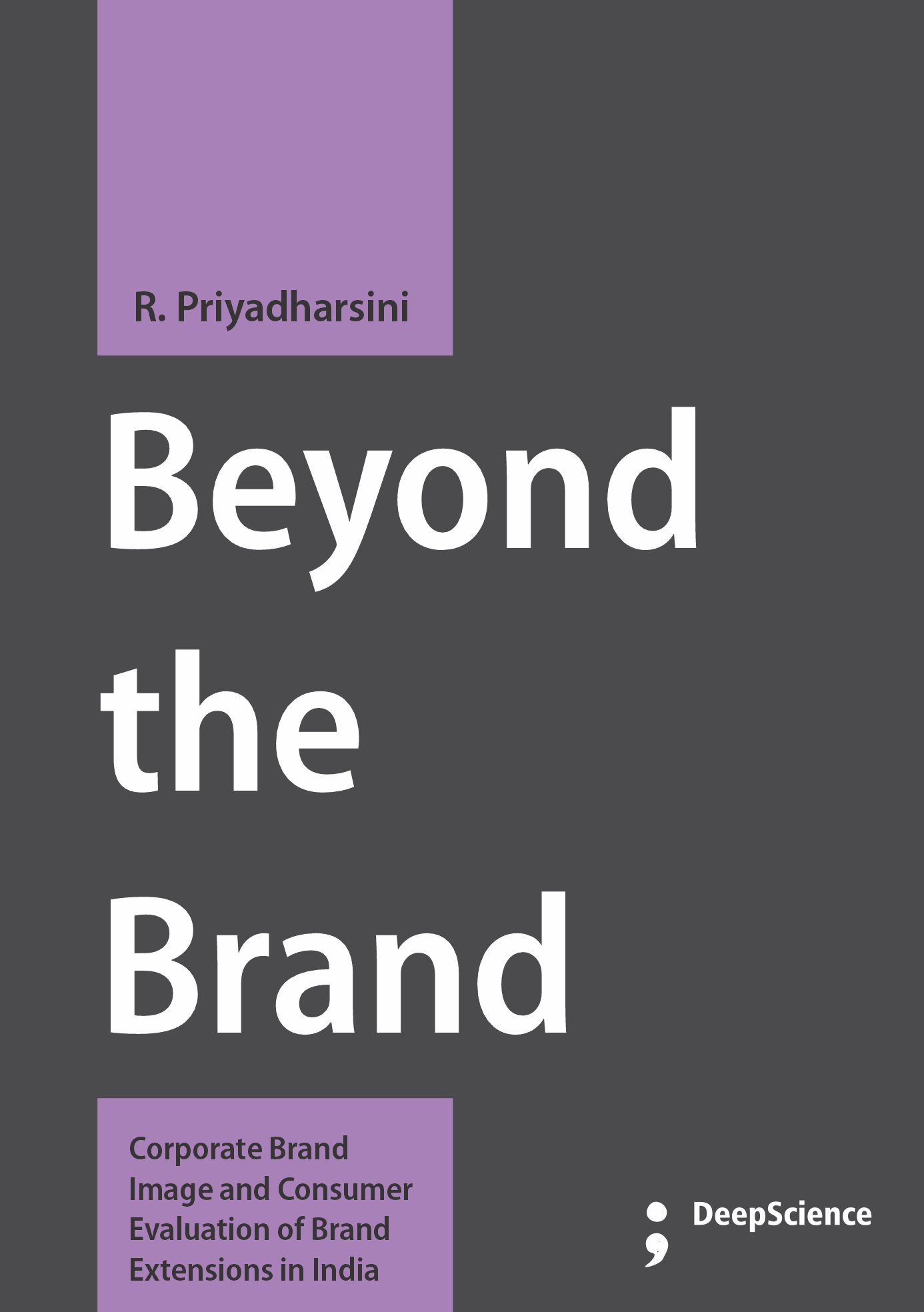
Beyond the Brand: Corporate Brand Image and Consumer Evaluation of Brand Extensions in India
##plugins.pubIds.doi.readerDisplayName##
https://doi.org/10.70593/978-93-7185-831-1
Keywords:
Brand, Brand Image, Consumer Evaluation, Brand Extensions, Consumer Psychology, EthicsSynopsis
Brands are no longer used in the traditional way of identifying some products or services, today they have become strong reservoirs of meanings, trust and relationships. Unlike a high competition environment that is characterized by a faster pace of innovation and more discriminating consumers, the success of organizations does not only survive on what they can offer but how they authenticate and consistently offer the same to what they represent. The book is called Beyond the Brand, and it is a result of this critical change in perception of brands as something supporting and not fixed, but a system that could grow, reinvent and maintain its relevance over time.
The book was inspired by a general question that both marks and producers who have studied marketing struggle with: Why do certain brand extensions seemingly thrive without much efforts whereas others even with powerful parent brands fail to be accepted by the consumer. Although most of the literature has been devoted to brand equity and extensions strategies, thus far little attention has been devoted to how corporate brand image can act as a source of unification and moderation- especially in the circumstances of the socio-cultural and economic setting of India. This work attempts to fill such a gap.
The country of India is a promising environment in which to study brand extensions. The market is marked by a strong and strong traditions, culture, price consciousness, and fast changing desires due to globalization and digital transformation. The consumers of India have a unique rationality and emotional commitment in one combined response to brand extensions hence its responses to extensions of the brand is very multifaceted and informative. It is in this context that brand loyalty, perceived quality, consumer involvement and quality relationship between the brand and the consumer are investigated in this book as to the extent to which they play a role in extension evaluations- and the extent to which the corporate brand image magnifies or moderates such relationships.
The book is a fruit of strict academic research that is supported by practice based on the brand changes that occurred in the real world. Special attention is given to ITC Limited the most significant part of which is the transformation of the tobacco-based business into a diversified FMCG and lifestyle conglomerate that can be regarded as one of the most valuable examples of brand extension in India. The book has shown how trust, consistency and strategic fit could help the brands to transcend categories without watering their core by understanding with detailed case studies, empirical evidence and psychological constructs.
The introduction to the chapters is in such a way that the reader travels through the basics of the concepts to the advanced levels of the strategy. The book starts with the development of branding and brand extensions in India then moves to the cognitive and the emotional judgment of the consumer being analyzed based on the theory and data. It subsequently converts these learning into practical strategic frameworks which draw on modern issues like digital disruption, demographic change, ethical branding and the new role of artificial intelligence in the marketing decision making process.
This is a piece of work meant to appeal to a variety of audiences. To students and researchers it offers an organized summary of branding theory enhanced with the Indian background of empirical evidence. It provides practitioners and brand managers with strategic instruments and guidance to create, analyze and control brand extensions with more accuracy and assurance. To policy makers and teachers, it brings out the expanded aspect of brands as social, cultural and ethical participants in an emerging economy.
Fundamentally, Beyond the Brand states that effective brand extension cannot be only a particular attribute of market opportunity and managerial aspiration. The transfer of trust is a fragile matter as the consumer does not simply evaluate whether the product fits well, but by determining the integrity, credibility, and good intentions of the organization, which is the brand owner. At a time when consumers are more and more interested in authenticity, purpose, and continuity, this process is gaining relevance; it is more than necessary to know how it works.
I do hope that this book causes readers to go further than products and portfolios and consider brands to be living relationships, a relationship that needs to be cultivated, cherished and developed with care and understanding. When it leads to more thoughtful brand leadership and better scholarship investigation, then it will have fulfilled its goal.
References
Brynjolfsson, E., & McAfee, A. (2014). The second machine age: Work, progress, and prosperity in a time of brilliant technologies. W.W. Norton.
Davenport, T. H., & Ronanki, R. (2018). Artificial intelligence for the real world. Harvard Business Review, 96(1), 108–116.
Drucker, P. F. (1954). The practice of management. Harper & Row.
Nonaka, I., & Takeuchi, H. (1995). The knowledge-creating company. Oxford University Press.
Kotler, P., Kartajaya, H., & Setiawan, I. (2021). Marketing 5.0: Technology for humanity. Wiley.
Downloads
Published
18 December 2025
Copyright (c) 2025 R. Priyadharsini
Details about the available publication format: E-Book
E-Book
ISBN-13 (15)
978-93-7185-831-1
Details about the available publication format: Book (Paperback)
Book (Paperback)
ISBN-13 (15)
978-93-7185-719-2
How to Cite
R. Priyadharsini. (2025). Beyond the Brand: Corporate Brand Image and Consumer Evaluation of Brand Extensions in India. Deep Science Publishing. https://doi.org/10.70593/978-93-7185-831-1
Download Citation






 WhatsApp +91 7977171947