
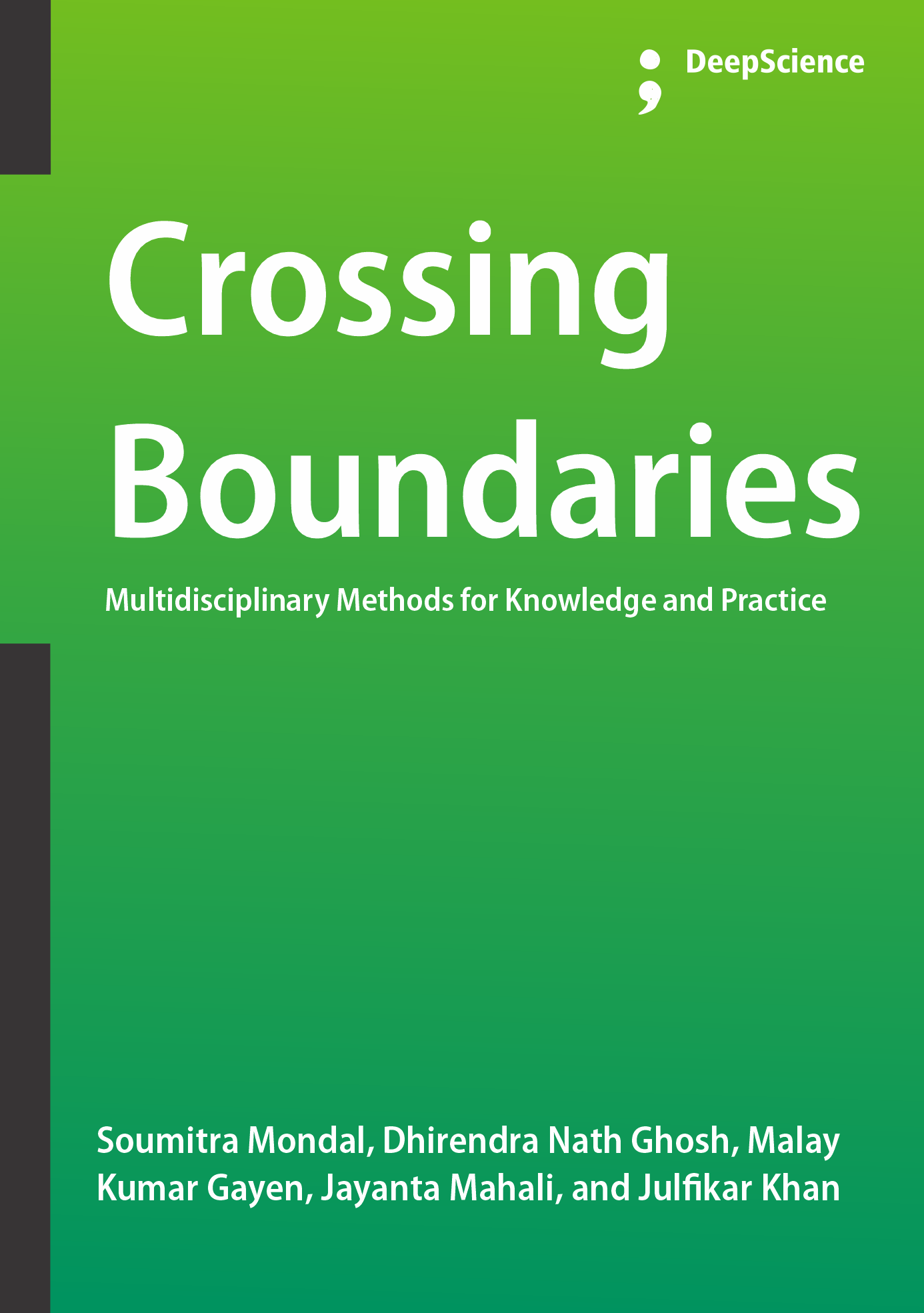
Crossing Boundaries: Multidisciplinary Methods for Knowledge and Practice
##plugins.pubIds.doi.readerDisplayName##
https://doi.org/10.70593/978-93-7185-601-0
Keywords:
Education, Inclusive Education, Teacher Education, ICT, Classroom, Higher EducationSynopsis
This is an all inclusive investigation of 13 chapters, which consider the various aspects of education, learning and development in the society. Chapter 1 follows the development of online learning, where attention is paid to technological and pedagogical innovations, institutional, and policy structures that precondition lifelong learning in digital learning environments. Chapter 2 delves into the inclusive education tracing its path through segregated systems till the modern-day framework of education that layers its emphasis on equity, accessibility, and social integration to support the fact it is indeed a human right and a life long learning. Chapter 3 looks at the historical change in teacher education, first as informal apprenticeship, and then as contemporary and policy-based preparation of a professional. Chapter 4 is concerned with the development of female education in the Indian country and the way ancient customs gave way to the modern educational reforms. The 5 th and 6 th chapters tackle the challenges that hearing and visually impaired learners have to face, address the communication barrier, the lack of access to the resources and the lack of teacher training, and note the possibilities to use informative inclusion and the comprehensive development. Chapter 7 reveals the importance of play-based and child-centered pedagogies in developing skills of the 21 st century in early childhood. Chapter 8 explores the issue of tribal education in India with respect to the influence of constitutional guarantees, specific policies, and legislation. In Chapter 9 and 10, the aspect of integrating ICT tools, such as digital classrooms, e-learning sites, multimedia lessons and adaptive learning systems, the authors explore their effect on the quality of instruction, the engagement of learners, and their learning capacities. Chapter 11 measures the digital literacy and ICT competence of teachers, in which there is no advanced pedagogical usage of technology. In chapter 12, the issue on environmental education and human-environment interactions is discussed through spatial and qualitative research in bringing out land use, resource management, and climate vulnerable issues. In chapter 13, the authors highlight the importance of Indigenous Knowledge Systems (IKS) as a means of promoting inclusivity in the pedagogue and culturally sensitive educational processes. Taken in combination, the chapters allow one to see a comprehensive picture of the changing environment of education, technology, and inclusion. The chapter 14 is imposed by examining the matter of biological organisation on the scale of the molecules to broad ecosystems, which is fundamental to an understanding of the living systems. Life science is the study of the development, adaptation, and interactions of organisms as well as their change through a multiplicity of disciplines such as genomics, microbiology, ecology, and biotechnology. The topic in Chapter 15 is the largest threat to animal diversity in the global world habitat loss. The change of the natural ecosystems to the agricultural, urban and industrial ones has resulted in many animal species declining as well as a disruption of the ecology balance.
The book invites the educators and policymakers, scholars and changemakers to envision and bring a new future in which equitable learning is not an exception, and is instead the rule.
References
Allen, I. E., & Seaman, J. (2017). Digital learning compass: Distance education enrollment report 2017. Babson Survey Research Group.
Bates, A. W. (2015). Teaching in a digital age: Guidelines for designing teaching and learning. Tony Bates Associates Ltd.
Bonk, C. J., & Graham, C. R. (2006). The handbook of blended learning: Global perspectives, local designs. Pfeiffer Publishing.
Bozkurt, A., & Sharma, R. C. (2020). Emergency remote teaching in a time of global crisis due to coronavirus pandemic. Asian Journal of Distance Education, 15(1), 1–6.
Christensen, C. M., Horn, M. B., & Staker, H. (2013). Blended: Using disruptive innovation to improve schools. Jossey-Bass.
Daniel, J. (2012). Making sense of MOOCs: Musings in a maze of myth, paradox and possibility. Journal of Interactive Media in Education, 2012(3), 1–17.
Dziuban, C., Graham, C. R., Moskal, P. D., Norberg, A., & Sicilia, N. (2018). Blended learning: The new normal and emerging technologies. International Journal of Educational Technology in Higher Education, 15(3), 1–16.
Garrison, D. R., & Vaughan, N. D. (2008). Blended learning in higher education: Framework, principles, and guidelines. Jossey-Bass.
Downloads
Published
22 December 2025
Copyright (c) 2025 Soumitra Mondal, Dhirendra Nath Ghosh, Malay Kumar Gayen, Jayanta Mahali, Julfikar Khan
Details about the available publication format: E-Book
E-Book
ISBN-13 (15)
978-93-7185-601-0
Details about the available publication format: Book (Paperback)
Book (Paperback)
ISBN-13 (15)
978-93-7185-059-9
How to Cite
Mondal, S. ., Ghosh, D. N. ., Gayen, M. K. ., Mahali, J. ., & Khan, J. . (Eds.). (2025). Crossing Boundaries: Multidisciplinary Methods for Knowledge and Practice. Deep Science Publishing. https://doi.org/10.70593/978-93-7185-601-0
Download Citation




 WhatsApp +91 7977171947