
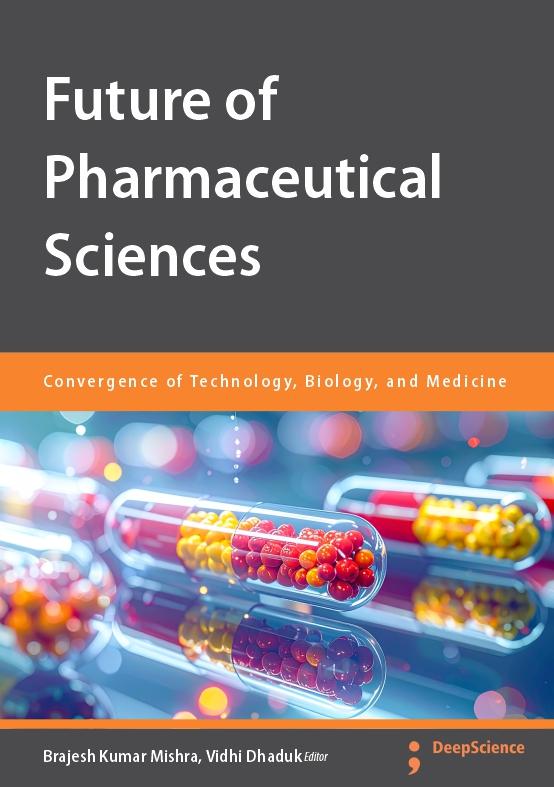
Future of Pharmaceutical Sciences: Convergence of Technology, Biology, and Medicine
##plugins.pubIds.doi.readerDisplayName##
https://doi.org/10.70593/978-93-7185-248-7
Keywords:
Pharmaceutical Sciences, Pharmacy, Artificial Intelligence, Drug Discovery, Drug Development, Nanomedicine, Drug DeliverySynopsis
Pharmaceutical sciences are at a historical point in their history. The development of a scientific breakthrough that has been accelerated by rapid scientific advancements as well as the unparalleled advancement in technology has changed the manner through which medicines are discovered, developed, manufactured and delivered. What was previously a field of study dominated by chemistry and biology has today turned into an actual interdisciplinary field where technology, data science, genomics, artificial intelligence, and digital healthcare intersect to transform the modern approach of medicine. This is an edited book that amicably has been put together to portray this current transformation. The overall driving force behind this book is to offer an in-depth and futuristic view on the impact of the emerging technologies on the research and practice of pharmaceuticals. The banding of various scientific methods has become necessary as well as lucrative because the issue of healthcare has increasingly become more personal and multidimensional.
This book is the compilation of the academic work of the researchers and scholars operating in the fields of pharmaceutical science and its corresponding areas. The topics discussed in the chapters are fundamentally integrated, including technology convergence, and the omics-driven drug development, artificial intelligence in drug discovery and design, pharmaceutical processes digitalization, and novel treatment approaches. The interdisciplinary cooperation, which is accelerating innovation, increasing precision, and efficiency in the pharmaceutical value chain, is also outlined in each chapter, instead of treating technology and biology as independent variables. Contributions have shown common ground in the way convergence is facilitating safer, faster and more effective therapeutic responses through precision medicine and targeted drug delivery, to data-driven clinical decision-making. The information has been delivered in a systematic, but user-friendly way that will serve postgraduate learners, psychologists in their doctoral research, academicians, professionals in the industry, as well as policy stakeholders, among others.
Besides the scientific advancement, the book gives a credit to the larger implication of technological convergence, such as regulatory issues, ethical obligation, integrity of data, and readiness to workforce. The volume is likely to promote balanced and accountable innovation in the pharmaceutical sciences through tackling the opportunities and challenges to achieve this goal.
I would like to personally thank all the participating authors, as well as the publisher, who took part in the project and provided their expertise along with financial assistance to the distribution of the work in an open-access environment. In my opinion, the book will make a significant contribution to the field of education, research, as well as innovation in pharmaceutical sciences in the years to come.
References
Blanco-González, A., Cabezón, A., Seco-González, A., Conde-Torres, D., Antelo-Riveiro, P., Piñeiro, Á., & Garcia-Fandino, R. (2023). The role of AI in drug discovery: challenges, opportunities, and strategies. Mdpi.Com, 16(6), 891. https://doi.org/10.3390/ph16060891
D’Souza, S., Prema, K. V., & BalajiSeetharaman. (2020). Machine learning models for drug–target interactions: current knowledge and future directions. Drug Discovery Today, 25(4), 748–756. https://doi.org/10.1016/j.drudis.2020.03.003
Hu, Y., Zhao, T., Zhang, N., Zhang, Y., & Cheng, L. (2019). A review of recent advances and research on drug target identification methods. Current Drug Metabolism, 20(3), 209–216. https://doi.org/10.2174/1389200219666180925091851
Kanakala, G. C., Devata, S., Chatterjee, P., & DevaPriyakumar, U. (2024). Generative artificial intelligence for small molecule drug design. Current Opinion in Biotechnology, 89, 103175. https://doi.org/https://doi.org/10.1016/j.copbio.2024.103175
Kumar, N., & Acharya, V. (2024). Advances in machine intelligence‐driven virtual screening approaches for big‐data. Medicinal Research Reviews, 44(3), 939–974. https://doi.org/10.1002/med.21995
Downloads
Published
21 December 2025
Copyright (c) 2025 Brajesh Kumar Mishra, Vidhi Dhaduk
Details about the available publication format: E-Book
E-Book
ISBN-13 (15)
978-93-7185-248-7
Details about the available publication format: Book (Paperback)
Book (Paperback)
ISBN-13 (15)
978-93-7185-179-4
How to Cite
Mishra, B. K. ., & Dhaduk, V. . (Eds.). (2025). Future of Pharmaceutical Sciences: Convergence of Technology, Biology, and Medicine. Deep Science Publishing. https://doi.org/10.70593/978-93-7185-248-7
Download Citation





 WhatsApp +91 7977171947