

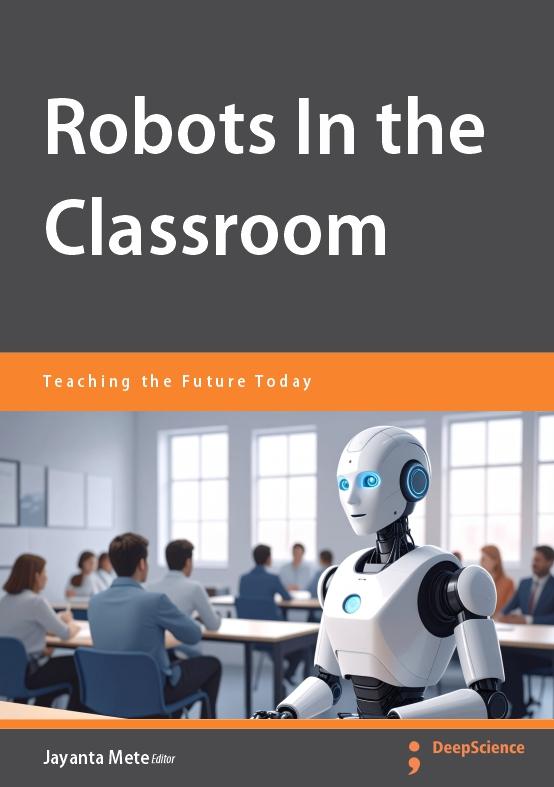
Robots In the Classroom: Teaching the Future Today
##plugins.pubIds.doi.readerDisplayName##
https://doi.org/10.70593/978-93-7185-612-6
Keywords:
Robot , Human-Robot Interaction, Classroom , Teaching, robotics , ethics , Artificial IntelligenceSynopsis
Introduction of robotics into the learning institutions is a propositional frontier which is both exciting and transformative and it is recently destined to change the way we view teaching as well as learning. In the article, Robots in the Classroom: Teaching the Future Today, the authors are exploring how robots, with their artificial intelligence and emotional intelligence, are changing the classroom experience today. This book discusses the way robots are turning into more than simple teaching assistants and becoming interactive, sensitive, and emotional learning companions that are able to identify the emotions of a student and react to them. With the world becoming a technology-driven world, the importance of robotics in education cannot be overemphasized, as it plays a critical role in not only in the provision of content, but also in fostering different learning requirements. The chapters in this book indicate the synergies of human educators and robots in which these technological applications are able to supplement and enrich skills of the teachers. The importance of emotional intelligence in robots, the ethical implications of introducing AI in learning, possibilities of eco-robots to facilitate sustainability and the changing position of teachers and students in the new paradigm are critically discussed. The ethical issues regarding the rights and duties of the robot, and the limits of the relationships between humans and robots are considered in detail and require the consideration of educators, policymakers, and technologists. However, in the end, this book can be an appeal to a future where robotics will be the force that complements teachers, not replacing them, and instead contribute to the creation of a more diverse, varied, and efficient educational process. With the help of interdisciplinary cooperation and moral reasoning, the possibility of robots empowering both students and teachers in the classroom can be achieved to its full extent, turning the process of education into something different.
References
Huijnen, C. A., Lexis, M. A., Jansens, R., & De-Witte, L. P. (2016). Mapping robots to therapy and educational objectives for children with autism spectrum disorder. Journal of Autism and Developmental Disorders, 46(6), 2100-2114.
Johal, W., Jacq, A., Paiva, A., &Dillenbourg, P. (2018). Child-robot spatial arrangement in a learning by teaching activity. In 2018 IEEE International Conference on Robotics and Automation (ICRA) (pp. 1-8). IEEE.
Kennedy, J., Baxter, P., Senft, E., & Belpaeme, T. (2016). Social robot tutoring for child second language learning. 2016 11th ACM/IEEE International Conference on Human-Robot Interaction (HRI), 0(0). https://doi.org/10.1109/hri.2016.7451757
Kleinsmith, A., & Bianchi-Berthouze, N. (2012). Affective body expression perception and recognition: A survey. IEEE Transactions on Affective Computing, 4(1), 15-33.
Kory-Westlund, J. M., & Breazeal, C. (2019). A long-term study of young children's rapport, social emulation, and language learning with a peer-like robot playmate in pre-school. Frontiers in Robotics and Artificial Intelligence, 6, 81. https://doi.org/10. 3389/frobt.2019.00081
Kozima, H., Nakagawa, C., & Yasuda, Y. (2005, June). Designing and observing human-robot interactions for the study of social development and its disorders. In 2005 international symposium on computational intelligence in robotics and automation (pp. 41-46). IEEE.
Leite, I., Martinho, C., &Paiva, A. (2013). Social robots for long-term interaction: A survey. International Journal of Social Robotics, 5(2), 291-308.
Downloads
Published
16 December 2025
Copyright (c) 2025 Jayanta Mete
Details about the available publication format: E-Book
E-Book
ISBN-13 (15)
978-93-7185-612-6
Details about the available publication format: Book (Paperback)
Book (Paperback)
ISBN-13 (15)
978-93-7185-924-0
How to Cite
Mete, J. . (2025). Robots In the Classroom: Teaching the Future Today. Deep Science Publishing. https://doi.org/10.70593/978-93-7185-612-6
Download Citation






 WhatsApp +91 7977171947